 Copyright © Michael Richmond.
This work is licensed under a Creative Commons License.
Copyright © Michael Richmond.
This work is licensed under a Creative Commons License.
See the home page for the 2010 CLEA workshop for a schedule and participants.
 Links to extra information for specific CLEA exercises.
You can look at and download images from Sunday night and see if we were able to take a picture of Pluto .
We acquired images of Eta Carinae from a remote telescope in Australia during the workshop. You can also learn ways to create an RGB color composite, with these images as the starting point.
Please feel free to browse, copy, adopt and modify to suit your needs the lecture notes from all my classes. You'll probably find most useful the following:
- The first four are aimed at non-science majors.
- Introduction to Stellar Astronomy (lectures)
- Introduction to Stellar Astronomy (lab exercises)
- Fragments of notes to Solar System Astronomy (lectures)
- Introduction to Solar System Astronomy (lab exercises)
- This is an introductory course aimed at science majors.
- University Astronomy (lectures)
- Upper-level courses requiring lots of physics and math
- Stellar Astrophyics (lectures)
- Observational Astronomy (lectures, projects)
I've also given a number of presentations to astronomy clubs and school groups; perhaps you might find some of them interesting.
- A collection of talks on astronomical topics
- How do we know the composition of stars? (Part I of III)
- Making heavy elements out of light ones: a cosmic cookbook (Part II of III)
- Stocking the kitchen: elements produced in the Big Bang (Part III of III)
- News from the world of supernovae
- Status of the SDSS-II supernova survey
- Extrasolar planets in the News
- What is the most distant body in the Solar System? A historical view
- What is that "Big Void" the newspapers mention?
- Did amateur astronomers really discover the transit by an extrasolar planet?
- Variable objects in the Subaru Deep Field
- Some recent papers on the Milky Way's rotation curve
- Recent developments in extrasolar planetary science
- Proper motions of stars in the Subaru Deep Field
- How do astronomers measure distances? I. Within the Milky Way
- How do astronomers measure distances? II. In the neighborhood around the Milky Way
- How do astronomers measure distances? III. To galaxies beyond the Local Group
- Searching for variable stars in the SDSS equatorial stripe.
- Very early results from the Kepler mission
We will discuss CCDs briefly at the CLEA workshop, since they (and close cousins) are used so much in optical, near-IR, and X-ray astronomy.
Can you combine astronomical images taken through different
filters to create a nice color composite?
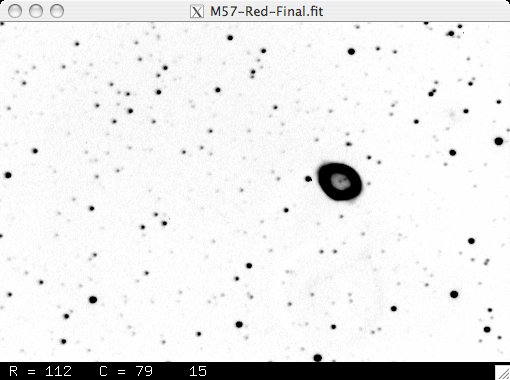
One of the morning sessions at the workshop is devoted to the measure of stellar brightness: photometry.
Is it possible to do real research projects with small telescopes? Sure!
As we work through a number of the CLEA exercises in the workshop, you may want to read
Some very useful reference material for making finding charts or searching the literature for more information.
During the 2008 workshop, we tried observing at night, though the conditions weren't always very good.
For historical interest only
Copyright © Michael Richmond.
This work is licensed under a Creative Commons License.