Copyright © Michael Richmond.
This work is licensed under a Creative Commons License.
Copyright © Michael Richmond.
This work is licensed under a Creative Commons License.

Contents
As of Aug 1, 2026, NASA's Exoplanet Archive listed 6333 planets circling stars other than the Sun. This is a conservative estimate, as astronomers have some evidence for many thousands of other planets; those just need to be confirmed by additional observations.
Those of you who are of certain vintage may look at this number with some surprise. After all, the number of exoplanets was zero when many of us were growing up.
  Q:  When were the first exoplanets (which are currently
          confirmed to be real) discovered by astronomers?
The answer is a little tricky, since one can argue for several "first detections", but all the values occur within the time span between 1989 and 1995.
In other words, exoplanet science is one of the most recent of the sub-fields within astronomy.
Whether we got our start in 1989, or 1992, or 1995, astronomers have been working very hard. The number of exoplanets has grown over time quite rapidly.
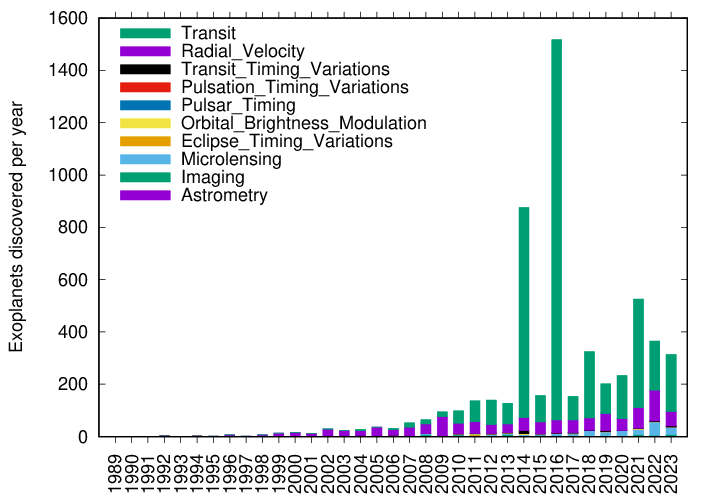
Note the giant spike in discoveries between 2014 and 2016. This leap forward was the result of a new special-purpose telescope producing its first results -- a telescope which was specifically designed for finding planets orbiting other stars.
  Q:  Do you know which telescope drove the discovery of thousands
           of extrasolar planets between 2014 and 2016?
The answer is ... the Kepler space telescope.
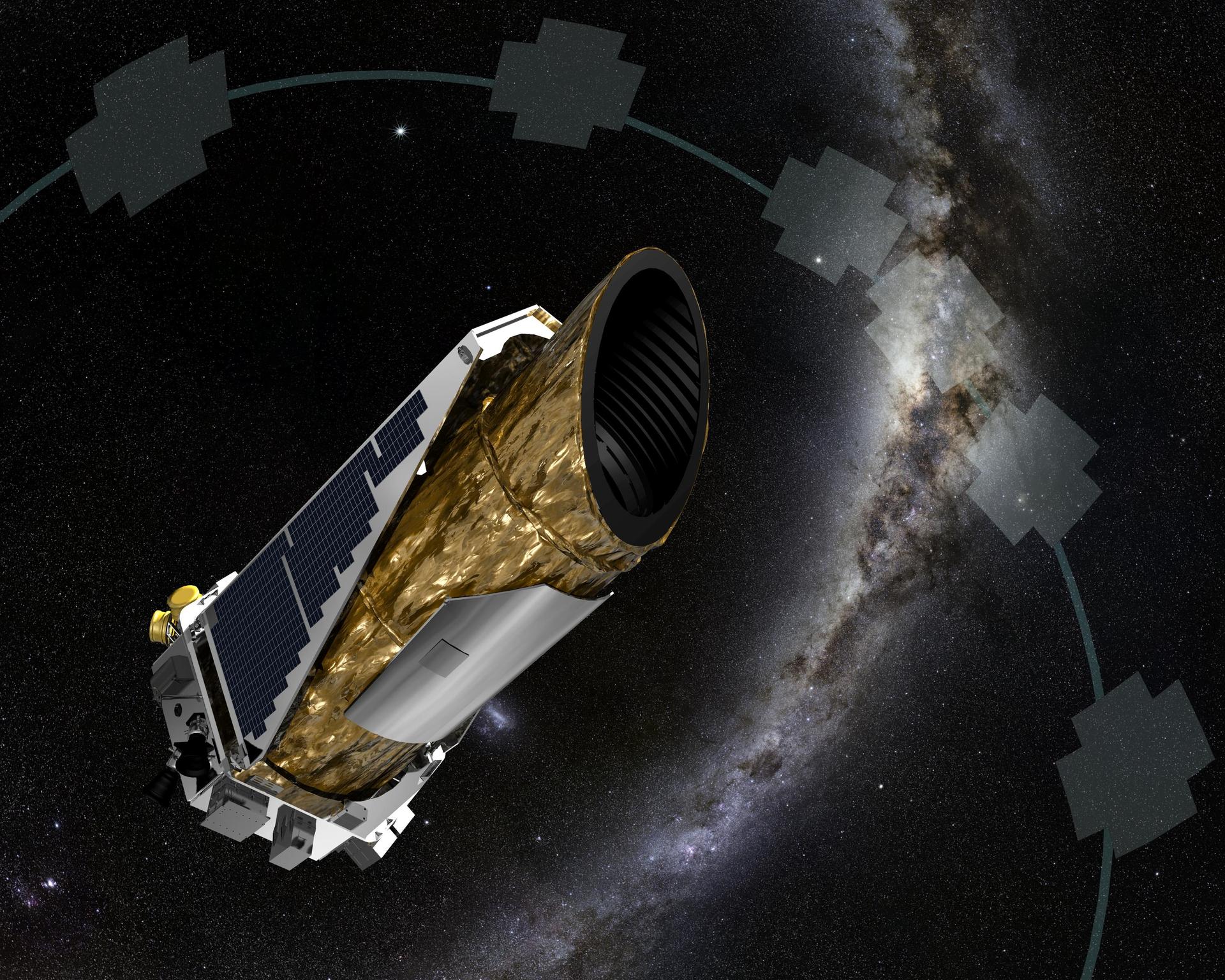
Image of Kepler courtesy of
NASA, ESA, CSA, and STScI
Kepler spent its nine-year lifetime searching for new exoplanets. It didn't try to cover the entire sky, but stared repeatedly, for months at a time, at just a few small areas. It was very good at its job, finding over 2,700 planets, representing almost half of all the systems we know so far.
The most straightforward way to find exoplanets is, well, to take pictures of nearby stars with a telescope. If any planets orbit that star, our pictures ought to reveal those planets -- right?
If you read articles about the search for exoplanets, you'll often see pictures like the one below, which lead one to believe that our latest telescopes and cameras can study planets around other stars in detail.
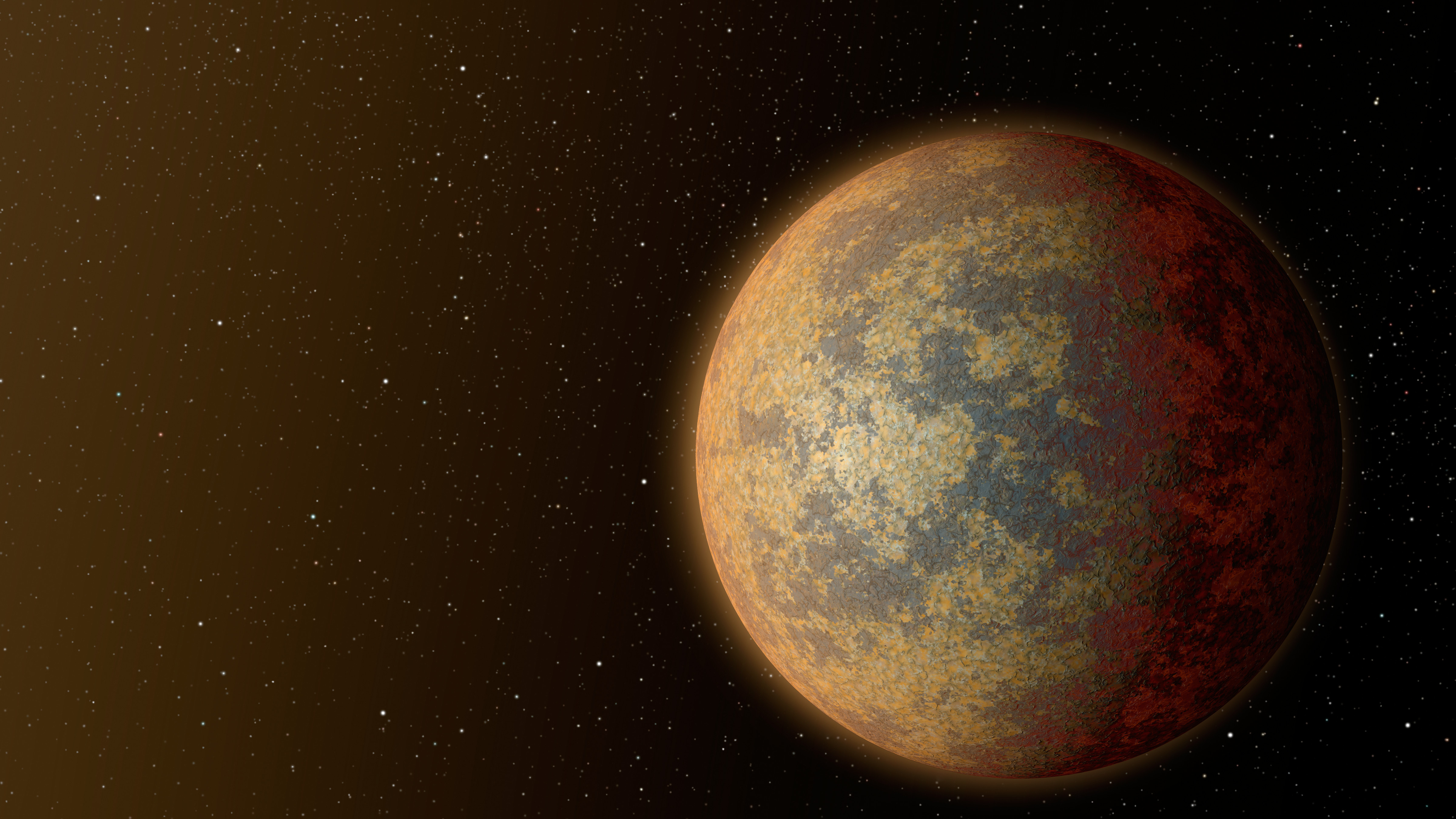
Image courtesy of
NASA/JPL-Caltech
Here's another example, showing the 7 planets we've found so far in the Trappist system.
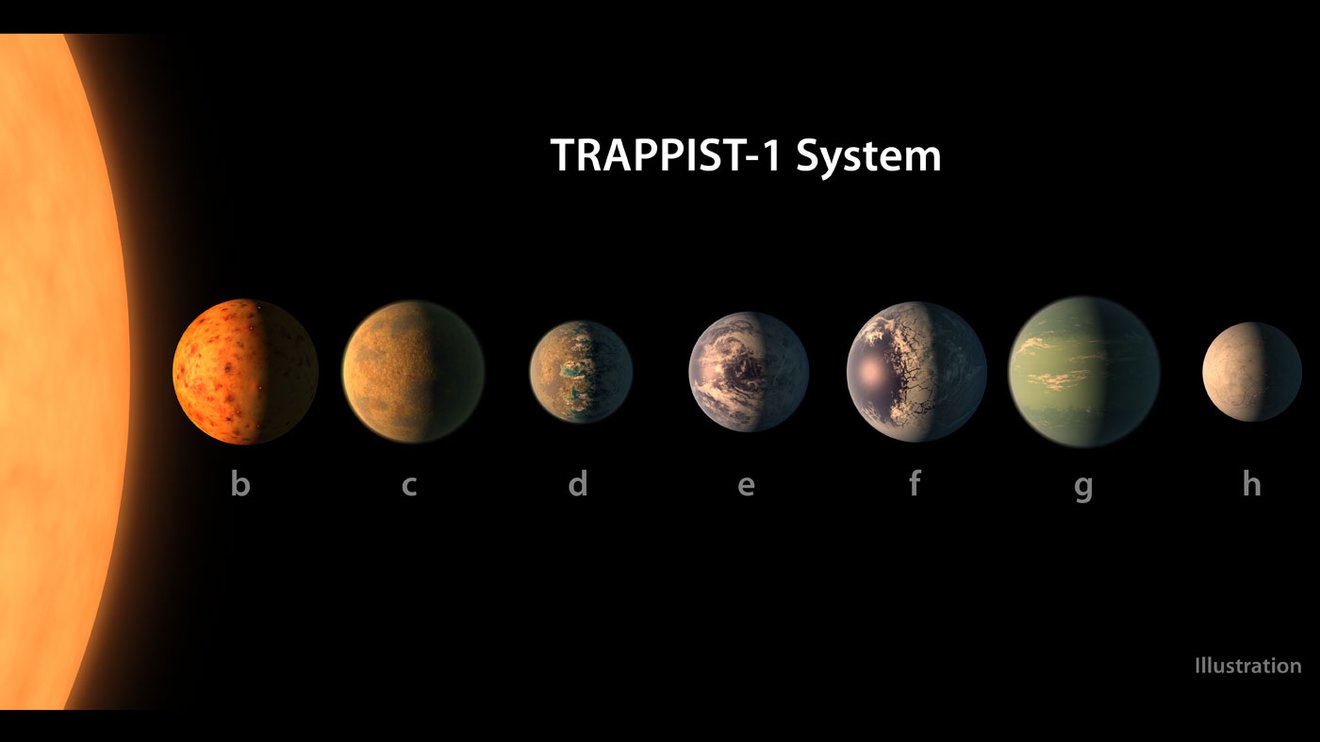
Image courtesy of
NASA/JPL-Caltech
Look at all the detail -- one can see oceans, continents, clouds, and craters! Some of these pictures resemble magazine covers from the old science-fiction magazines.
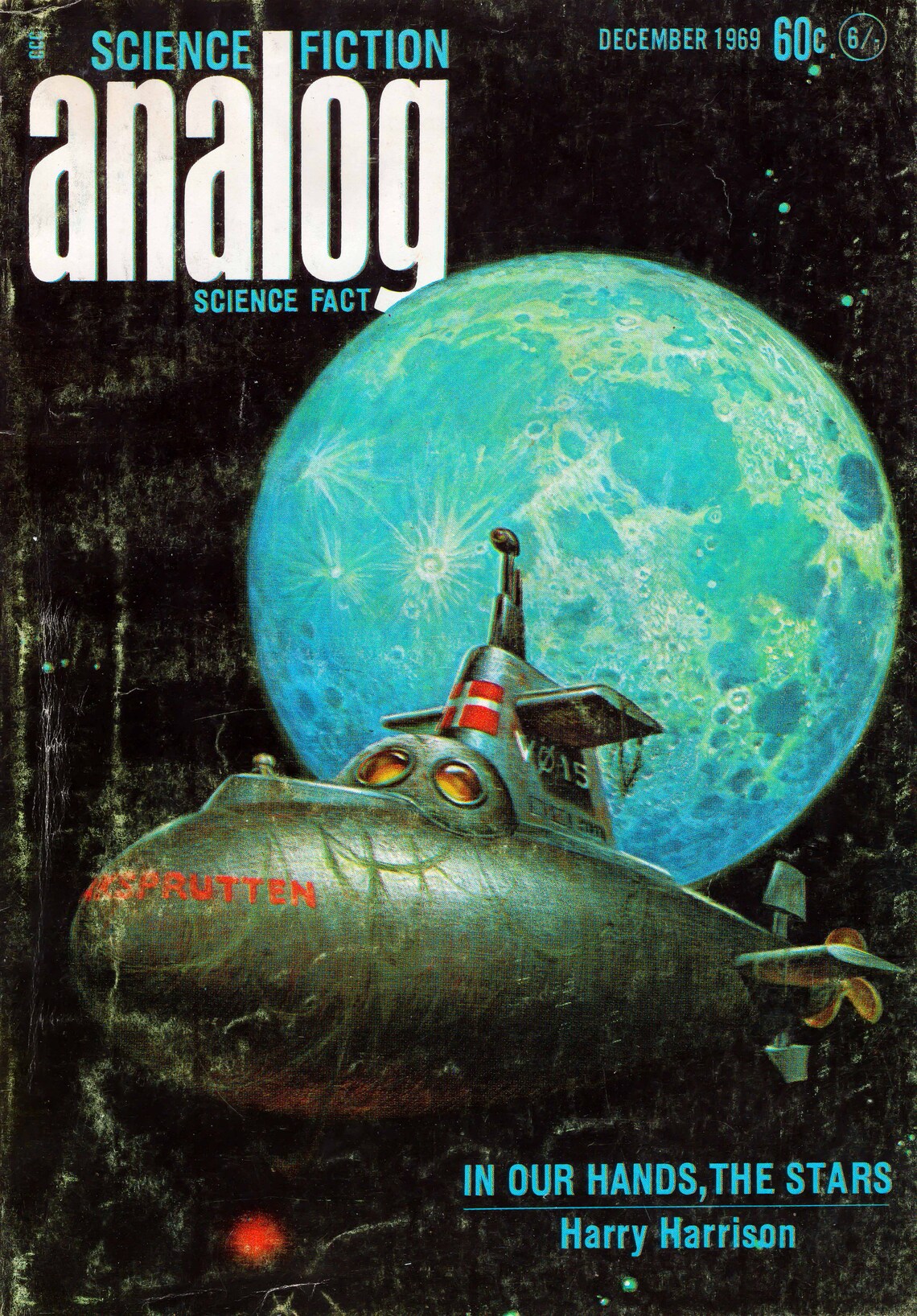
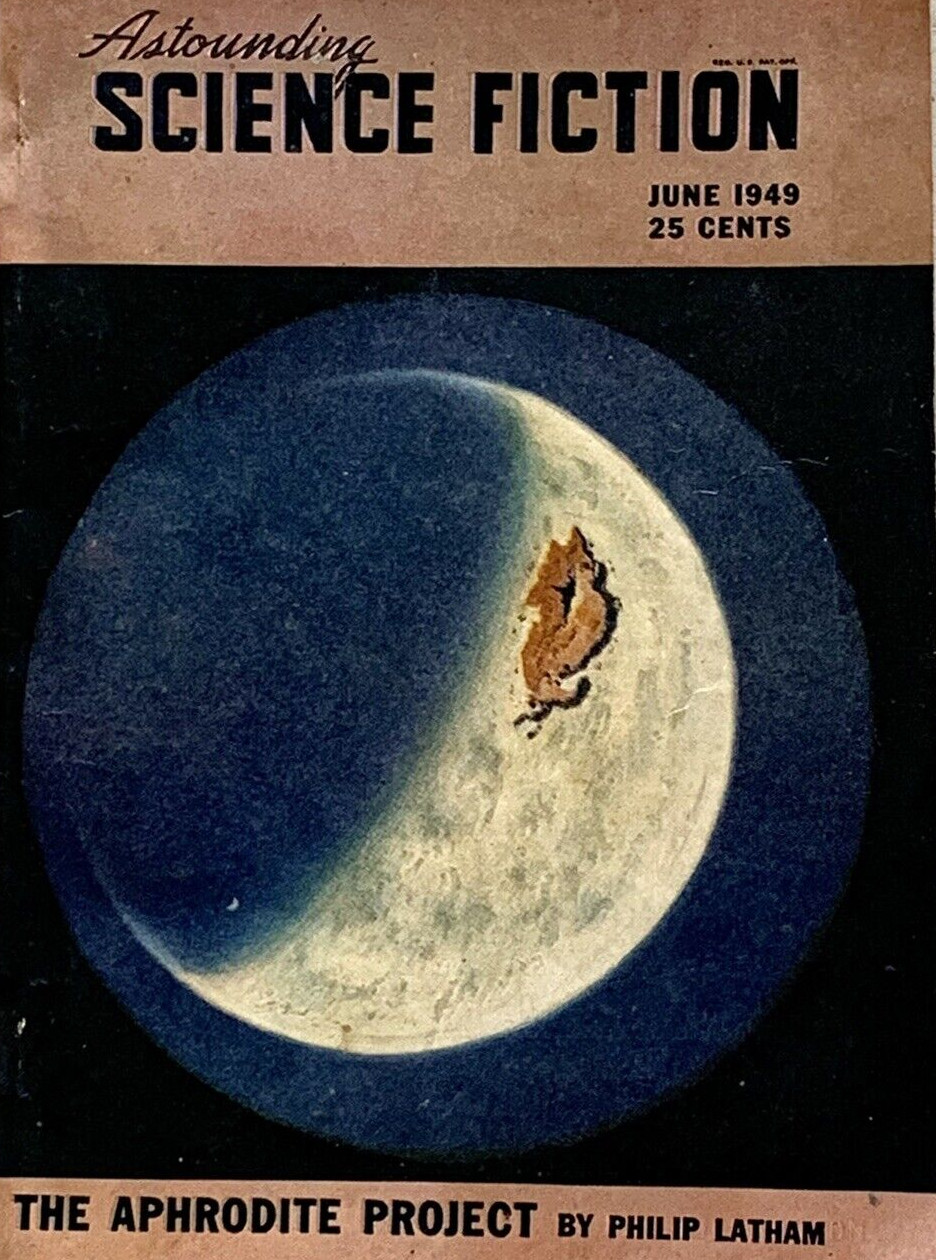
Analog cover art courtesy of
etsy.com ;
Astounding cover art courtesy of
ebay.com
However, reality is not quite so pretty. Our current telescopes cannot see planets around other stars easily, due to the glare from the host star. In fact, only about one percent of the currently known exoplanets have been found by this technique. Even when we can distinguish planets clearly, their images are somewhat underwhelming. (Click on the image below to watch a short video)
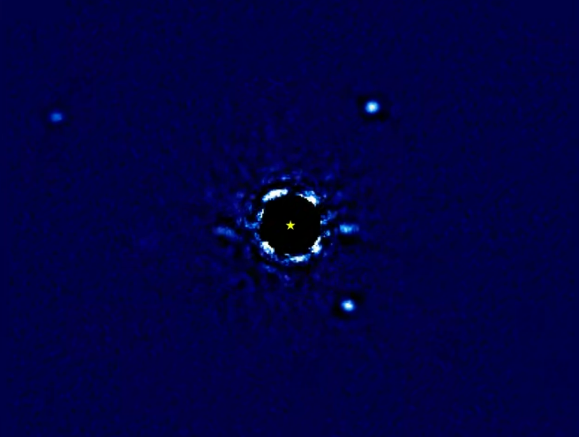
Image and movie of HR 8799 courtesy of
ESO and J. Wang and Christian Marois
The sad fact is that the ability of an optical telescope to resolve fine detail is limited by its size. Our biggest current telescopes, even those 30-meter behemoths under construction, will perceive planets around other stars as nothing more than a single tiny dot. In order to distinguish even the roughest details on the surface of an exoplanet, we would need to build much larger instruments.
  Q:  How large would an optical telescope have to be in order to
         distinguish continent-sized features on the planets
         of the nearby Trappist system?


         a) 100     meters in diameter   (football field)

         b) 1,000   meters in diameter   (Rochester airport)

         c) 10,000  meters in diameter   (Rochester metro area)

         d) other:  __________________   (name your size)
It turns out that we would need to build a telescope over 100 km in diameter, roughly the size of Lake Ontario!
The most productive method for finding exoplanets is the one used by the Kepler spacecraft. It would stare at some spot in the sky for weeks on end, making measurement after measurement after measurement of the brightness of hundreds of thousands of stars. The great, great, great majority of those measurements showed ... nothing. Just the same brightness, over and over.
But every now and then, Kepler would detect a teeny-tiny little dip in the brightness of one star. These dips would last for just a few hours, and then the star would return to its usual intensity. (Click on image to play animation)
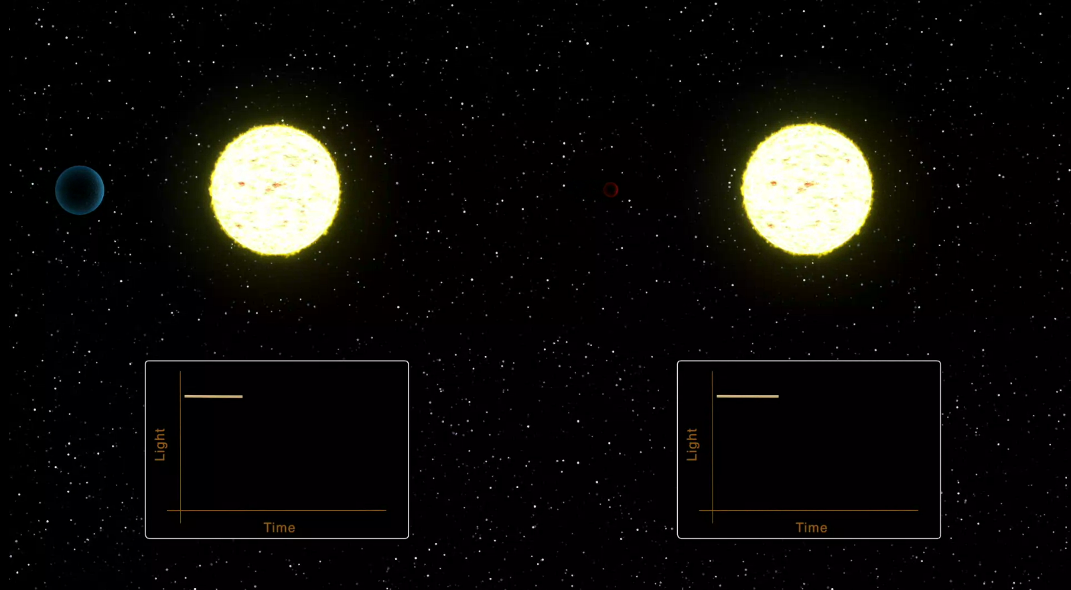
Image and movie courtesy of
NASA's Jet Propulsion Laboratory
The depth of the dip tells us about the size of the planet, relative to the size of its host star.
Astronomers call these events transits. You may have heard of the "Transit of Venus", which last occurred in 2012. Astronomers on Earth watched as Venus moved across the face of the Sun.
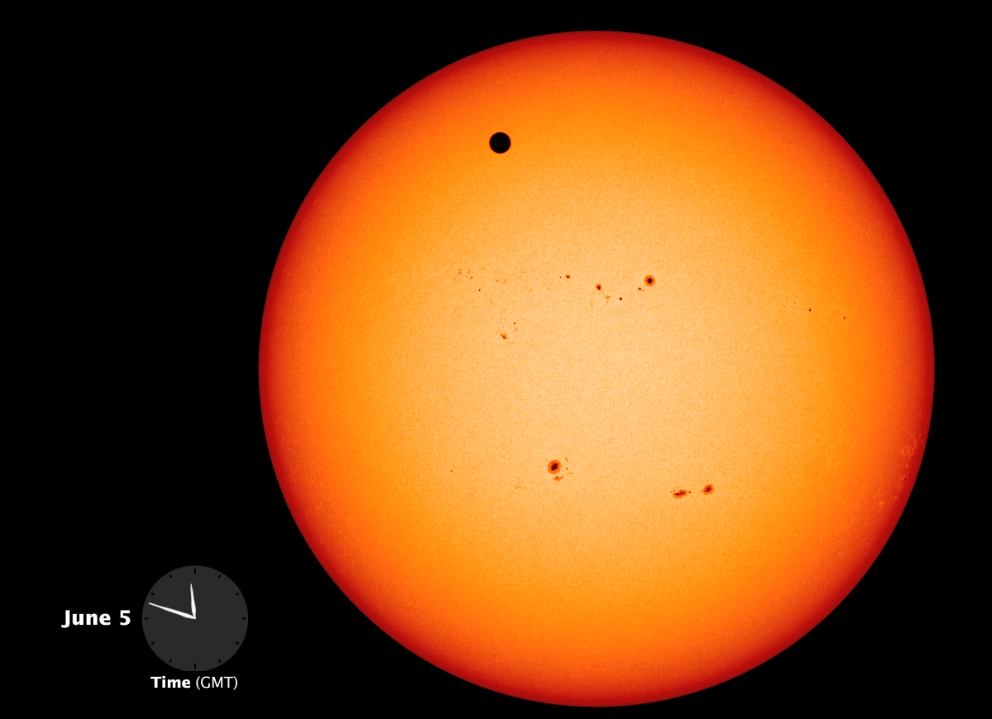
Image and movie courtesy of
NASA's Earth Observatory
If we see a dip in the brightness of one particular star, and then, after five days, we see another dip, and five days later, another, and then another five days after THAT, we may reasonably conclude that there is a planet orbiting the star, and that the period of that planet's orbit is five days. The amount of light blocked as the planet passes in front of its star tells us the size of the planet, relative to the size of its star. So the transit method gives us quite a bit of information:
Thanks to telescopes such as Kepler and TESS, astronomers have found a LOT of exoplanets using the transit method. In fact, roughly 75 percent of all known exoplanets have been discovered in this way.
A great many of these transiting exoplanets turn out to have similar features: they are LARGE, roughly the size of Jupiter, the largest planet in our own solar system, and they circle around their host stars in very SMALL ORBITS.
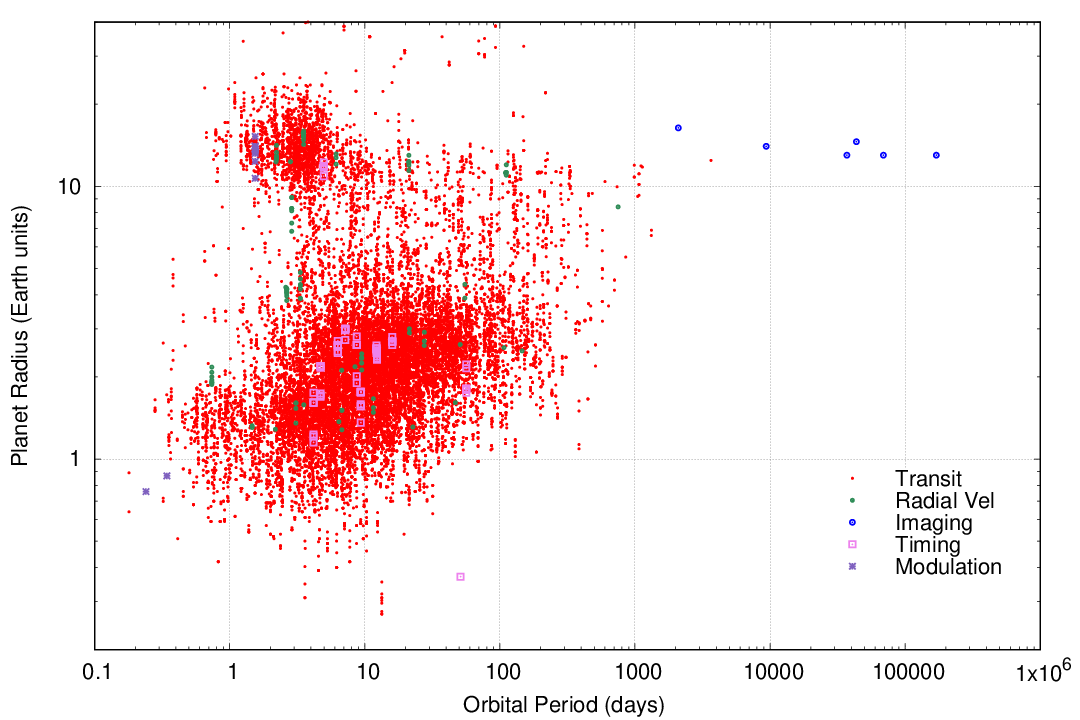
That's very strange: in our own solar system, the large planets all have very large orbits, which take decades or centuries to complete one revolution. Why do so many giant planets around other stars have such tiny orbits? The existence of hot Jupiters is indeed a puzzle that has occupied theorists for the past thirty years.
The second-most successful technique for finding exoplanets, which has produced about 19 percent of the total known so far, is based on the very, very careful measurement of features in stellar spectra. If we send the light from a star through a prism, it will break up into a rainbow; or, as astronomers call it, a spectrum.
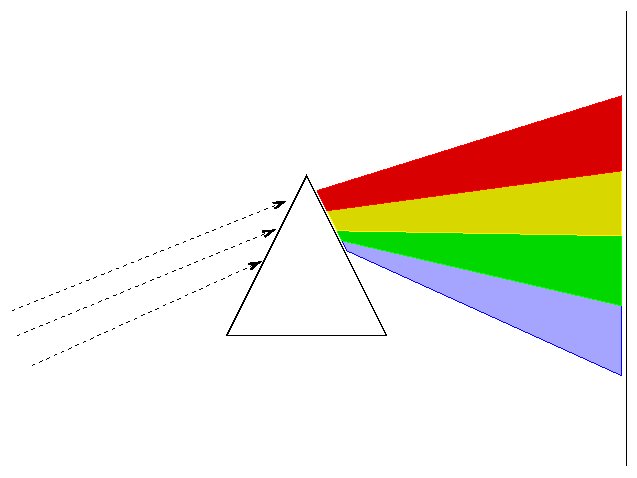
If we examine this spectrum carefully, we will see that a number of very thin, dark lines appear throughout the rainbow.

Spectrum of the Sun courtesy of
Fermilab Quarknet Center
These lines are caused by atoms in the outer layers of the Sun's atmosphere. The nuclear reactions in the center of the Sun produce light of all wavelengths, which flows outward into space; but as that light passes through the cooler gas in the outer atmosphere of the Sun, atoms absorb very specific wavelengths of that light. Each element absorbs a different set of wavelengths, allowing us to identify the chemical makeup of the solar atmosphere.
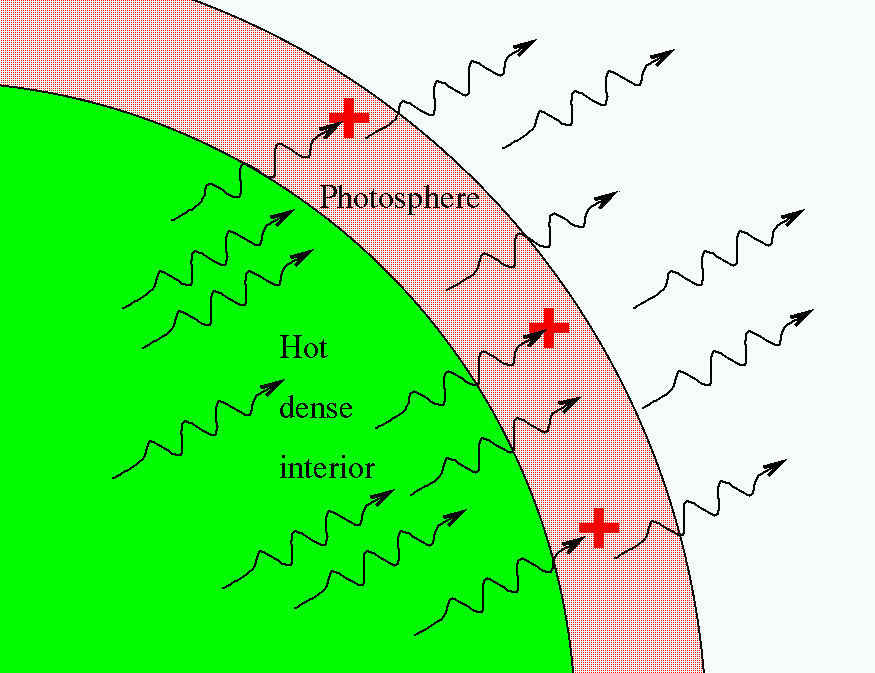
Now, it turns out that the wavelengths of these absorption lines will change if the star happens to be moving toward us or away from us, due to an effect known as the Doppler shift.
So, let's consider what happens if a planet happens to orbit around some particular star. Both the star and the planet will orbit around their common center of mass. Because the mass of a planet is small compared to the mass of a star, the center of mass will be very close to the star -- just as when a small child and her mother play on a seesaw, the child must be far from the fulcrum, and the mother must be close to it.
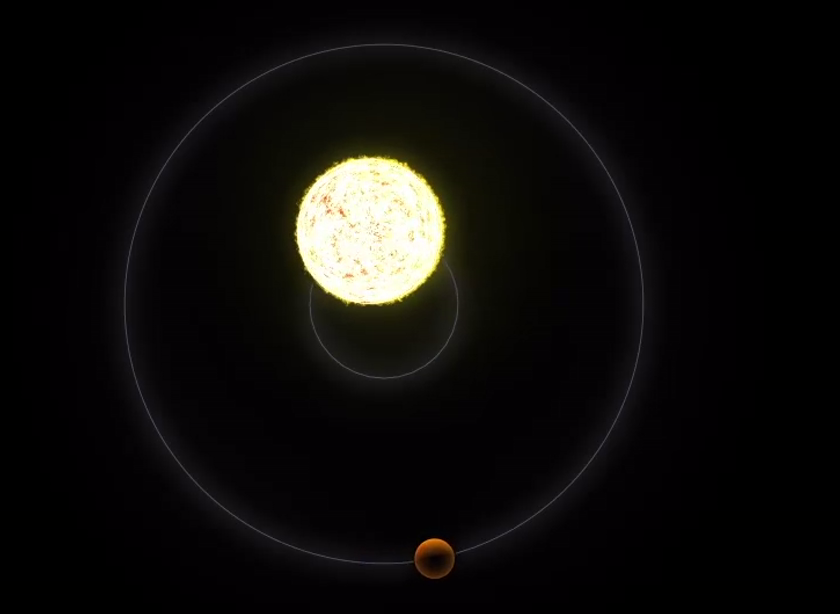
Image courtesy of
NASA Exoplanet Exploration
As the planet moves in a large orbit around this center of mass, the star will also move; its orbit will be smaller, and it will move more slowly -- but the star will move. And if the orbit happens to be edge-on from our point of view, that means that the star will comes toward the Earth, then move away from the Earth, then come toward us, then move away from us, in a periodic fashion. (Click on image to play animation)
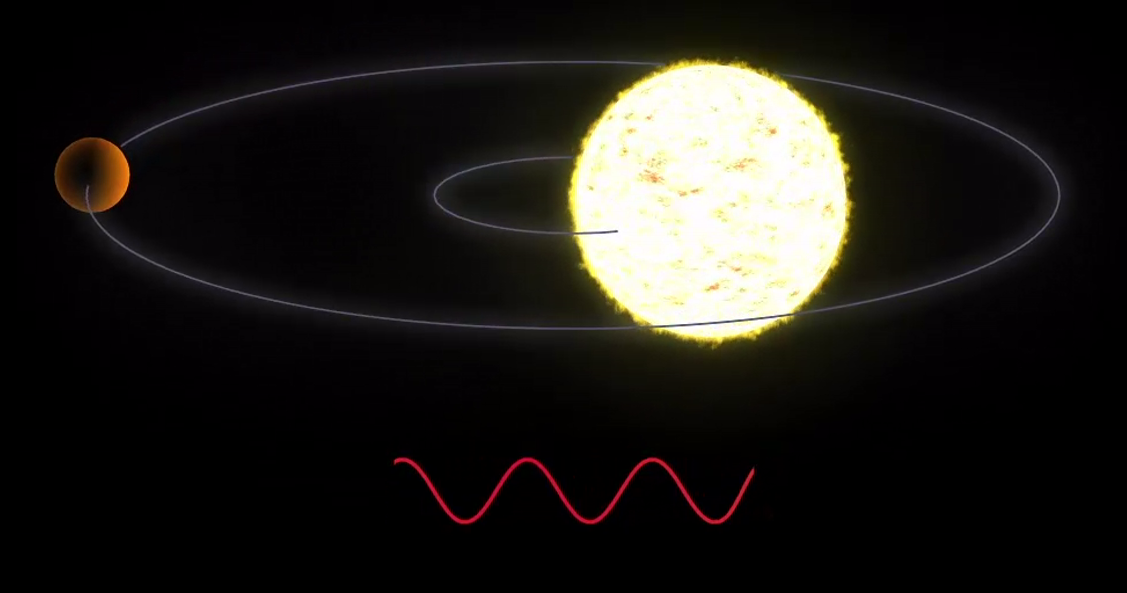
Image and movie courtesy of
NASA Exoplanet Exploration
And THAT means that if we can measure the positions of the line in the spectrum of this star, then we can deduce that it must be pulled in a circle by the gravity of some other object -- which might be an exoplanet!
Although this sounds pretty easy, it's actually very, very difficult. The trouble is that the motions of stars are very slow, because they are so massive that even the pull of a giant planet like Jupiter gives them only a tiny speed. Our Sun, for example, moves at only about 13 meters per second -- that's about 30 miles per hour -- due to the gravitational influence of all the planets in our solar system combined. The resulting Doppler shifts in the positions of its spectral lines are TINY. Trying to find low-mass planets like the Earth using this technique is almost (but not quite!) impossible.
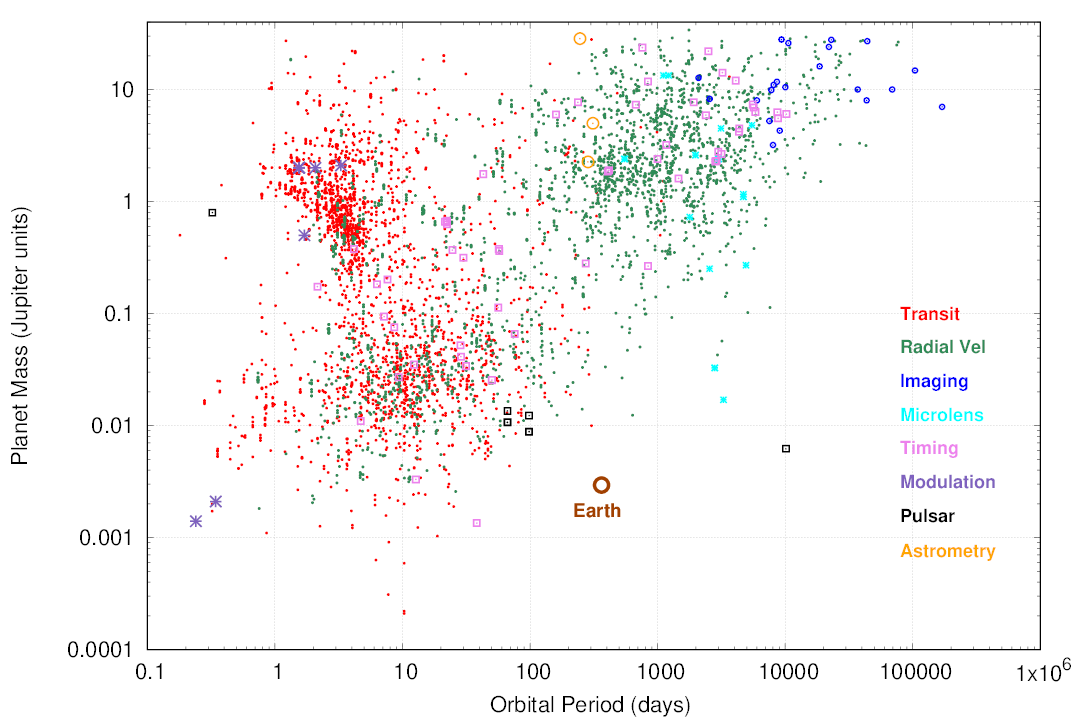
As a result, if one looks at the properties of the planets found via the radial velocity technique, one will see that most of planets discovered this way tend to be massive:
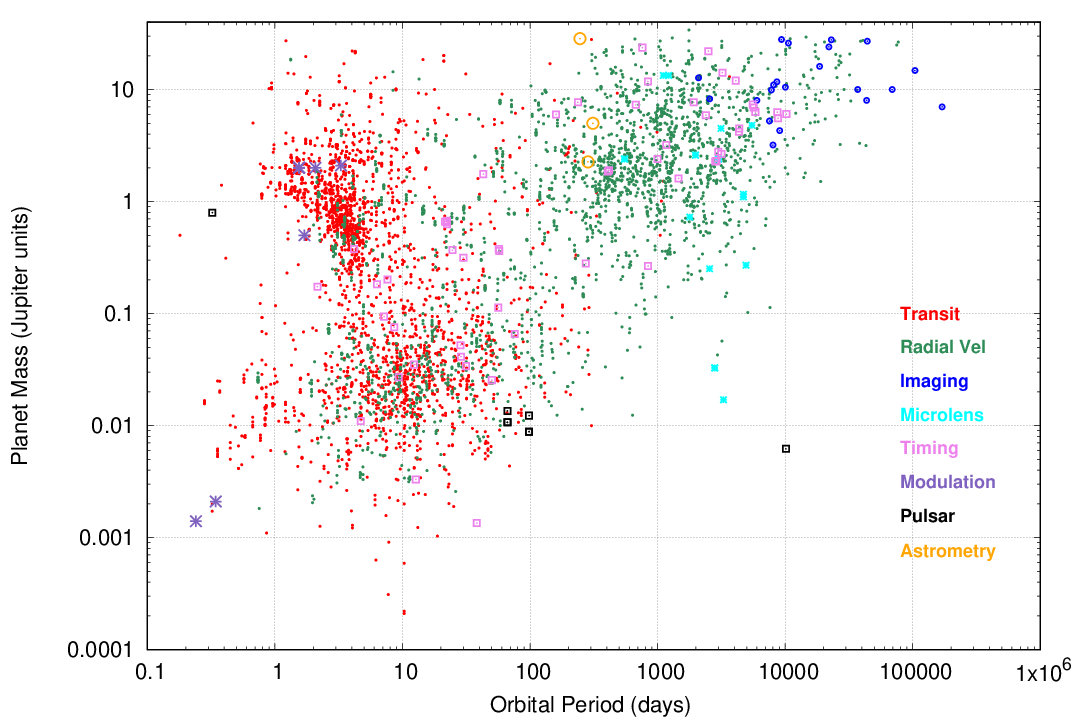
  Q:  Where would a planet similar to the Earth
         appear on this diagram?
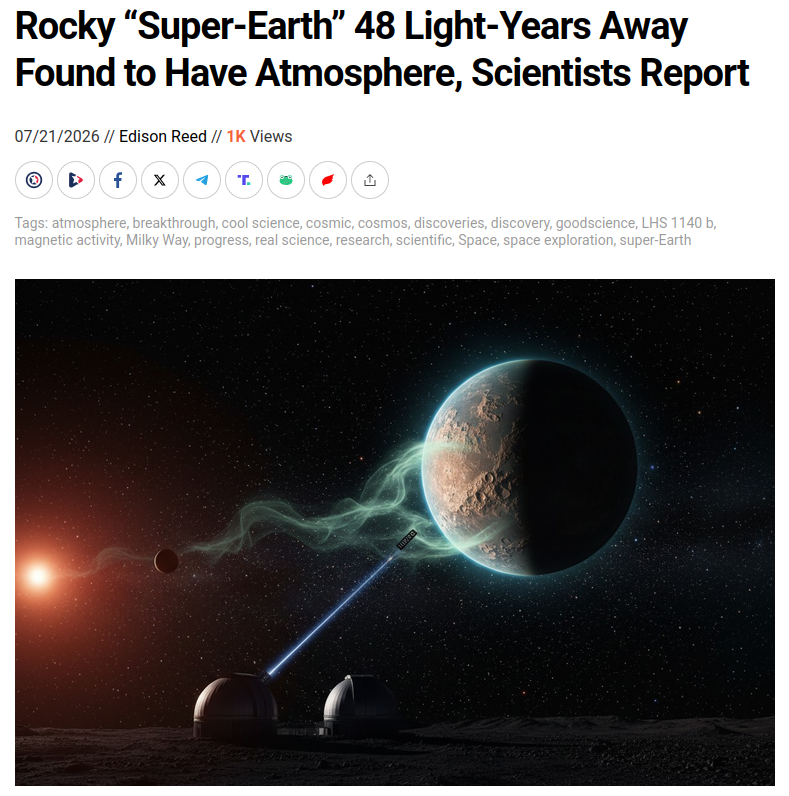
Headline and artist's rendition courtesy of
Natural News
Just before dawn in early August, if you look above the southern horizon, you'll see (faintly) the constellation of Cetus, the Whale. He's rather a cheerful fellow, it appears.
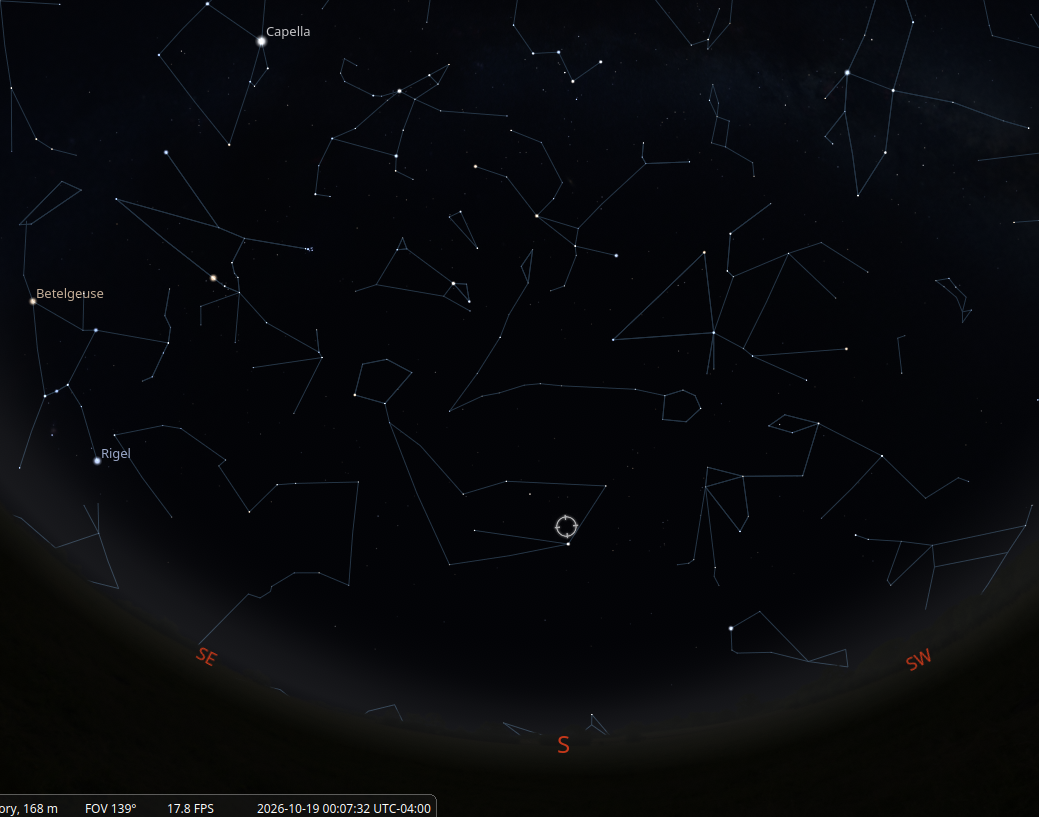
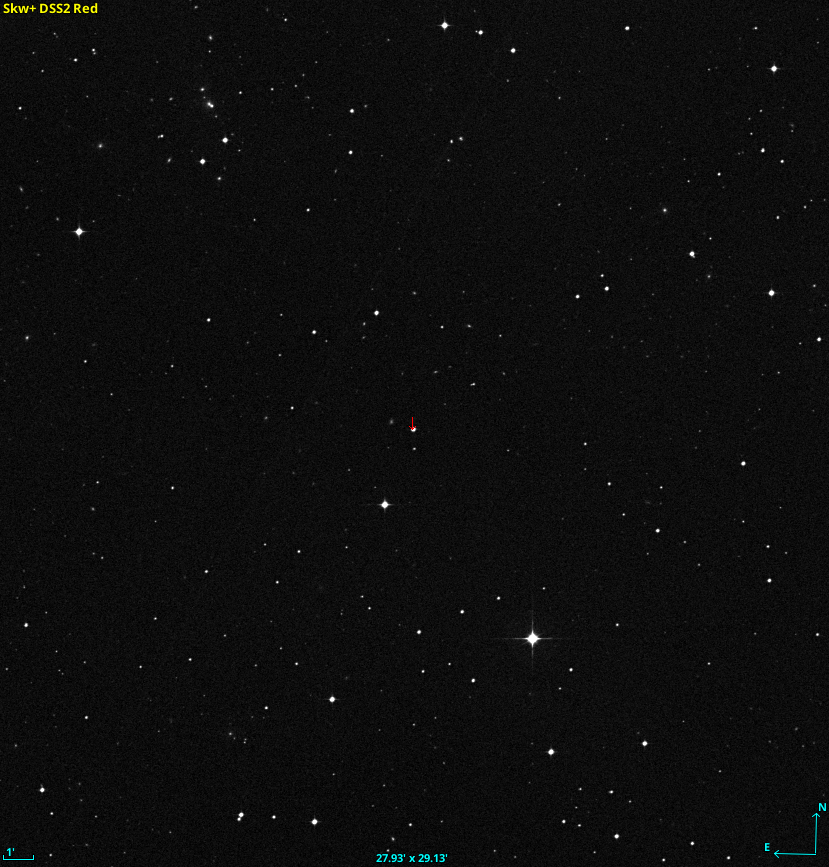
Just above the bright star at the tip of his mouth lies a much fainter one -- too faint to be seen with the naked eye. If one zooms in with a telescope, this fainter star, sometimes called LHS 1140 (among many other names), still doesn't seem special in any way. It's just a faint little dot of light.
However, long-term monitoring of this star by the MEarth-South telescopes in Chile (each just 16 inches in diameter) ...
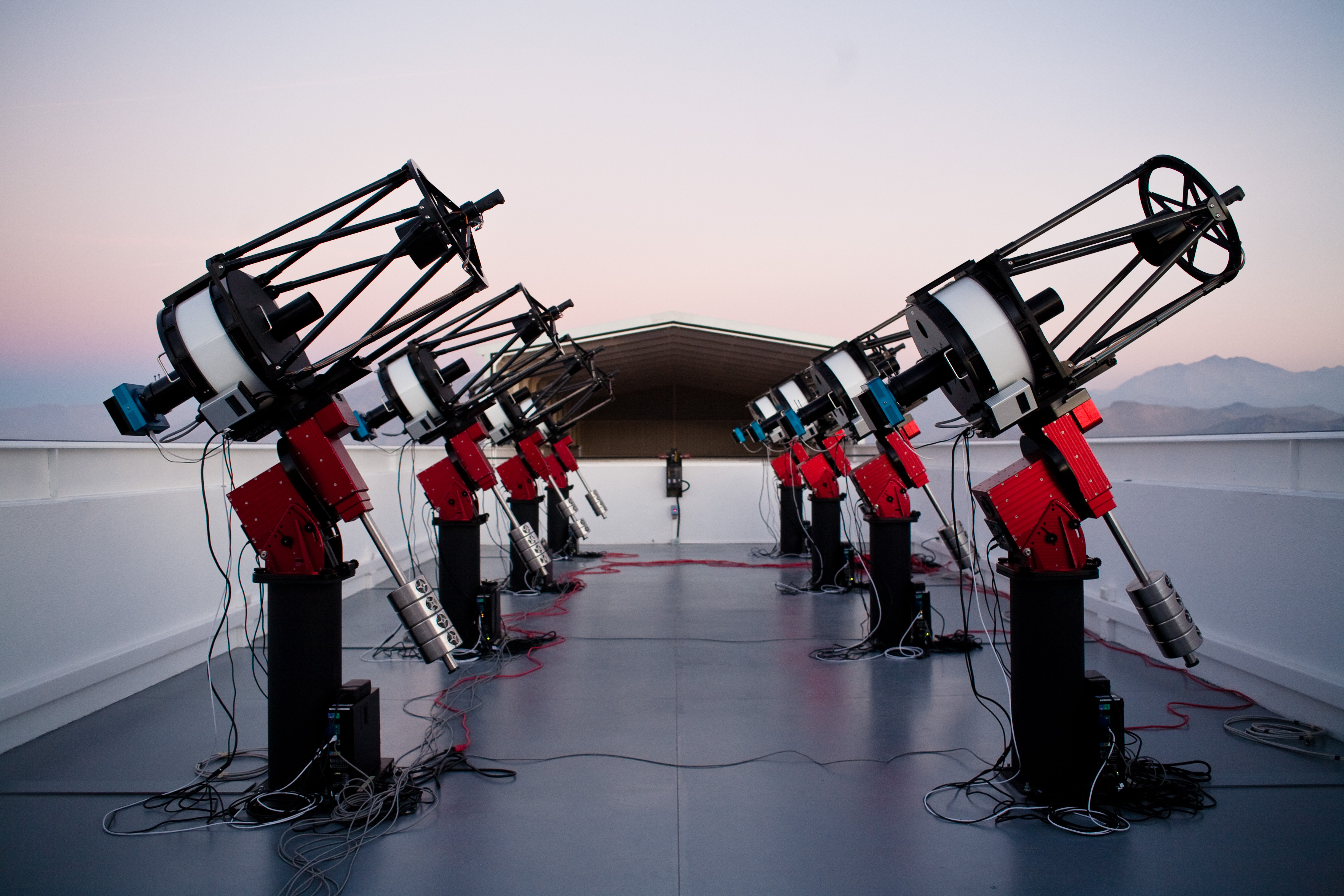
Image of MEarth-South telescopes courtesy of
The MEarth Project
... revealed short, periodic dips in the brightness of this star. In short, transits. Astronomers announced in 2017 that LHS 1140 was circled by at least one planet. The depth of the transit showed that this planet must have a radius slightly larger than that of the Earth; about 1.4 Earth radii, to be precise.
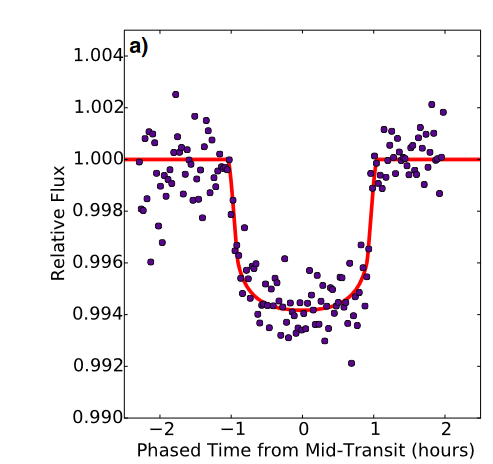
Figure 1 (left panel) taken from
Dittman et al., Nature 544, 333 (2017)
The astronomers then turned to a much larger instrument in Chile, the ESO 3.6-m telescope, to acquire spectra of the star.
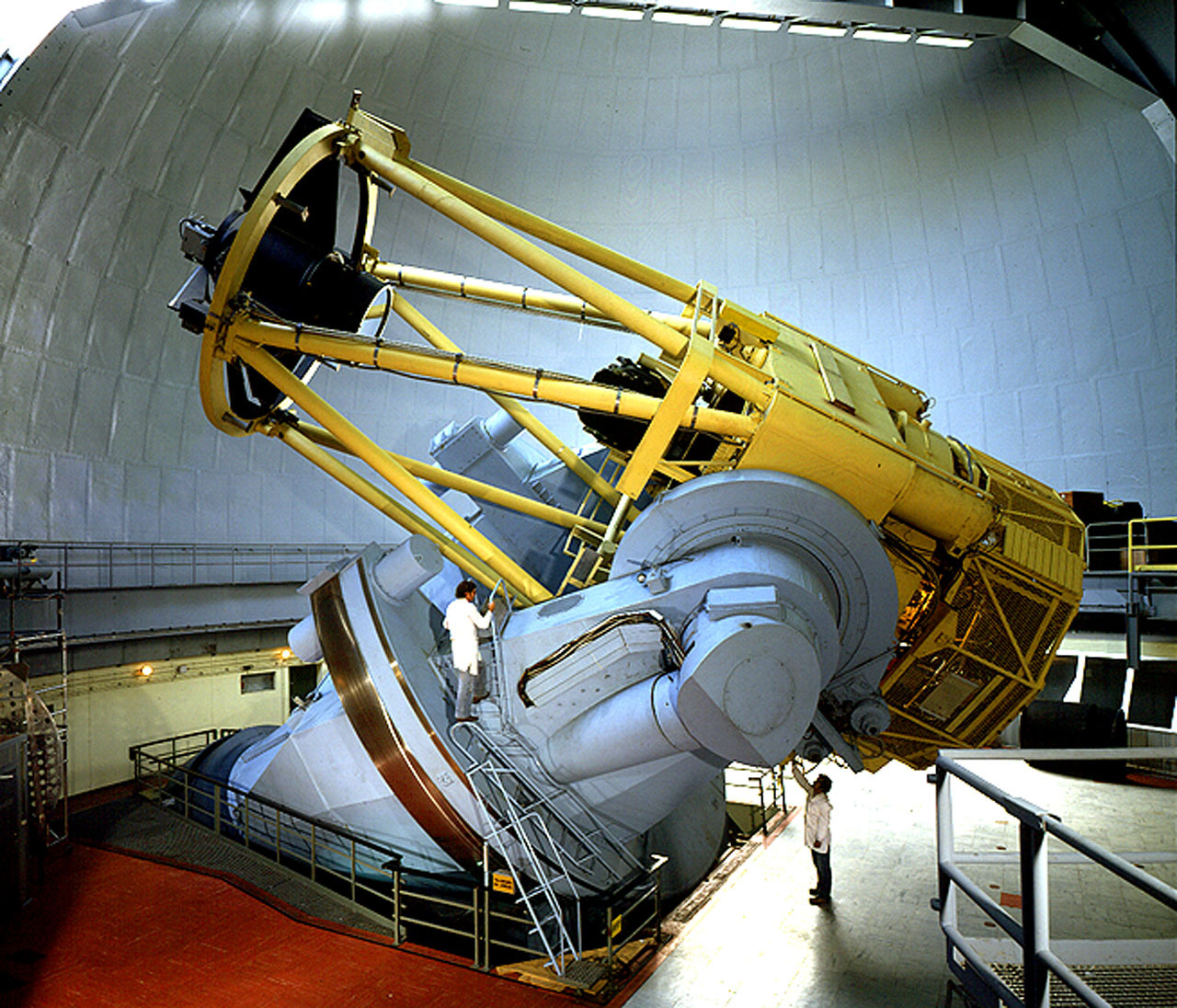
Image of ESO 3.6-m telescope courtesy of
ESO/C.Madsen
Using these spectra, they measured Doppler shifts in the star's light and determined the mass of the planet: about 6.6 times larger than that of the Earth.
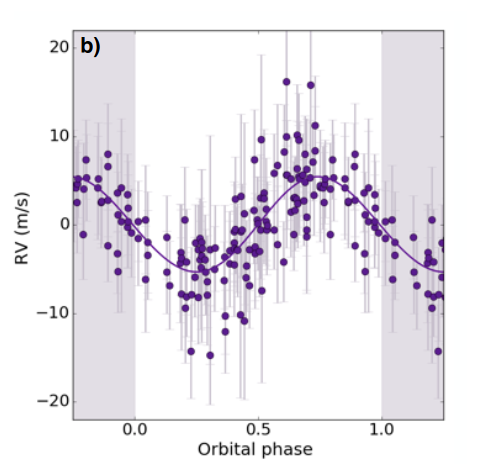
Figure 2 (right panel) taken from
Dittman et al., Nature 544, 333 (2017)
Once we know both the MASS and RADIUS of a planet, we can make reasonably good estimates of its nature: is it
Based on our measurements, it was pretty clear that this new exoplanet, LHS 1140b, fell into the "solid and rocky" category. In the diagram below, the colored curves show the locations of "solid" planets.
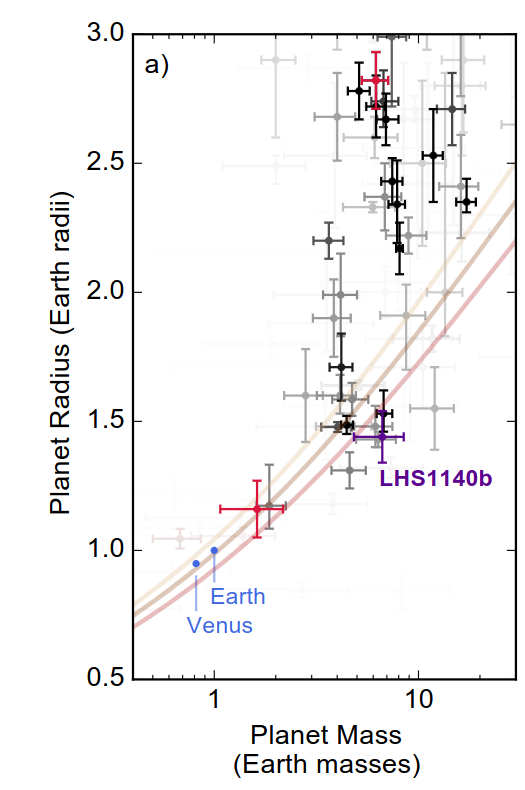
Figure 2 (panel A) taken from
Dittman et al., Nature 544, 333 (2017)
To summarize, back in 2017, astronomers knew that a solid, rocky planet somewhat larger than the Earth orbited a nearby star. The planet's orbit was much smaller than Earth's orbit around the Sun -- only about 25 days -- so it is much closer to its host star; but LHS 1140 is less powerful a star than the Sun, so being closer is actually a good thing. In fact, this exoplanet appeared to lie within its star's habitable zone, the region in which water might remain in a liquid form on a planet's surface.
Could there be life on LHS 1140b?
  Q:  LHS 1140b appears to have a solid surface and temperatures
        at which water would be a liquid.

      What else should a planet have to make it a good place to visit?
How about AN ATMOSPHERE? It would be even better if that atmosphere had plenty of oxygen, right?
So, some astronomers looked for evidence of a gaseous atmosphere around this exoplanet. The measurements are hard to make and require very large telescopes. In this case, one of the Magellan Telescopes in Chile:
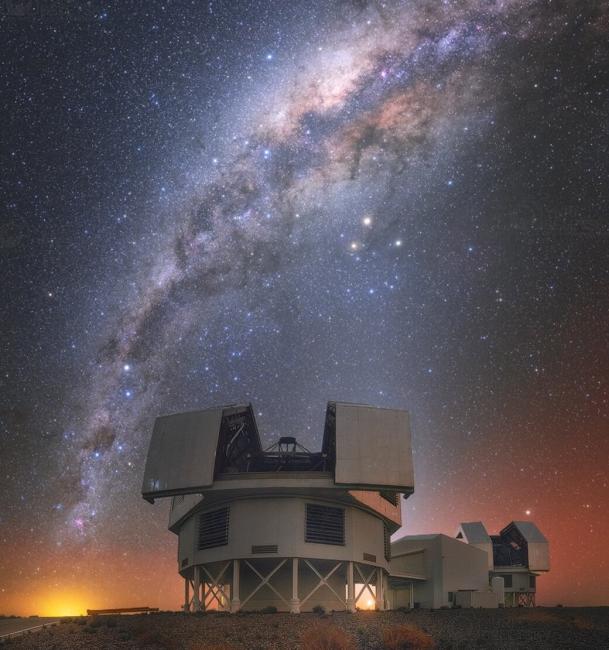
Image of Magellan Telescopes courtesy of
Yuri Beletsky and the Center for Astrophysics
Its mirror is 8.4 meters -- about 27 feet -- in diameter, so it can collect the MANY photons needed to make very precise measurements.
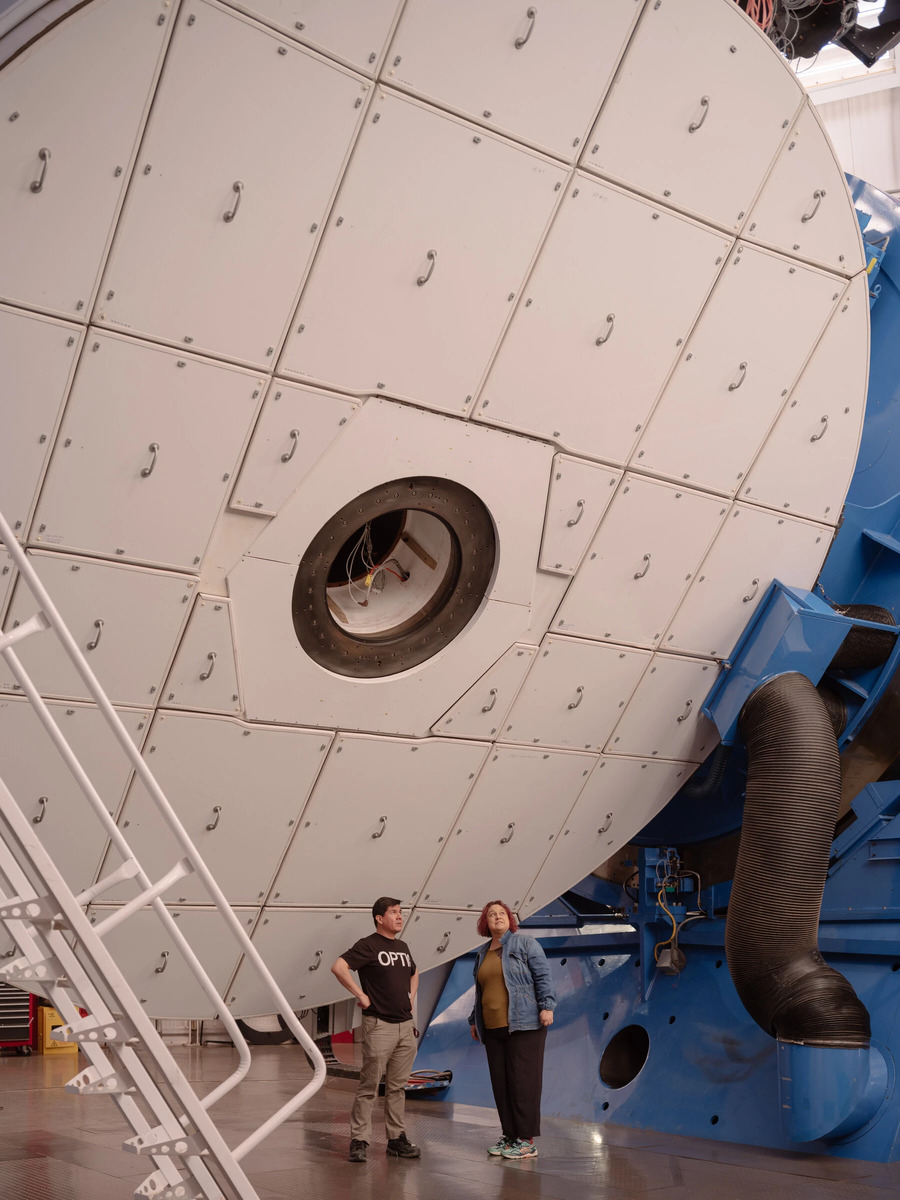
Image of Magellan Baade telescope courtesy of
New York Times
Not only is the telescope a monster, but the instrument which analyzes all that light is a high-tech marvel. The picture below shows a portion of the inner structure of the WINERED spectrograph; note that the sensors are inside a compartment which must be cooled to a temperature of 80 Kelvin. That's -315 Fahrenheit!
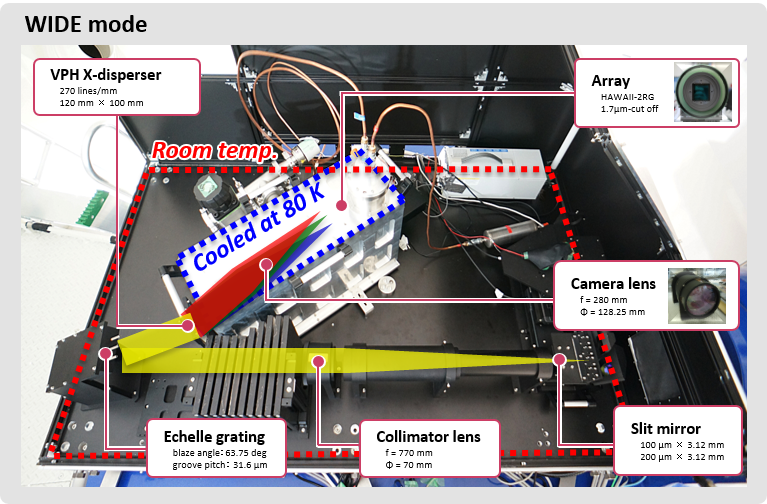
Image of WINERED spectrograph courtesy of
Laboratory of Infrared High-resolution spectroscopy
The scientists measured light from the host star before, during, and after the planet passed in front of it. When the planet was in front of the star -- and for a short time afterward -- a tiny fraction of the star's light was absorbed at a wavelength of 10833 Angstroms. This absorption line tells us that the element HELIUM must be present in at atmosphere around the planet. Unfortunately, no other absorption lines due to the atmosphere of the planet were visible in the spectrum.
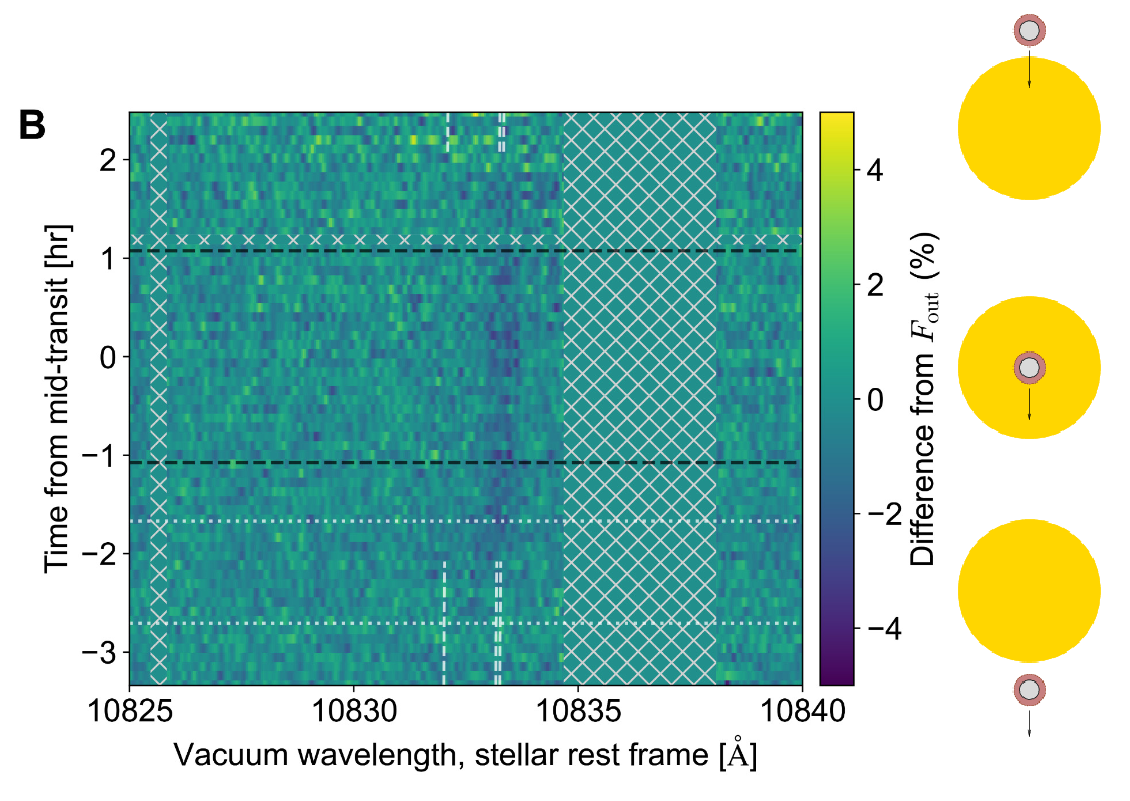
Figure 1 taken from
Cherubim, C., et al., Science, 16 Jul 2026
with some modifications added to the side
So, not only does the planet LHS 1140b have a solid surface, and a temperature possibly amenable to liquid water, but it also has an atmosphere. Hooray!
Well, maybe.
Take a look at the atmospheres of the planets in our own solar system. Do any of them have significant amounts of Helium?
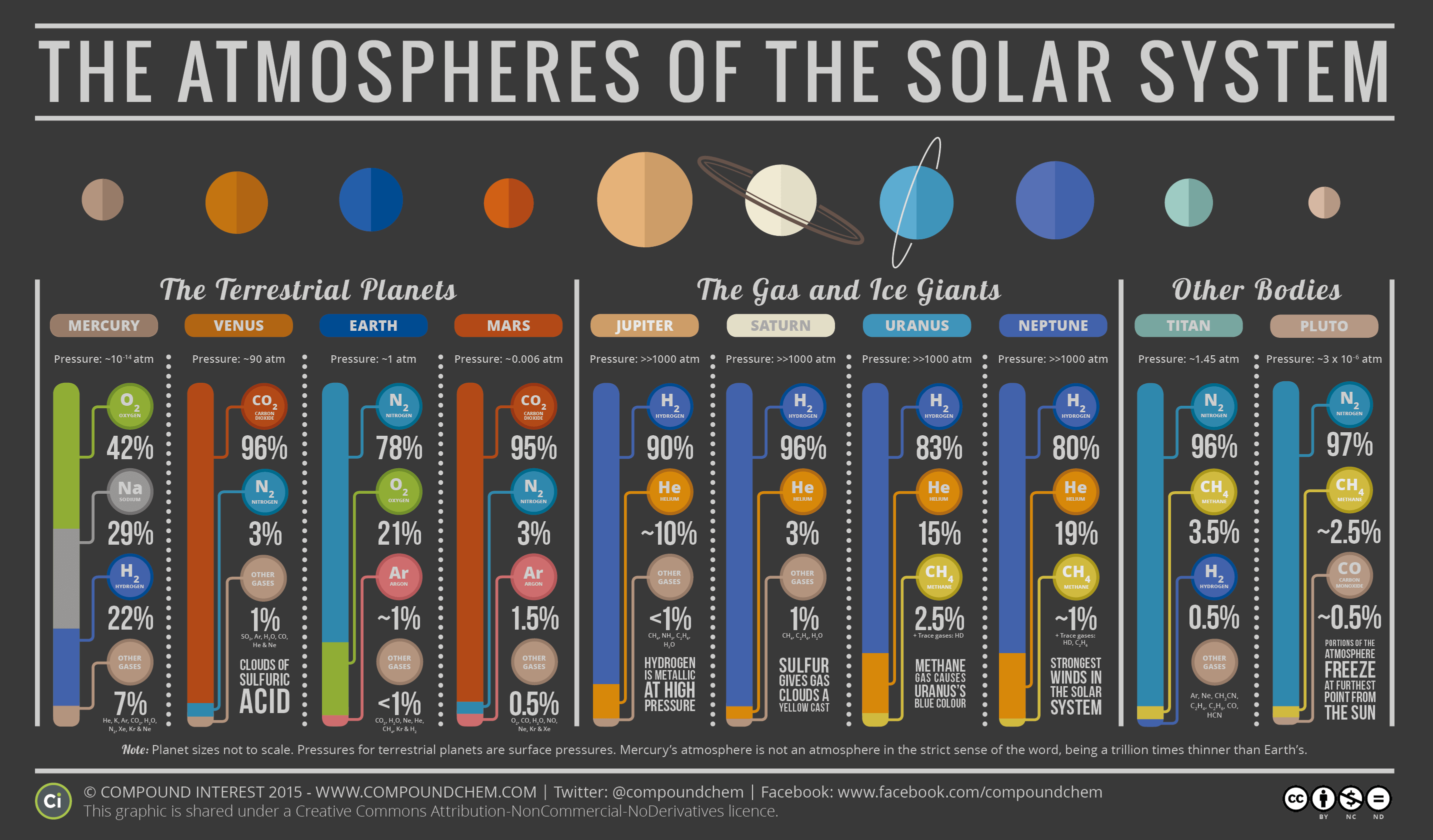
Graphic courtesy of
Andy Brunning and Compound Interest
Hmmm. Maybe LHS 1140b might not be such a fun place to visit ...
I haven't described all the methods that astronomers use to find planets around other stars. For a discussion of all those methods, in much greater detail, see the first of the references below.
Copyright © Michael Richmond.
This work is licensed under a Creative Commons License.