 Copyright © Michael Richmond.
This work is licensed under a Creative Commons License.
One of the hottest topics in astronomy these days is the nature of the Little Red Dots (LRDs, for short). Just what are they, and who first gave them this name? Your first task is to find the earliest appearance of this phrase:
Bonus for any earlier papers in which the phrase "little red dots" appears in the abstract or body of the text, but not in the title.
One resource that I recommend highly for basic introductions to complicated astronomical topics is astrobites. This site is a collection of summaries and reports on recent astronomical papers, written by graduate students. Their goal is to explain the main results of these papers to an audience of not-yet-expert readers: interested laymen and other astronomy students, both undergraduate and graduate. I find many of these articles an excellent way to begin learning about some new topic that comes up in the course of my research, or just happens to catch my eye.
In class, we will discuss the paper mentioned by the astrobites article, as well as more recent papers about Little Red Dots.
We will also spend a bit of time getting ready for the first set of student presentations in the final weeks of class.
Okay, the obvious question is --
Q: Why are they called Little Red Dots?
The answer is pretty straightforward.
Look at the LRD in the image below. Estimate the angular size of this object in arcseconds.
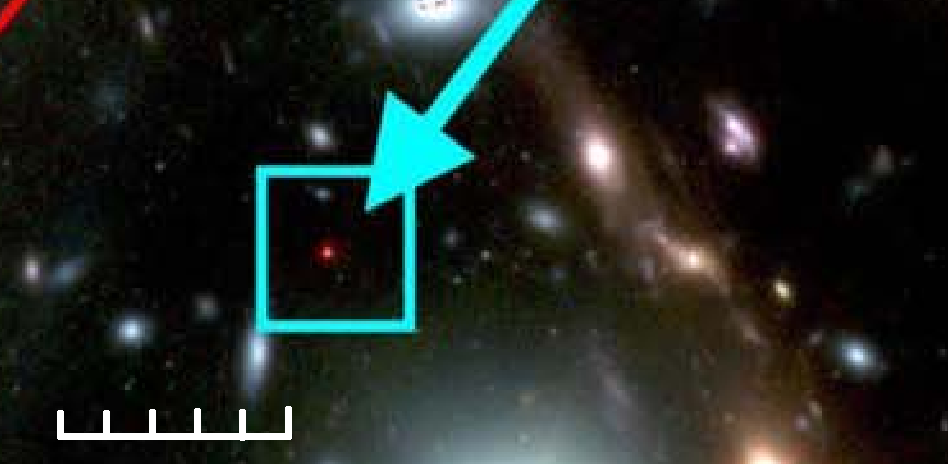
Closeup of region around image QSO1A from
Furtak, L. J., et al., ApJ, 952, 142 (2023).
The scale bar is five arcseconds long, with tick marks at
1 arcsecond interval.
Now, the redshift of this object is about z = 7.5. Estimate its diameter using Ned Wright's Cosmology Calculator.
But wait! Due to gravitational lensing, this image appears to be about 7 times larger than the proper size. Now estimate its proper diameter again.
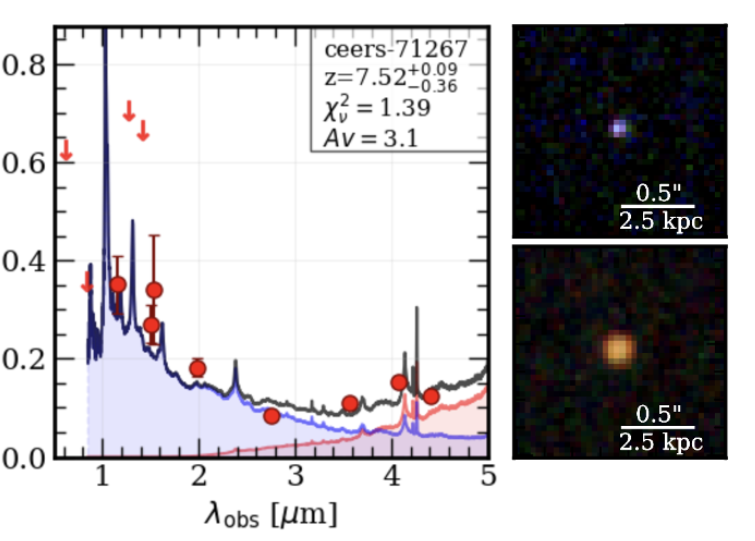
Lower-right panel of Figure 1 in
Kokorov, V., et al., ApJ 968, 38 (2024)
We think that dust is responsible for this reddish color. Dust grains surrounding the object scatter light rays with short wavelengths; in addition, they absorb some of its luminosity, causing them to heat up and re-emit the energy in the infrared.
One model for LRDs is that they are very massive -- not just 10 or 100 times the mass of a single star, but millions of solar masses -- black holes surrounded by accretion disks and dusty clouds of gas. As material circles a black hole in its accretion disk, it heats up and emits huge amounts of energy. We see plenty of AGN and quasars in our local universe which follow this general model.
The problem is that our best models suggest that creating supermassive black holes takes a LONG TIME, but a number of LRDs appear to be at such high redshift that they ought to be too young to have grown so massive. In the figure below, the left-hand panel shows that the number of LRDs (red diamonds) is smaller than the number of supermassive black holes predicted by some simulations (blue line) ... which is good.
But the right-hand panel shows that at higher redshift, the models (blue line) can't produce as many supermassive black holes as we observe (red diamonds). That's not so good.
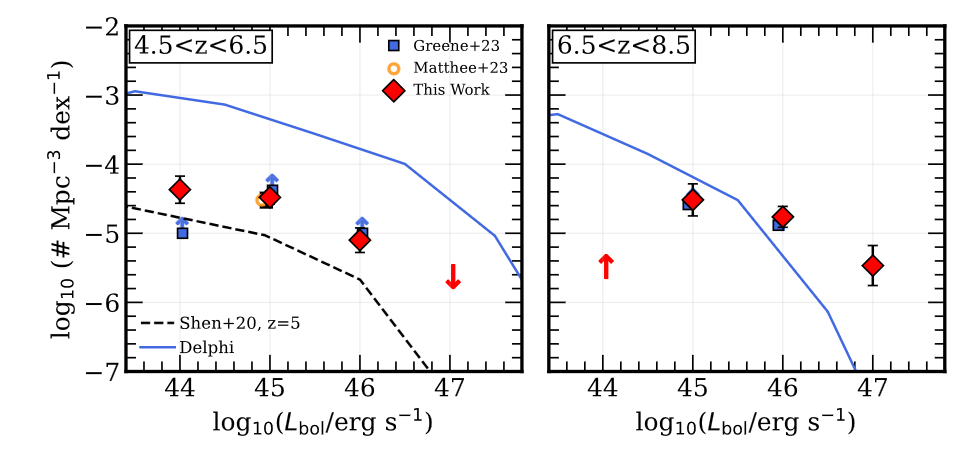
Figure 5 taken from
Kokorov, V., et al., ApJ 968, 38 (2024)
Just how massive are the black holes powering LRDs? What evidence is there for them? One of the strongest bits of evidence is due to a very lucky situation in which a big cluster of galaxies is gravitationally lensing the light of an LRD which is behind it.
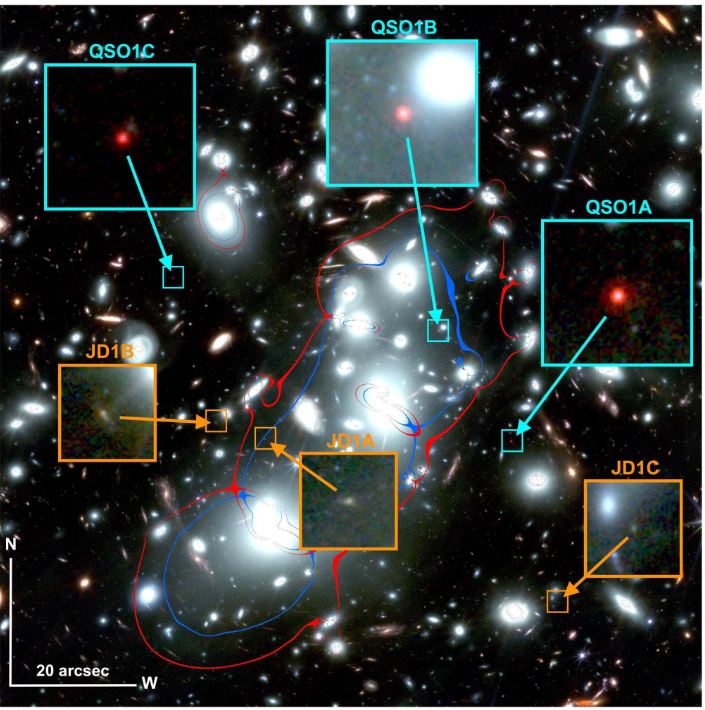
Figure 1 taken from
Furtak, L. J., et al., ApJ, 952, 142 (2023)
The lensing causes the LRD to be both brighter and larger in angular size by a factor of seven or so. That allows astronomers to measure its properties on small scales much more precisely than usual. For example, consider these measurements of the motions of gas around the LRD. Note the signature of rotation ...
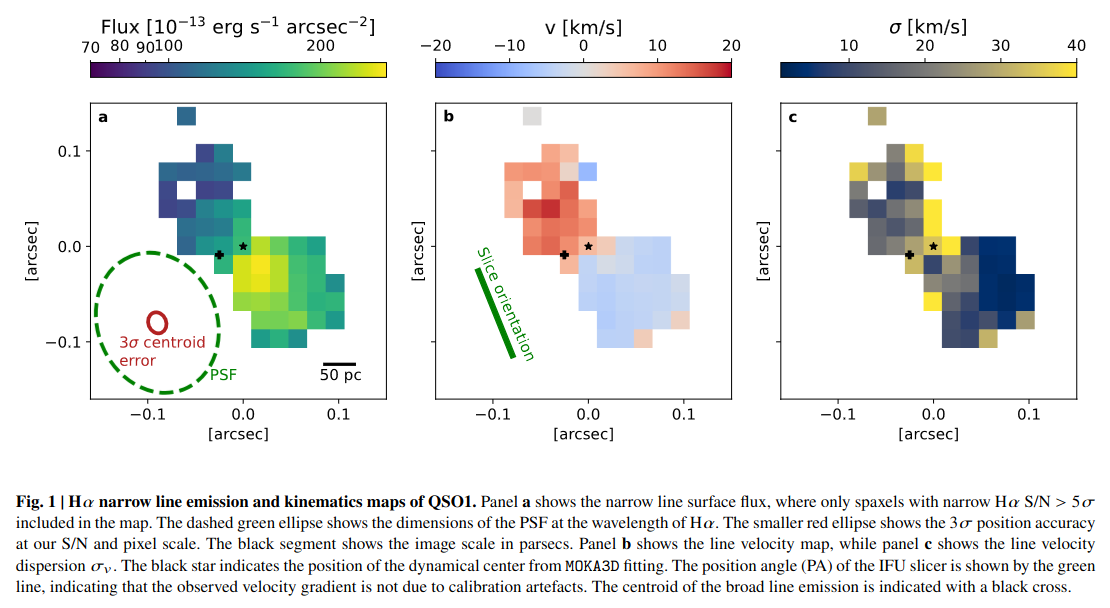
Figure 1 taken from
Juodzbalis, I., et al., Nature 653, 1017 (2026)
   Q:  Based on the middle panel in the figure above, what is the
          maximum speed of gas rotating around the center of the LRD?


   Q:  How far is this gas from the center of the LRD?


   Q:  Compute the mass of the object at the center of the LRD
          based on these two measurements.
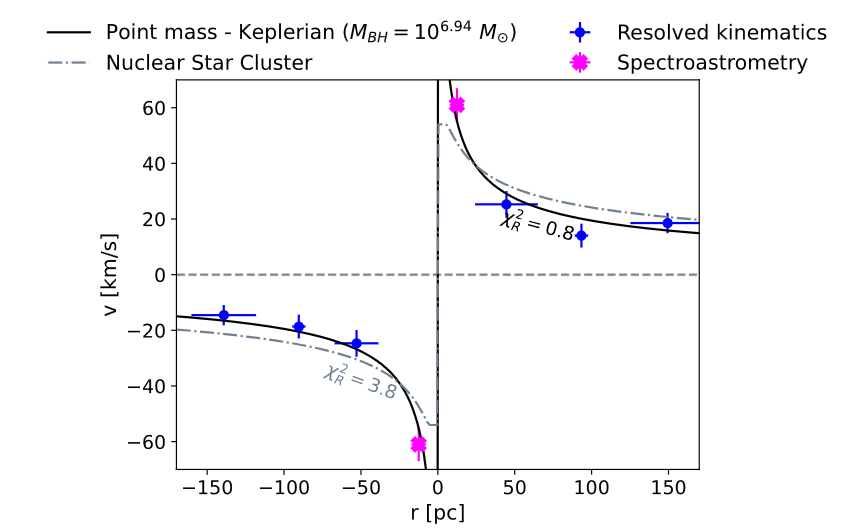
Figure 2 taken from
Juodzbalis, I., et al., Nature 653, 1017 (2026)
Copyright © Michael Richmond.
This work is licensed under a Creative Commons License.