On the night of Sep 11/12 2026, under excellent conditions, I acquired images of thecataclysmic variable star QR And.
Conditions were very good, and I measured the star over a period of about seven hours.
This cataclysmic variable is the subject of a long-term study by the Center for Backyard Astrophysics. This will be my first night of observations of this system, mostly to see if I should work on it regularly. (Answer: probably yes, with some modifications to procedure)
QR And RA = 00:19:49.93 Dec = +21:56:52.1
These observations involved:
Notes from the night:
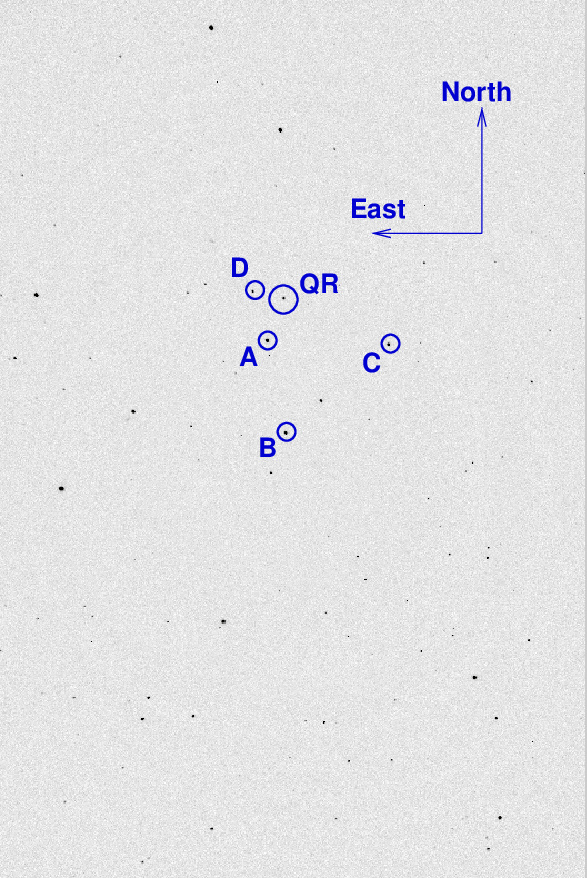
The picture below shows a cropped image of the field of QR And from Sep 06/07, 2026. The field of view is about 20 arcminutes across.
I've marked the location of several comparison stars, with magnitudes and names taken from the AAVSO's table X43062GE.
  star       name                  B          V
------------------------------------------------------
    A     000-BBB-469         11.743     10.647
    B     000-BBB-468         12.454     10.928
    C     000-BBB-450         11.951     11.425
--------------------------------------------------------------------------
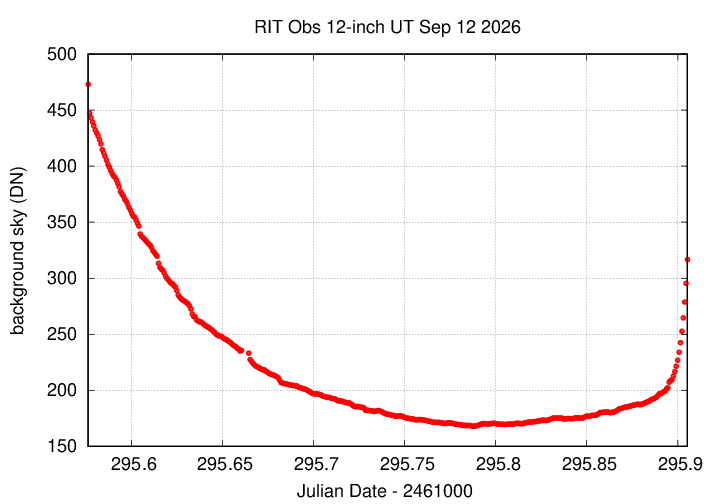
Here's the sky background over the course of the run. Smooth curve means no sign of clouds.
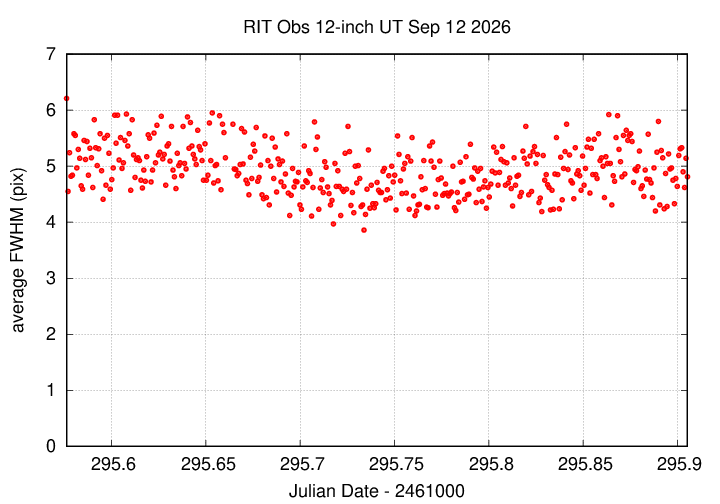
The FWHM improved slightly as the field rose and crossed the meridian.
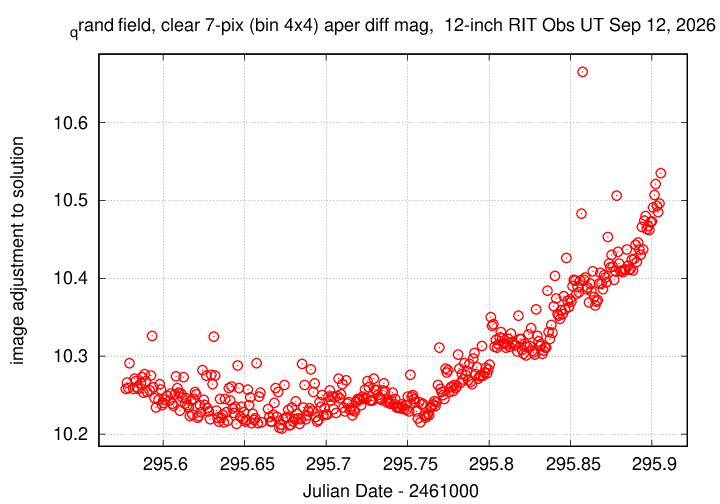
The graph below shows changes in the photometric zeropoint of an ensemble solution of the instrumental magnitudes over the course of the run. No evidence for clouds.
Using aperture photometry with a radius of 7 pixels in clear filter (binned 4x4, each pixel is 1.036 arcsec, so a radius of 7.3 arcsec), I measured the instrumental magnitudes of a number of reference stars and the target. Following the procedures outlined by Kent Honeycutt's article on inhomogeneous ensemble photometry, I used all stars available in each image to define a reference frame, and measured each star against this frame.
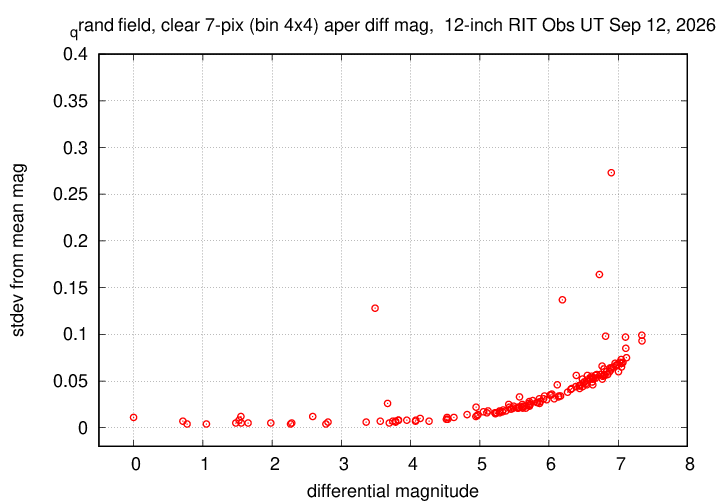
Sigma-vs-mag plots show that the floor in clear filter was about 0.004 mag.
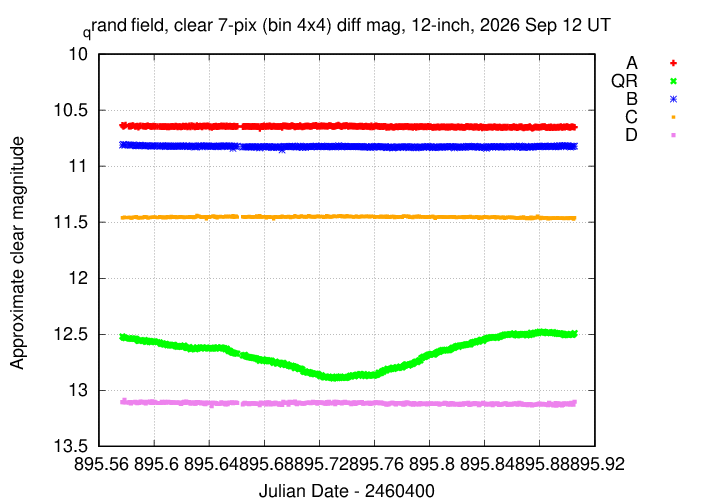
Here's the light curve of the target and some nearby comparison stars. I've placed the clear-filter measurements onto the V-band scale.
I've submitted these results to the AAVSO and the CBA.