On the night of Oct 19/20, 2026, under very good conditions, I attempted to record an occultation of the star HIP 16880 by the asteroid (4209) Briggs, or by a possible moon orbiting the asteroid. Alas, I saw no hint of any occultation.
You can find detailed information on this event in
The RIT Observatory was quite a distance to the north of the predicted shadow path, but this asteroid is suspected to have a satellite. Therefore, I decided it was worth the effort to monitor it at the time of closest approach -- which was, conveniently, around 8:55 PM.
These observations involved:
I decided to use the ASICap program to capture images, as I have done for other occultation events.
Notes from the night:
The target star, HIP 16880, has approximate magnitude V = 10.1 and is located at
RA = 03 37 13.97 Dec = +49 33 27.17 (J2000)
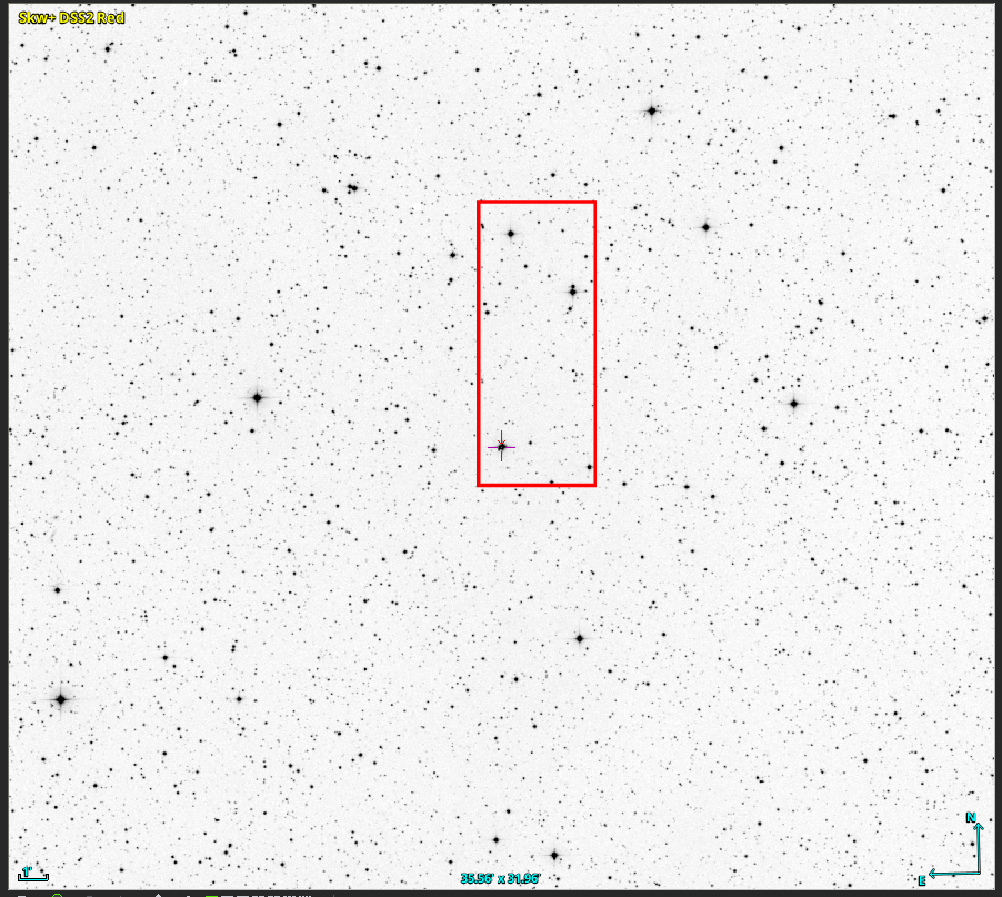
A chart of the field is shown below, North is up, East to the left. The size of the chart is about 35 x 31 arcminutes.
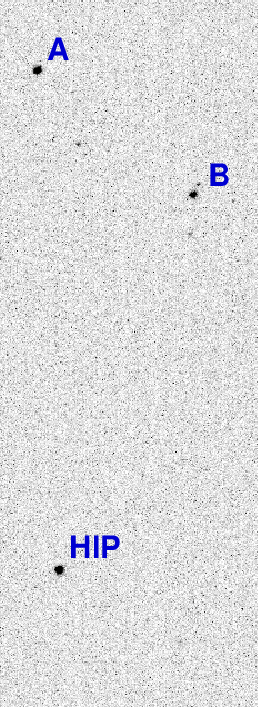
The target is indicated by crosshairs. I've drawn a box around the region of the field covered by the sub-frame of my observations. It contains the target star and two comparison stars of similar brightness; all the others are more than 2 magnitudes fainter. The two comparison stars were the only ones which provided good signal-to-noise values in the very short, 0.1-second exposures that I took.
Below is an example of one of those images. The plate scale is roughly 1.03 arcsec per pixel with the 4x4 binning. North is up, East to the left.
I acquired a set of 5407 images, each with exposure time 0.1 seconds. The dead time between exposures was very short, about 0.0015 seconds. The start and end of the run were
    start:  frame 0           UT 2026 10 20 00:50:51.371

    end:    frame 5407                      01:00:00.209
These times come from the FITS headers, which provide "DATE-OBS" values for the start of each exposure. I did not have any GPS connection for the times, unfortunately, but I did make two visual spot checks against the time from NIST displayed on my cell phone.
I conclude that the times recorded in the FITS header are probably less than 1 second away from the actual time of the recording.
I created a master dark frame from the median of 100 images taken with the lens cap on the telescope immediately after the occultation data was acquired. I subtracted that master dark frame from all target images, but did NOT perform any flatfielding. That's fine -- we're just looking for short-term dips in the relative magnitude. and the telescope didn't drift significantly over this short run of ten minutes.
I measured instrumental magnitudes using an aperture of radius 5 pixels and local sky from an annulus of radii 15 and 25 pixels. I detected the three bright stars in all exposures, and typically measured 2 or 3 faint stars as well. I then performed inhomogenous ensemble photometry on the measurements. In order to save time, I divided the frames into five groups of 1100 images, with an overlap of 100 frames at both ends between groups.
The standard deviation from the mean magnitudes within each group of frames was typically
   target:   scatter  approx   0.045 mag

   star A:                     0.057

   star B:                     0.074
Below are the light curves for the target (in green) and two comparison stars in each of the five groups. The x-axis in each light curve shows the index of the frame number within the group, not within the entire set of 5407 images.
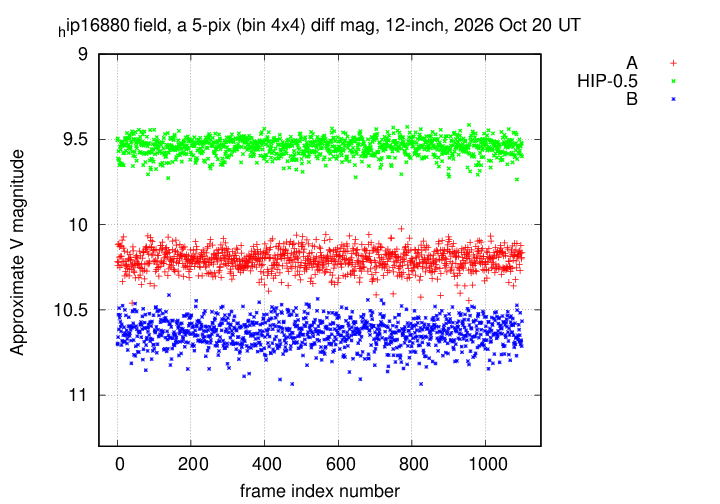
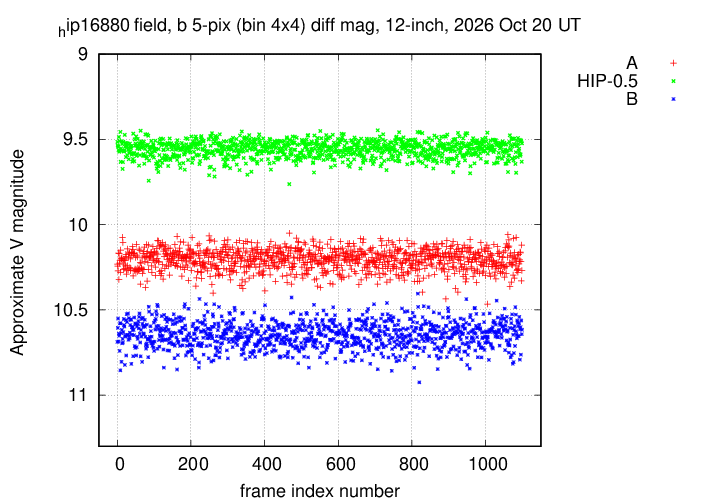
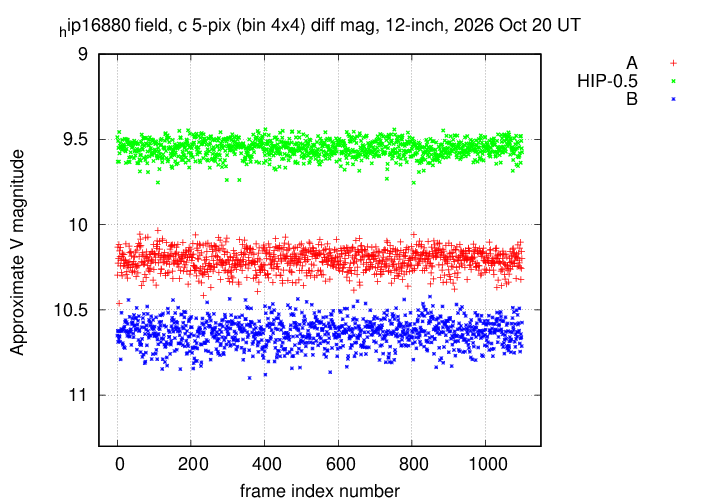
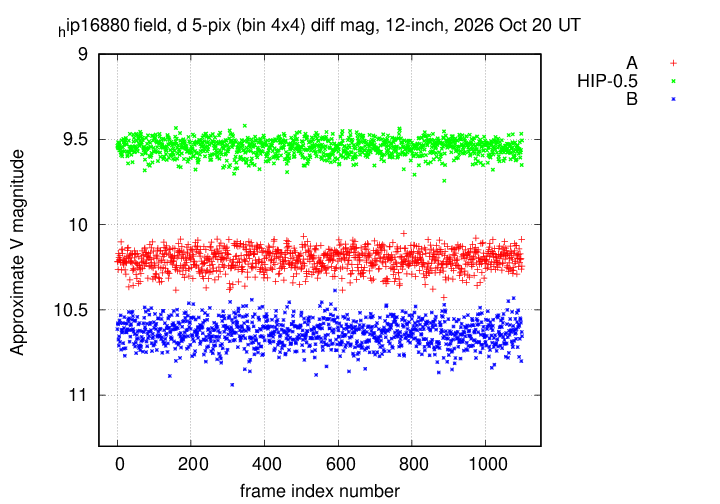
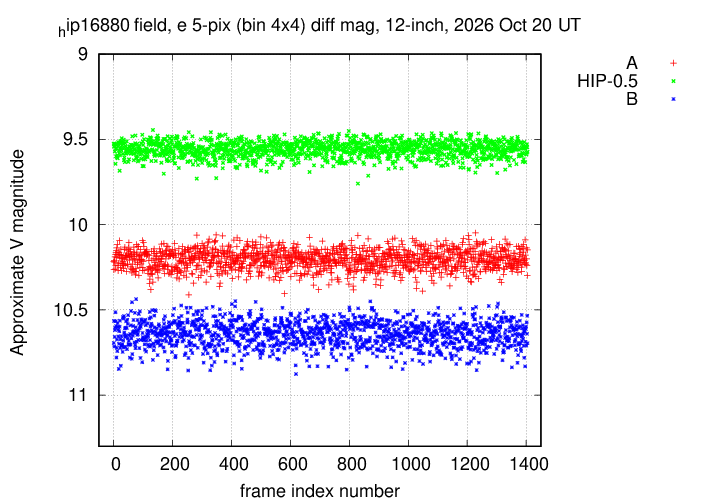
The result? I see no dip in the brightness of the target star. There are occasional low values, but they are no more than 0.25 mag at maximum, and consistent with random statistical fluctuations. There are no instances of two consecutive very low measurements.
In short, this event was a MISS from my location.
I've reported this miss to the International Occultation Timing Association using the