On the night of Oct 02/03, 2026, under good conditions, I acquired astrometry of two stars: GX And and Ross 248.
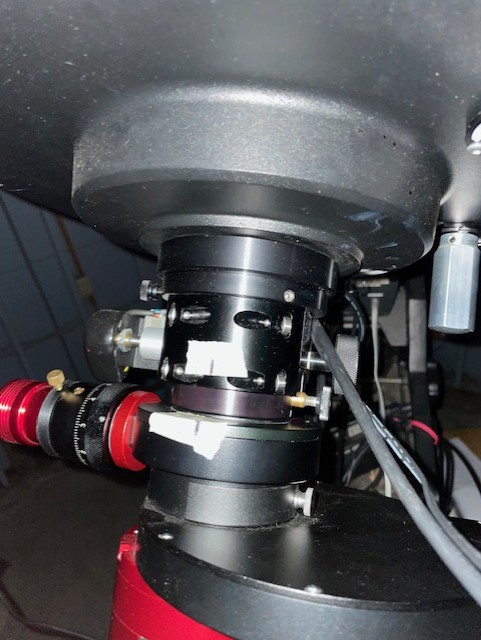
I also placed some alignment marks on pieces of tape fixed to the camera and focuser, so that it should be easier for mount the camera each night in a nearly North-up, East-left orientation.
GX And is a nearby (binary) star which will be the target of a parallax project at some point. One of the two components is bright -- about mag V = 8 -- so one must use short exposures to prevent it from saturating the detector. That may mean that this system isn't as easy to measure as Ross 248 or some others.
These observations involved:
Notes from the night:
The object is currently close to this position:
RA = 00:18:28.4 Dec = +44:01:31 (J2000)
but it does have a very high proper motion.
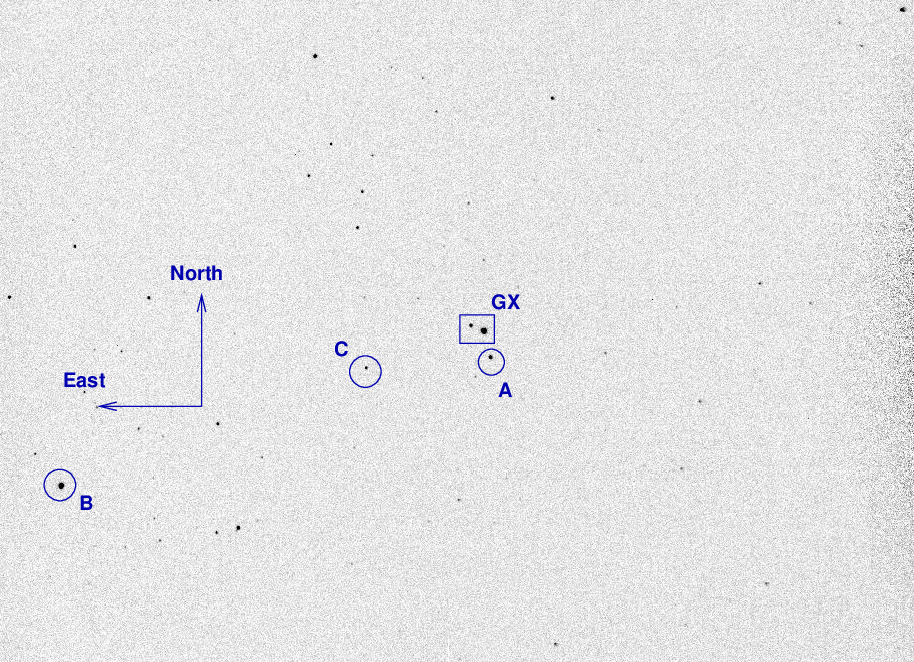
A chart of the field is shown below. The size of the chart is about 41 x 27 arcminutes. The noisy area at right (West) is the shadow of the guider's pickoff mirror.
The two components of the GX And binary sit inside the box. I've marked the location of several comparison stars as well.
  star       UCAC4               B          V          r
-----------------------------------------------------------

   A        671-001473          9.939      9.790

   B        670-001639          9.413      8.472

   C        671-001509         12.712     11.421     11.001

-----------------------------------------------------------
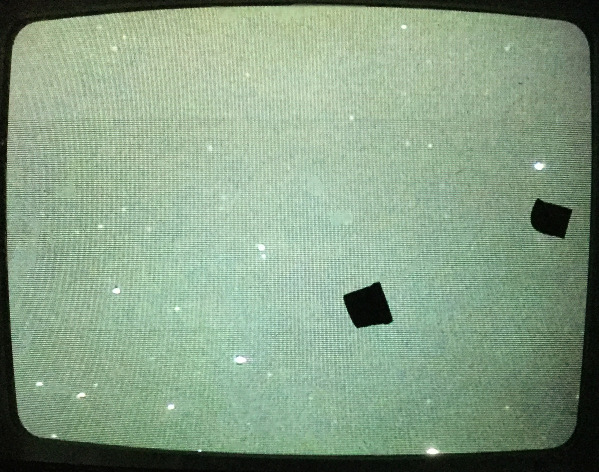
I took a photo of the finder TV's screen when pointing to GX And; this could be a useful reference for the future:
Using the same techniques as described for earlier nights, I matched detected stellar positions to the Gaia DR2 catalog. In this case, I used only stars within a "smaller" subset of the full catalog around the target, those no more than 10 arcminutes away from it.
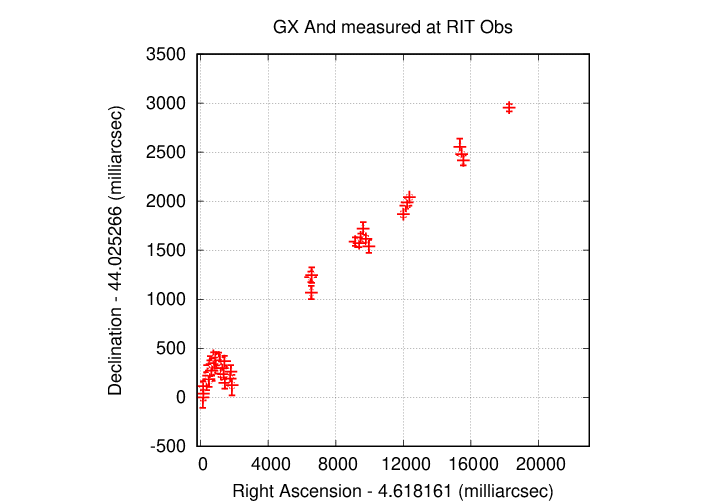
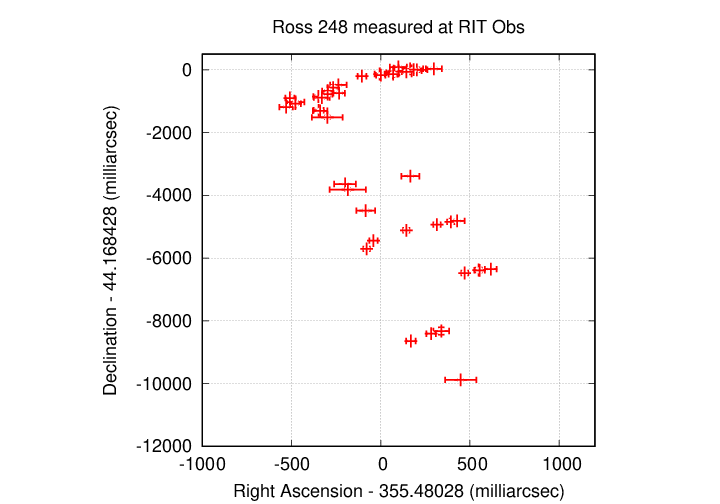
The target is moving to the upper-right with time, and clearly shows the back-and-forth motion due to parallax.
This is one of the stars that a capstone student may study over the next year in a project involving parallax. Ross 248 is a relatively faint red star surrounded by many other stars of similar brightness, so it's a good candidate for high-precision parallax measurements.
These observations involved:
The object is (currently) near position
RA = 23:41:55.27 Dec = +44:10:06.38 (J2000)
A chart of the field is shown below. The size of the chart is about 41 x 27 arcminutes. The noisy area at right (West) is the shadow of the guider's pickoff mirror.
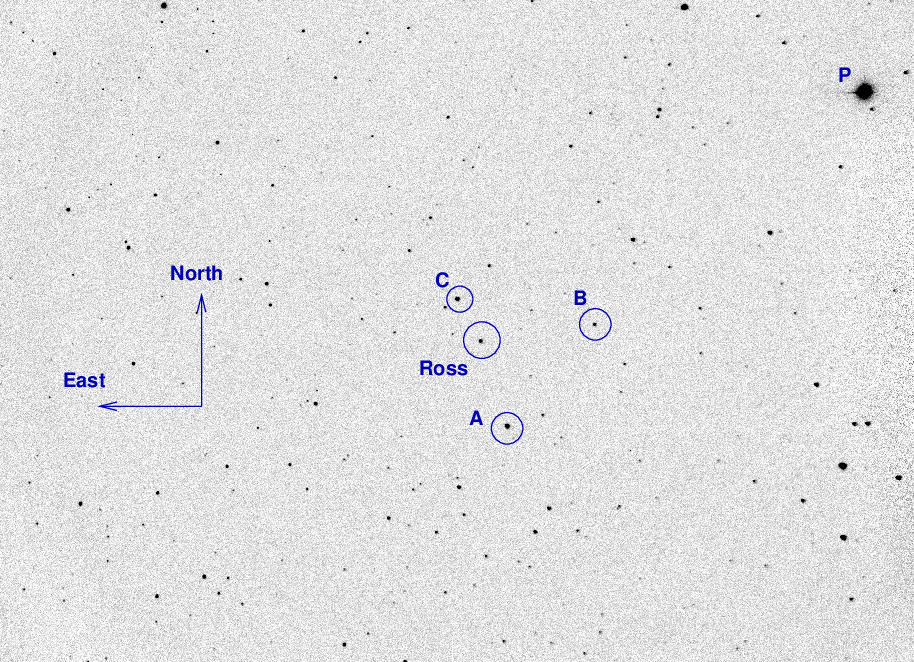
I've marked the location of several comparison stars.
  star       UCAC4               B          V         r
-------------------------------------------------------------------------

   A     UCAC4 671-120730      12.617     10.689

   B     UCAC4 671-120688

   C     UCAC4 671-120749      10.987     10.663


   P     kappa And              4.06       4.14

--------------------------------------------------------------------------
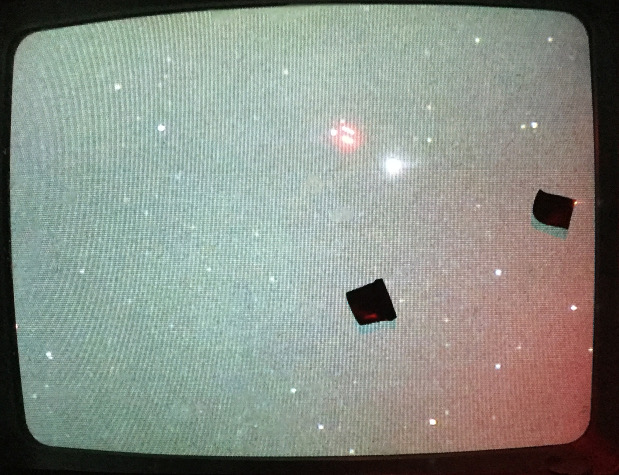
I took a photo of the finder TV's screen when pointing to Ross 248; this could be a useful reference for the future:
In order to get the best results for Ross 248, it is necessary to use only a subset of the stars in the camera's full field of view. For this evening's data, I chose the "intermediate" subset, and restricted matches to those stars within about 11 arcminutes of the target. It helps to limit the measurement of stars in the images to this same region, too.
This evening's images were a bit spoiled due to consistent East-West trailing, as there were no guide stars visible. The precision of the measurements was considerably better in Declination (scatter 27 mas) than in RA (87 mas).
Here are the positions I've measured so far. The most recent measurements are at the bottom of this plot.
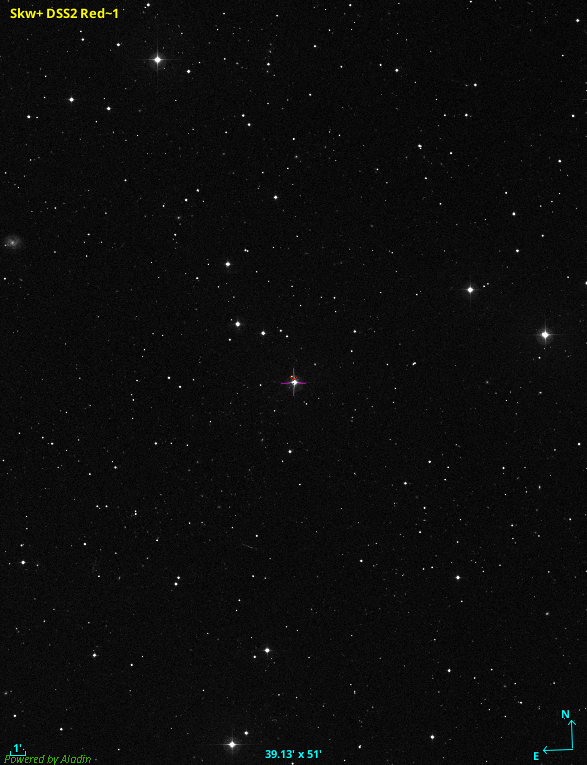
I've noticed recently that the orientation of images taken with the ASI 6200MM camera on the 12-inch hasn't been perfectly lined up: the rows and columns don't run exactly North-South and East-West. Compare the two pictures below: on the left is a field near HD 4007 from the Digitized Sky Survey, with North up, East left; on the right is an image of the same area taken with the 12-inch telescope before I made any adjustments this evening.
In the DSS image, note that the double-star at the bottom of the image lies to the LEFT (East) of the bright star near the middle, while in the RIT image, the same double star lies to the RIGHT of the bright star. That's quite a bit of rotation: about 14 degrees off.
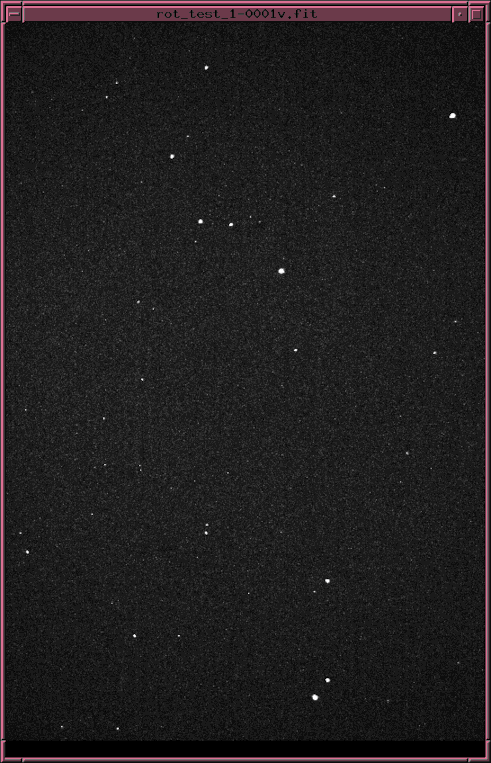
I then made a series of adjustments, loosening the focuser and rotating the camera's nosepiece slightly, then taking another picture. Eventually, I reached a position which seemed pretty good: Note how in the right-hand image below, the double star at the bottom does lie to the LEFT of the bright star in the middle.
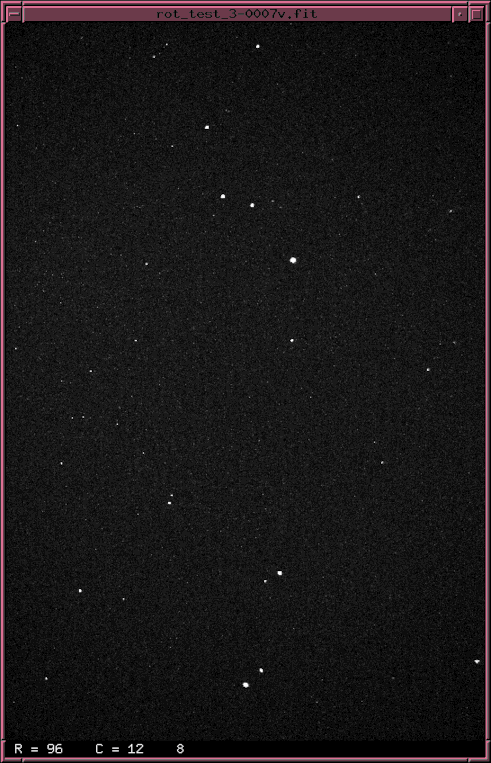
The next day, when I had a chance to measure things carefully, I found that the camera is still slightly misaligned, but only by about 3.5 degrees. That's a nice improvement.
In order to allow me to mount the camera close to this better orientation, I placed pieces of tape on the focuser (which is mounted to the telescope), and on the camera. I then drew a mark on each piece of tape with a pen to help me line things up next time: