On the night of May 30/31, 2026, under very good conditions, I acquired images of the recurrent nova T CrB. This star undergoes outbursts at long intervals of 80 years or so. Its next outburst is predicted to occur soon (but then again, it was also predicted to occur during 2024), and so I've joined the crowd who are monitoring it.
The star is still quiescent.
I'm in the middle of making small adjustments to the polar axis of the 12-inch telescope. Needs more work ...
This recurrent nova brightens by about 8 magnitudes (!), from V = 10 to about V = 2, around every 80 years. Will we see another outburst THIS summer?
These observations involved:
Notes from the night:
On previous nights, I'd noticed that stars drifted SLOWLY in Dec as the telescope followed T CrB. The sense was that the guide star appeared to drift up = North when scope was East of meridian, and down = South when scope was West of meridian. So, at the start of this evening, I modified the position of the polar axis slightly:
At the start of the run, after starting the guider, I noticed the guide star drifting VERY QUICKLY: it moved South while telescope was far to East of meridian. In other words, I had overshot the adjustment by quite a bit.
So, I paused imaging and tried to move the polar axis back (so marker moved in the direction of higher latitudes) to where it had been originally. When I re-started the guiding, I saw that I had not gone far enough: stars were still drifting (south when East of meridian) and (north when West of meridian), though not so quickly: it took about 20 minutes for the guide star to move from center of its tiny box to the upper or lower edge when scope was at its farthest extent from meridian.
Next time I observe, I'll adjust the polar axis so the marker moves a bit farther to higher latitudes on the scale, using small CCW twists of the knob.
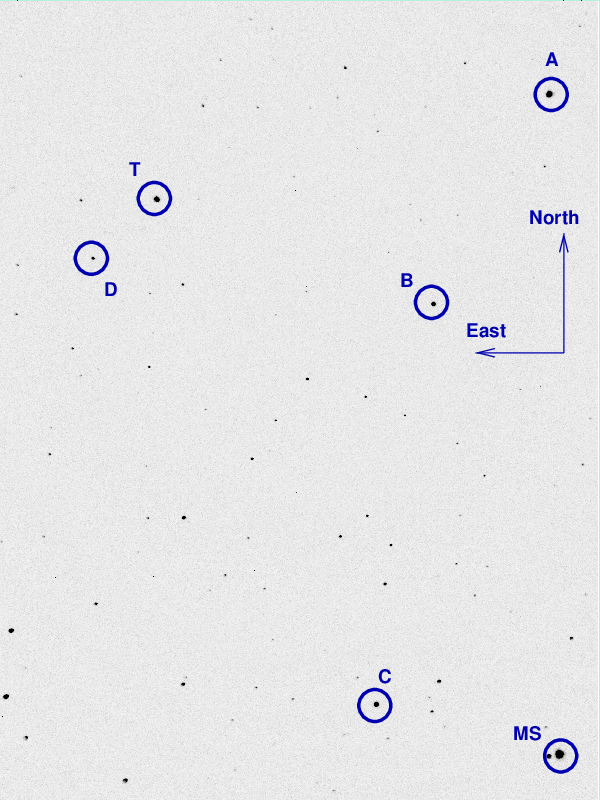
The picture below shows a cropped image of the field of T CrB from Jun 14/15, 2024. The field of view is about 20 arcminutes across.
I've marked the location of several comparison stars, with magnitudes and names taken from the AAVSO's table X40237AAS. Note that the magnitudes listed for stars "A" and "B" have changed from the ones I listed in last year's notes.
  star       name                  B          V
------------------------------------------------------
      A     000-BJS-901         11.096     10.554
      B     000-BBW-805         11.779     11.166
      C     000-BPC-198         13.049     12.336
--------------------------------------------------------------------------
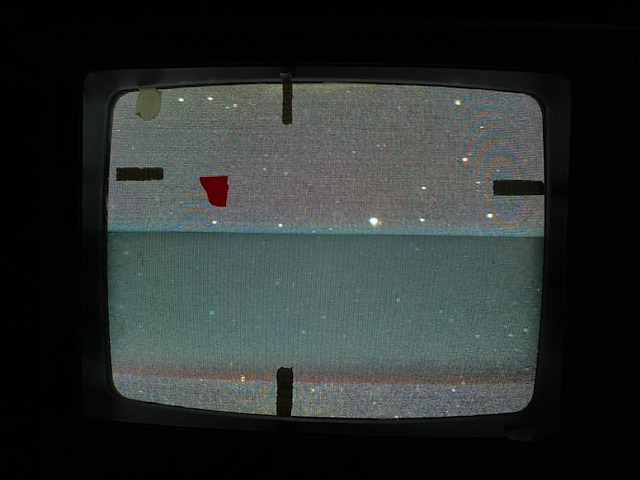
When the target is centered, the finder TV shows this field:
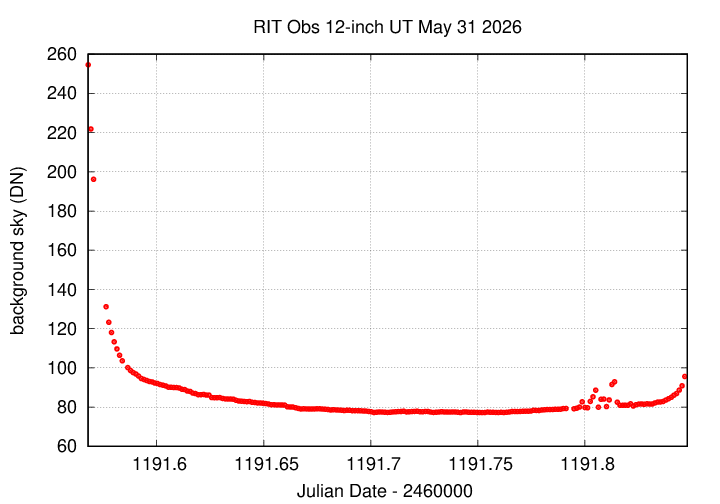
Here's the sky background over the course of the run. Note light clouds near the end of the run.
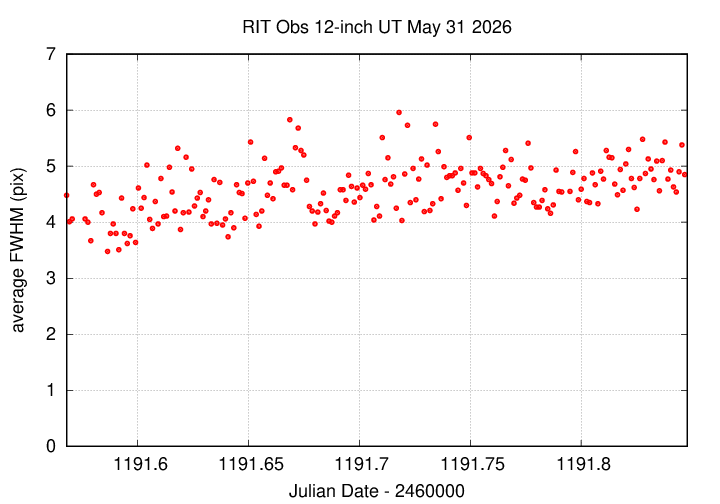
The FWHM shows a gradual increase the temperature dropped.
The graph below shows changes in the photometric zeropoint of an ensemble solution of the instrumental magnitudes over the course of the run.
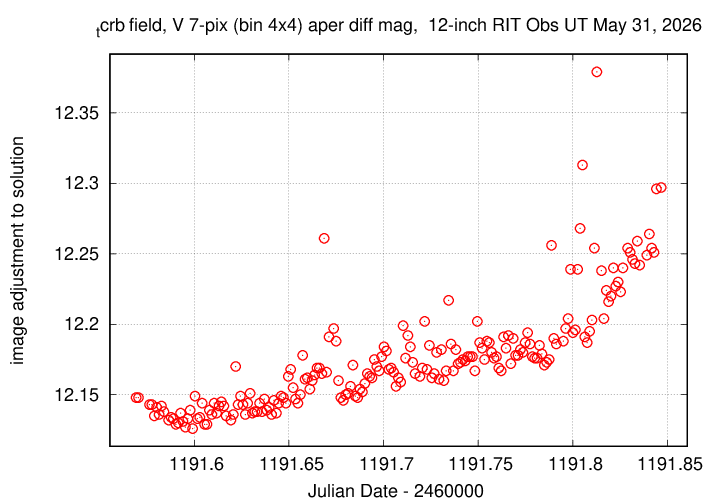
Using aperture photometry with a radius of 7 pixels in V filter (binned 4x4, each pixel is 1.036 arcsec, so a radius of 7.3 arcsec), and 7 pixels in B filter (binned 4x4, each pixel is 1.036 arcsec, so a radius of 7.3 arcsec), I measured the instrumental magnitudes of a number of reference stars and the target. Following the procedures outlined by Kent Honeycutt's article on inhomogeneous ensemble photometry, I used all stars available in each image to define a reference frame, and measured each star against this frame.
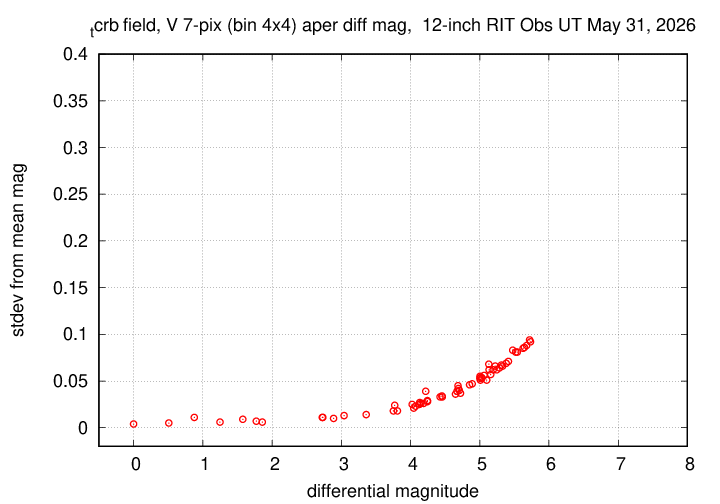
Sigma-vs-mag plots show that the floor in V-band was about 0.005 mag in V, which is good. It was 0.005 in B, which is also good.
The measurements show that the target is still in quiescent phase.
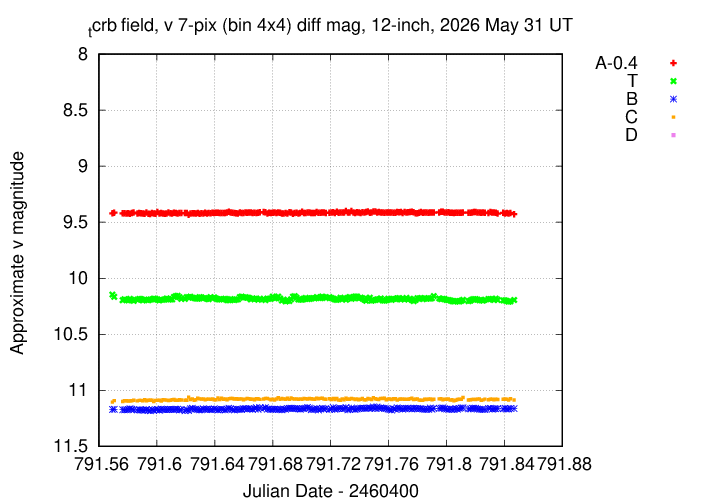
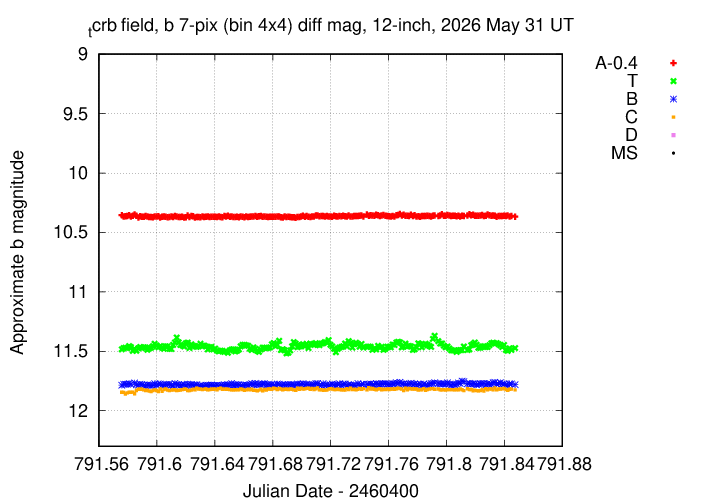
I've submitted these measurements to the AAVSO.