On the night of May 29/30, 2026, under good conditions (but only for a brief time, between clouds) I acquired images of the recurrent nova T CrB. This star undergoes outbursts at long intervals of 80 years or so. Its next outburst is predicted to occur soon (but then again, it was also predicted to occur during 2024), and so I've joined the crowd who are monitoring it.
The star is still quiescent.
This recurrent nova brightens by about 8 magnitudes (!), from V = 10 to about V = 2, around every 80 years. Will we see another outburst THIS summer?
These observations involved:
Notes from the night:
I tried to modify the polar axis setting of the telescope slightly: after loosening the bolts holding it in place, I turned the knob by about 1/9 revolution CW, then tightened the bolts. It was hard to see any change in the position of the marker on the latitude scale. During the night, the guide star drifted in the same sense that it had the previous night (tel pointing East, star drifts North; tel pointing West, star drifts South), so I may need to make a larger adjustment.
The size of the guider box is 128 x 128 pixels, so my estimate of the rate from last night needs to be doubled.
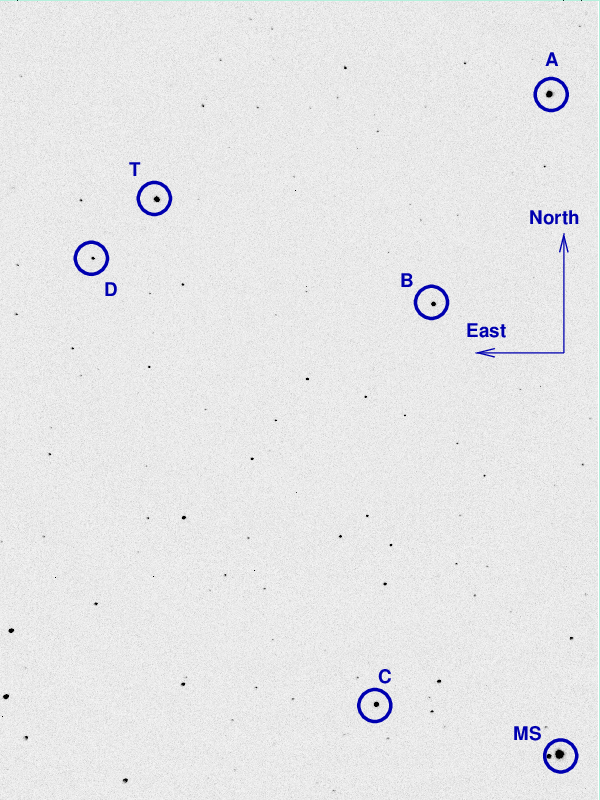
The picture below shows a cropped image of the field of T CrB from Jun 14/15, 2024. The field of view is about 20 arcminutes across.
I've marked the location of several comparison stars, with magnitudes and names taken from the AAVSO's table X40237AAS. Note that the magnitudes listed for stars "A" and "B" have changed from the ones I listed in last year's notes.
  star       name                  B          V
------------------------------------------------------
      A     000-BJS-901         11.096     10.554
      B     000-BBW-805         11.779     11.166
      C     000-BPC-198         13.049     12.336
--------------------------------------------------------------------------
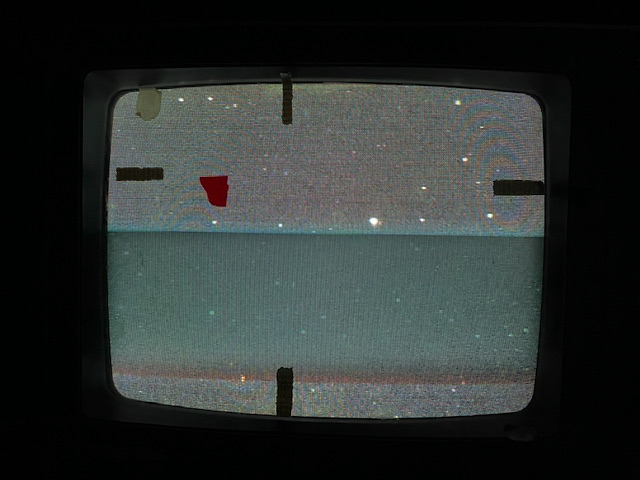
When the target is centered, the finder TV shows this field:
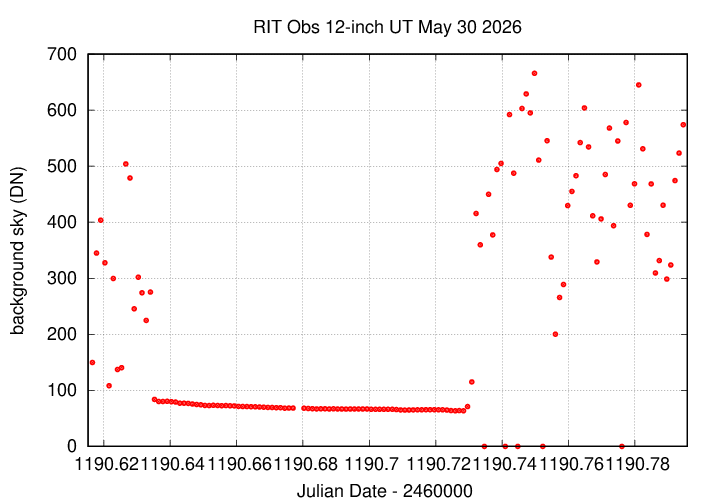
Here's the sky background over the course of the run. Note the clouds early and late.
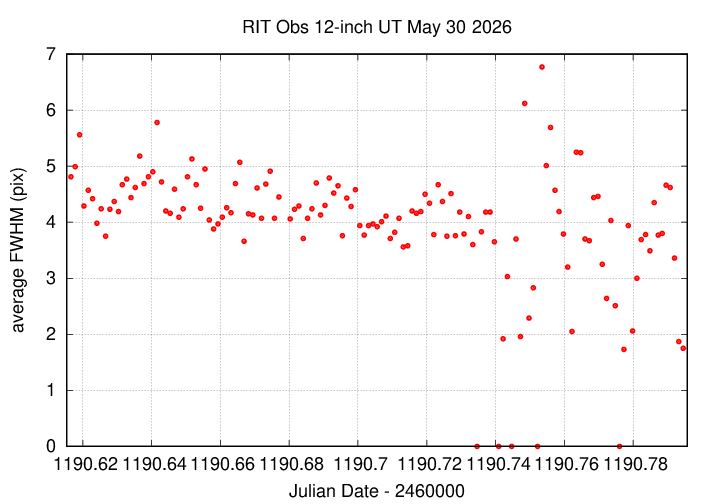
The FWHM show a small dip when I refocused.
The graph below shows changes in the photometric zeropoint of an ensemble solution of the instrumental magnitudes over the course of the run.
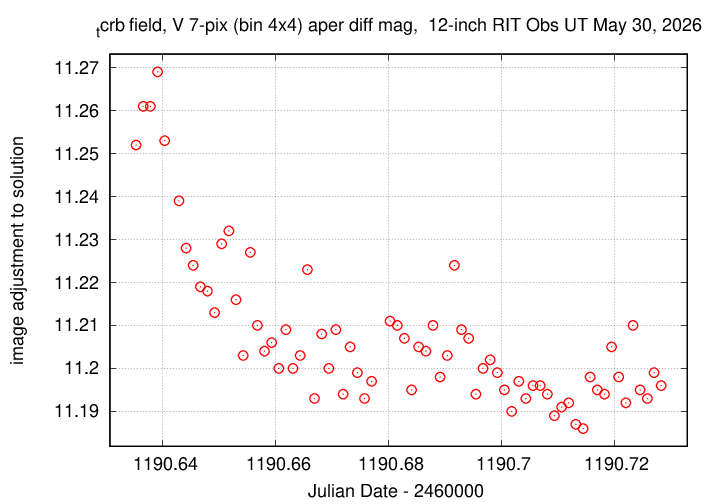
Using aperture photometry with a radius of 10 pixels in V filter (binned 4x4, each pixel is 1.036 arcsec, so a radius of 10.4 arcsec), and 7 pixels in B filter (binned 4x4, each pixel is 1.036 arcsec, so a radius of 10.4 arcsec), I measured the instrumental magnitudes of a number of reference stars and the target. Following the procedures outlined by Kent Honeycutt's article on inhomogeneous ensemble photometry, I used all stars available in each image to define a reference frame, and measured each star against this frame.
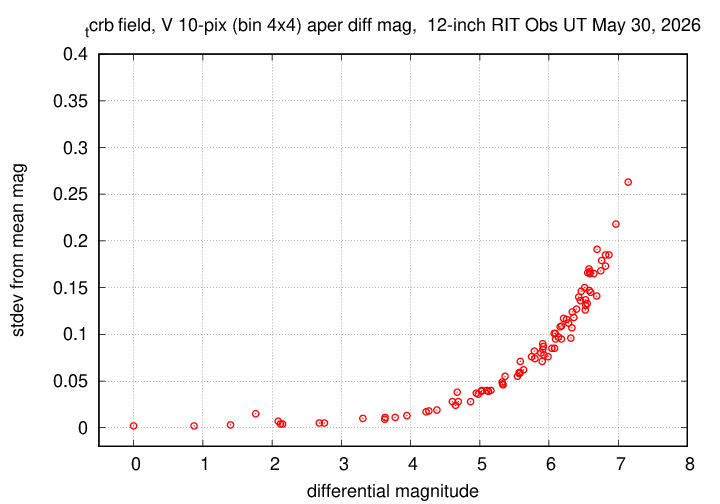
Sigma-vs-mag plots show that the floor in V-band was about 0.004 mag in V, which is pretty good. It was 0.003 in B, which is unusually good. This smaller-than-usual scatter is probably due to the short duration of the run, which means a smaller range of airmasses.
The measurements show that the target is still in quiescent phase.
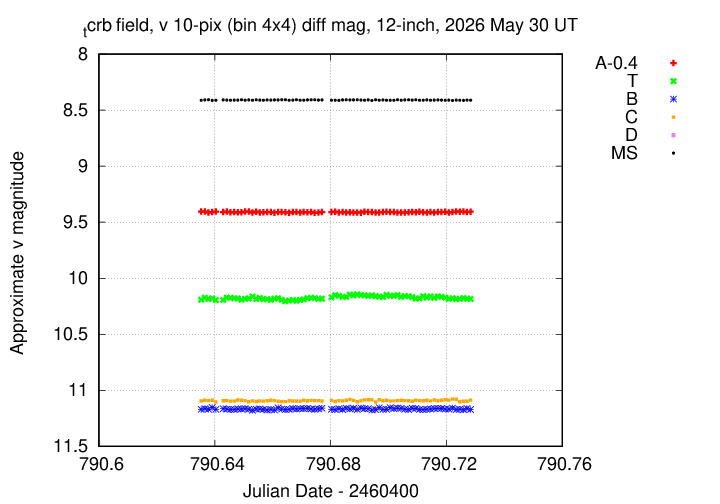
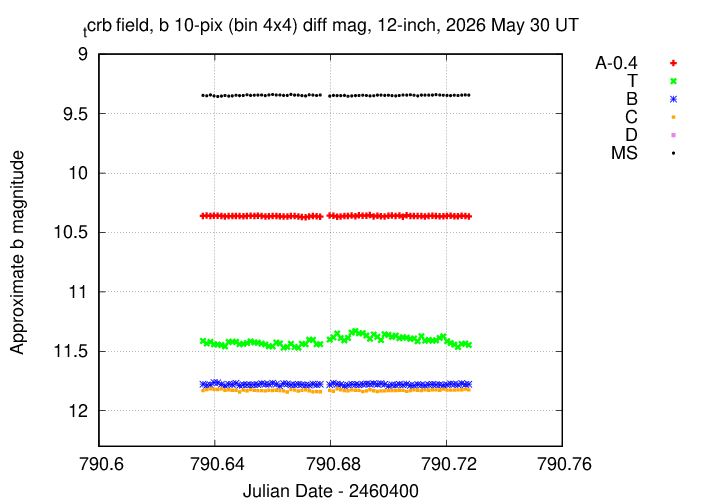
I've submitted these measurements to the AAVSO.