On the night of May 28/29, 2026, under fair-to-very-good conditions, I acquired images of the recurrent nova T CrB. This star undergoes outbursts at long intervals of 80 years or so. Its next outburst is predicted to occur soon (but then again, it was also predicted to occur during 2024), and so I've joined the crowd who are monitoring it.
The star is still quiescent.
The text below discusses the change of focus with temperature, and possible polar axis misalignment.
This recurrent nova brightens by about 8 magnitudes (!), from V = 10 to about V = 2, around every 80 years. Will we see another outburst THIS summer?
These observations involved:
However, measurements made in 2020 and 2021 with the old, ATIK 11000 camera, indicate that the change in focus was in the OTHER direction: values would increase as the temperature dropped. That suggests that expansion and contraction of material with the camera dominates over changes in the length of the telescope tube. Or, perhaps, that something in the electric focuser was reversed when we changed cameras. Hmmm.
Notes from the night:
One more note, on the polar alignment of the 12-inch. Over the course of the run, the target rose from low in the East, went nearly overhead, then set low in the West. Our guider is set to make corrections only in RA, since the Dec motor has significant backlash. I noted the following trends:
The size of these drifts was small: the guide star would approach the vertical limits of its box over the course of around 2 hours. Very roughly (assuming the size of the guide box is 64 x 64 pixels), this means a rate of around 4 arcsec per hour.
These drifts indicate that the polar axis of the 12-inch is slightly misaligned, in the sense that the north end of the polar axis is pointing too high. If I wish, I could try to adjust it, turning the appropriate knob in order to lower the north end slightly. I'll consider that for some future night.
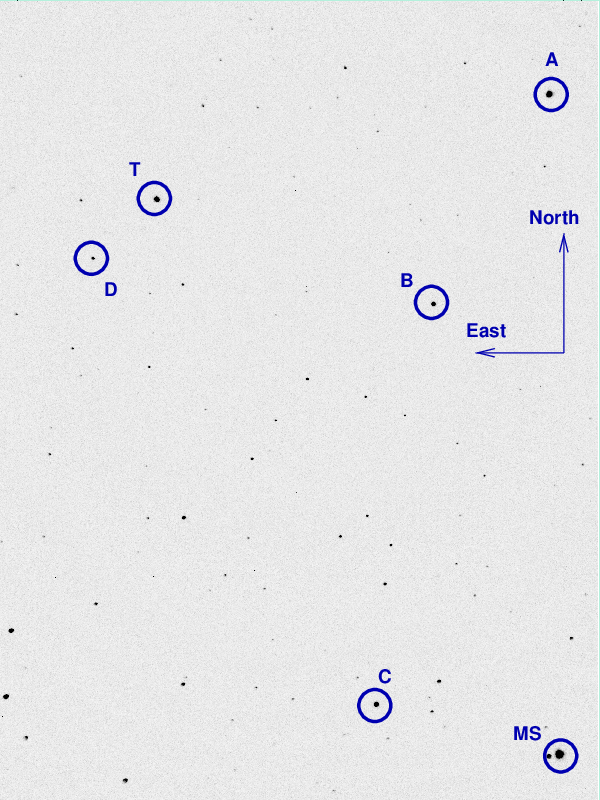
The picture below shows a cropped image of the field of T CrB from Jun 14/15, 2024. The field of view is about 20 arcminutes across.
I've marked the location of several comparison stars, with magnitudes and names taken from the AAVSO's table X40237AAS. Note that the magnitudes listed for stars "A" and "B" have changed from the ones I listed in last year's notes.
  star       name                  B          V
------------------------------------------------------
      A     000-BJS-901         11.096     10.554
      B     000-BBW-805         11.779     11.166
      C     000-BPC-198         13.049     12.336
--------------------------------------------------------------------------
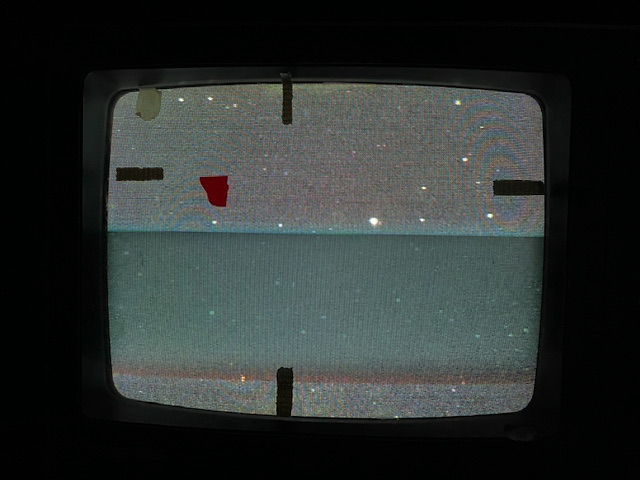
When the target is centered, the finder TV shows this field:
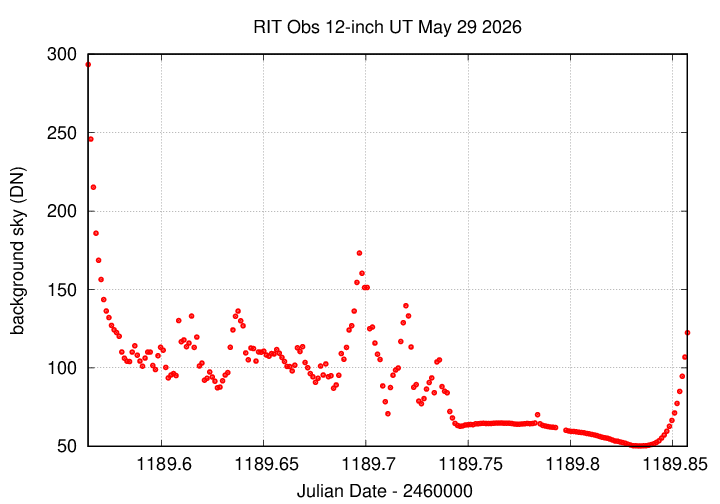
Here's the sky background over the course of the run. Note the bumpy values over the first 2/3 of the night, due to variations in cloud thickness.
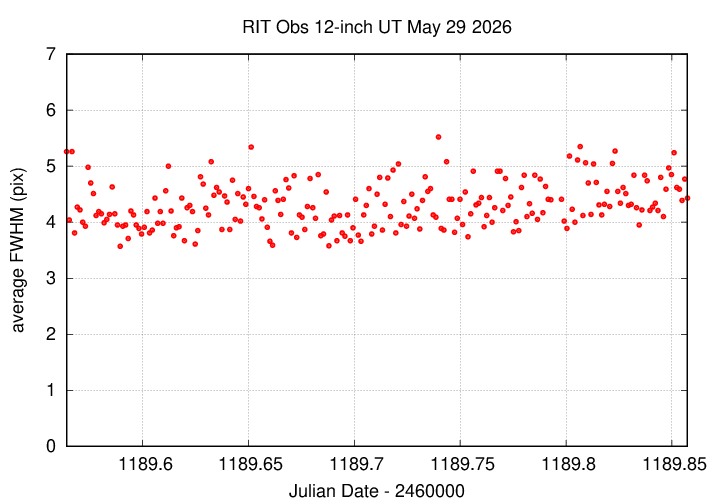
The FWHM increased a bit during the night.
The graph below shows changes in the photometric zeropoint of an ensemble solution of the instrumental magnitudes over the course of the run.
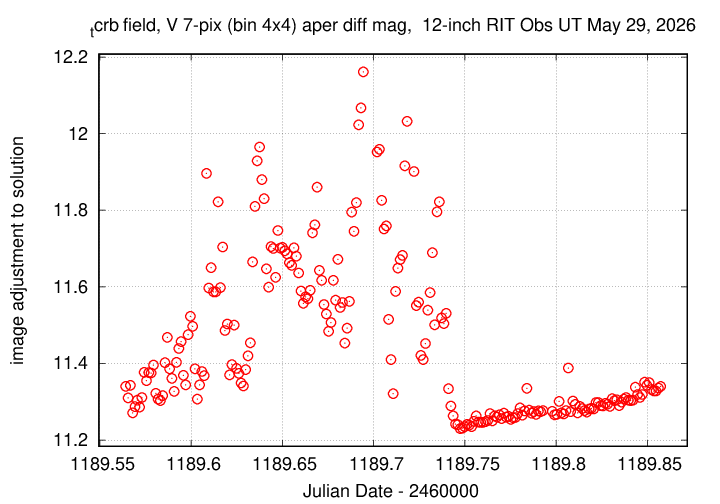
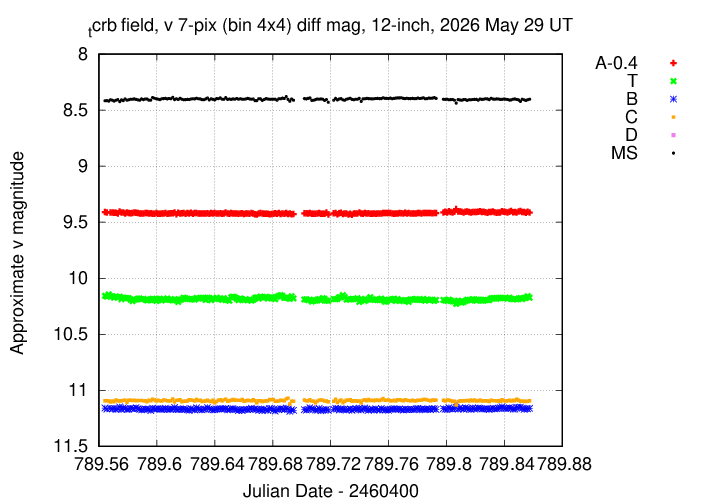
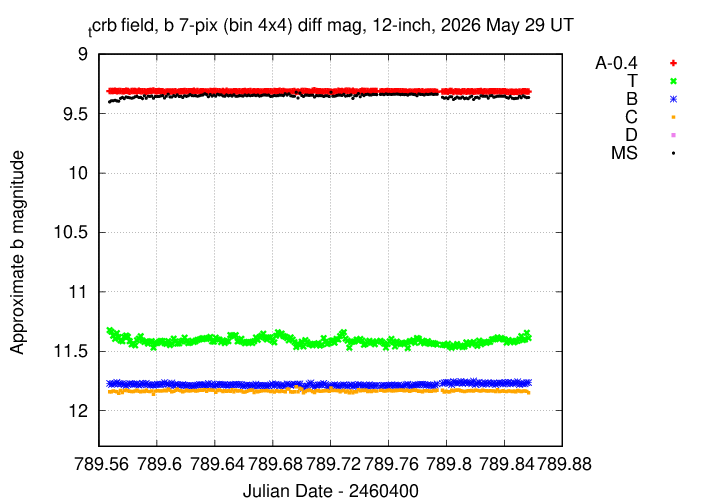
Using aperture photometry with a radius of 7 pixels in V filter (binned 4x4, each pixel is 1.036 arcsec, so a radius of 7.3 arcsec), and 7 pixels in B filter (binned 4x4, each pixel is 1.036 arcsec, so a radius of 7.3 arcsec), I measured the instrumental magnitudes of a number of reference stars and the target. Following the procedures outlined by Kent Honeycutt's article on inhomogeneous ensemble photometry, I used all stars available in each image to define a reference frame, and measured each star against this frame.
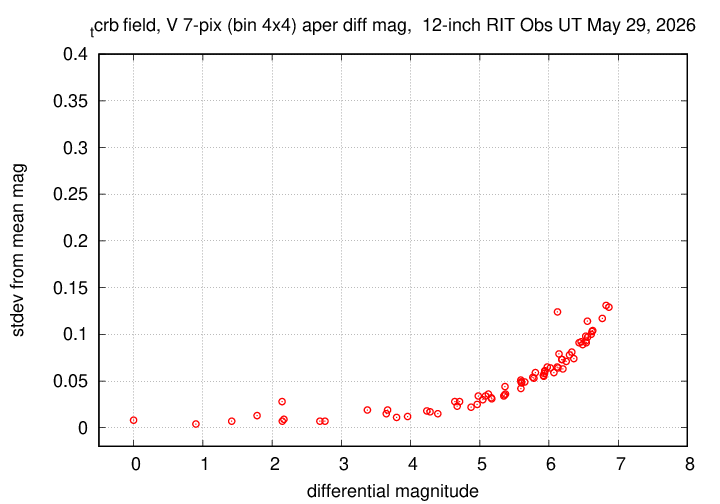
Sigma-vs-mag plots show that the floor in V-band was about 0.007 mag in V, which is so-so. It was 0.006 in B.
The measurements show that the target is still in quiescent phase.
I've submitted these measurements to the AAVSO.