On the night of May 02/03, 2026, under good conditions, I attempted to record an occultation of the star UCAC4 391-097136 by the asteroid (282) Clorinde. I also performed photometry of the recurrent nova T CrB for the first time in 2026.
You can find detailed information on this event in
The RIT Observatory was inside the predicted shadow path, but close to its eastern edge. Would we succeed in seeing the asteroid block the star's light? The target star was pretty faint -- V = 14.8, R = 13.8 -- so I had to use a relatively long exposure time to acquire a decent signal-to-noise ratio. Since the prediction for maximum duration of the event was also long (13.8 seconds), I decided to exposure for 4 seconds; that ought to provide several measurements during the dip.
These observations involved:
I decided to use the ASICap program to capture images, as I have done for other occultation events. I didn't know ahead of time that I'd be using such long exposures; had I known, I probably would have chosen MaximDL, with which I'm more familiar.
Notes from the night:
The target star, UCAC4 391-097136, has approximate magnitude V = 14.8 and is located at
RA = 18:40:52.73 Dec = -11:52:46.7 (J2000)
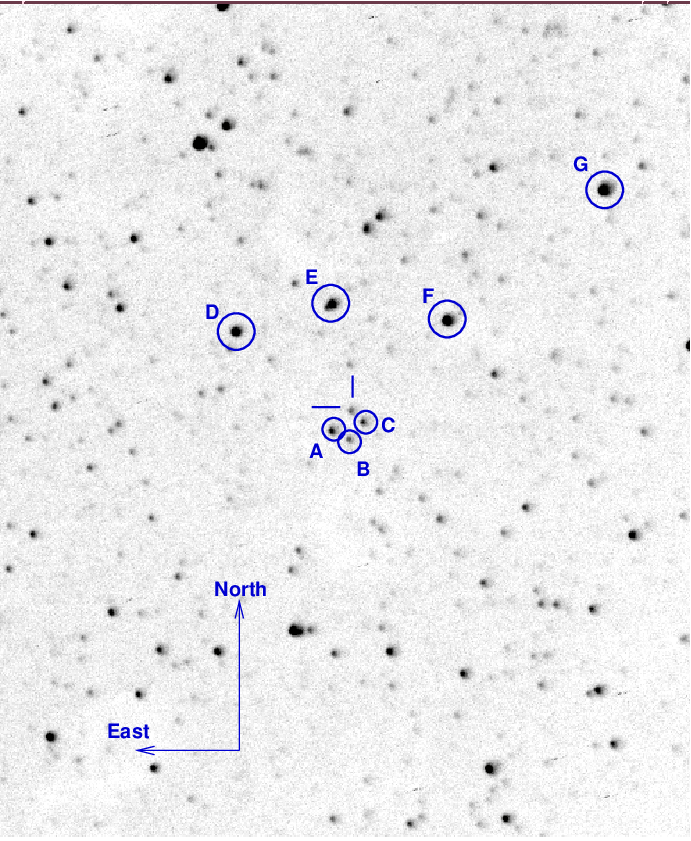
A chart of the field is shown below, based on the entire stack of 75 images I took. North is up, East to the left. The size of the chart is about 10 x 10 arcminutes.
The target is indicated by crosshairs. It lies at the Northern end of a little "diamond" shape of stars of similar brightness. Those other stars, "A", "B", and "C", will serve as useful indicators of the typical uncertainty in photometric measurements of the target.
I meant to acquire images in 4x4 binned mode, as I usually do. However, after setting the camera up well in advance in this mode, I discovered about twenty minutes before the event that the camera had lost connection with the computer. I had to scramble to re-connect to the camera, and set up all the parameters all over again, choosing a sub-frame and exposure time that showed some hint of the target stars. As a result, I accidently left the camera in un-binned mode, so that the plate scale was about 0.25 arcsec per pixel. When I realized that was the case, it was too close to the time of the event to fix the problem.
So, the raw FITS images are very over-sampled; the stellar PSF is around 3-4 arcsec, equivalent to 12-15 pixels.
During the interval
  start:  frame index 0     local time 03:00:28

  end:    frame index 75               03:07:04
I acquired images with 4-second exposure times. There was a gap of about 1.2 seconds between exposures while the camera was reading out. Establishing the time of each exposure was difficult. The time written into the FITS headers was slightly after the end of each exposure, apparently. I used a GPS-calibrated flash application on my iPhone to produce brief (0.1-0.5 second) flashes of light while holding the phone up to the telescope's aperture. I was able to detect several of them over the course of the recording, but they provide only a very coarse estimate of the time of mid-exposure. After some work, I decided that the best I could was to use the formula
UT of mid-exposure = (DATE-OBS recorded in FITS header) - 4 seconds
with an uncertainty of about +/- 3 seconds. Ugh. Since I (spoiler) didn't detect any occultation, the lack of a good time base doesn't really matter.
I used two independent techniques to search for the dimming of the target star:
In both cases, I used the bright stars "D", "E", "F", and "G" as photometric references (and many other stars, too, in the case of XVista); the faint neighbors "A", "B", and "C" served to indicate the typical scatter in measurements of the target star.
Spoiler: neither method showed any significant dip in the light of the target star near the predicted time of the event.
Let me show results from AstroImageJ first. I adopted an aperture size of 17 pixels = 4.3 arcseconds, with sky annulus radii of 35 and 60 pixels = 8.8 and 15 arcseconds, respectively.
I'll begin with photometry of the neighboring star "A". In the light curve below, all measurements have been normalized to the average value over the course of the run, so every star's symbols cluster around 1.0. The reference stars are shown as point symbols, and star "A" with a line connecting its measurements (which are labelled "T5" in the key).
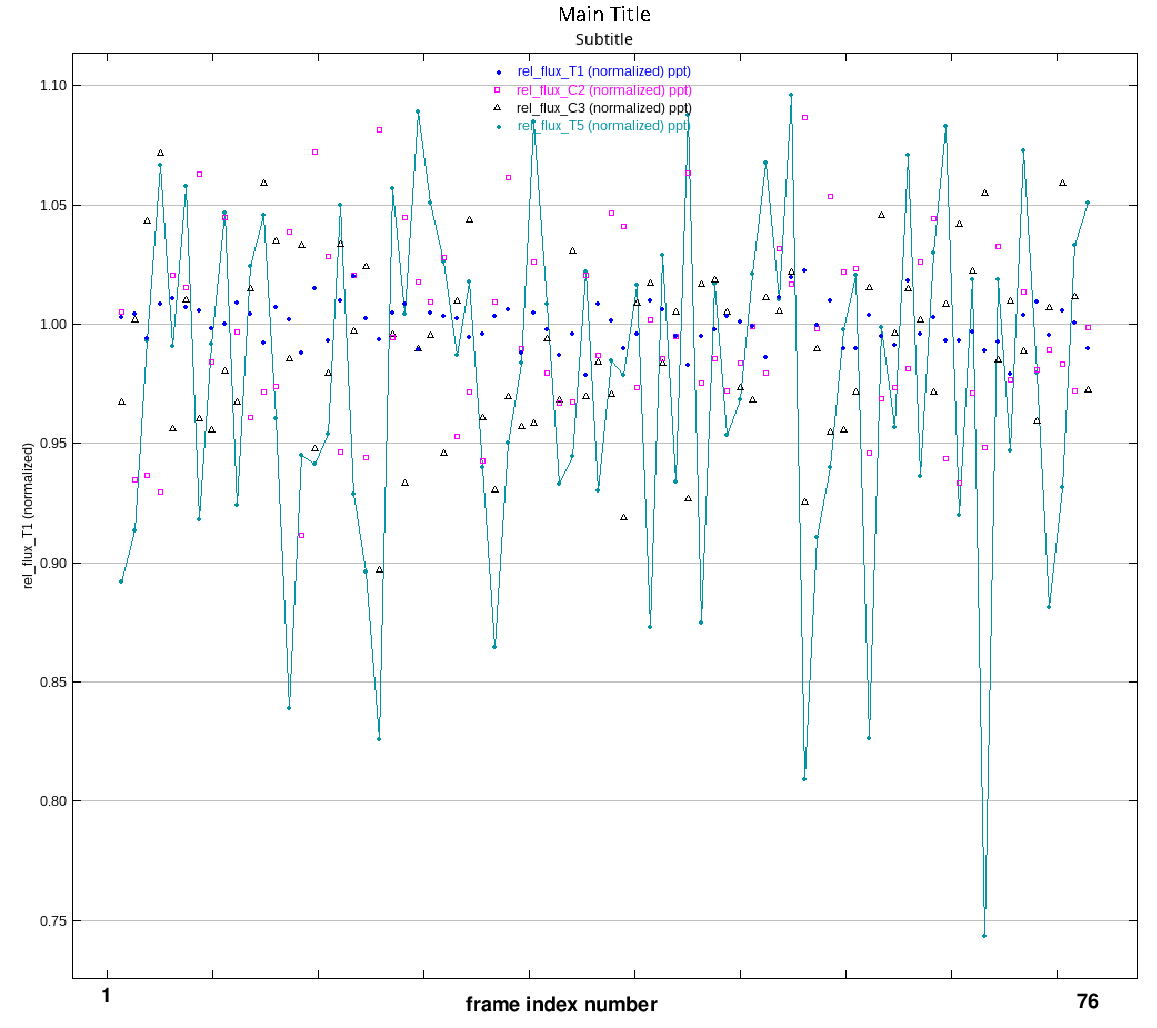
The standard deviation of these measurements is about 7 percent, but there are a number of outliers reaching to double that. This star should be constant in brightness throughout the measurements, so it gives us an idea for what to expect from the (slightly fainter) target star.
And here are the measurements of the target star; again, the reference stars are point symbols, and the target's measurements are connected by lines (and labelled "T8" in the key).
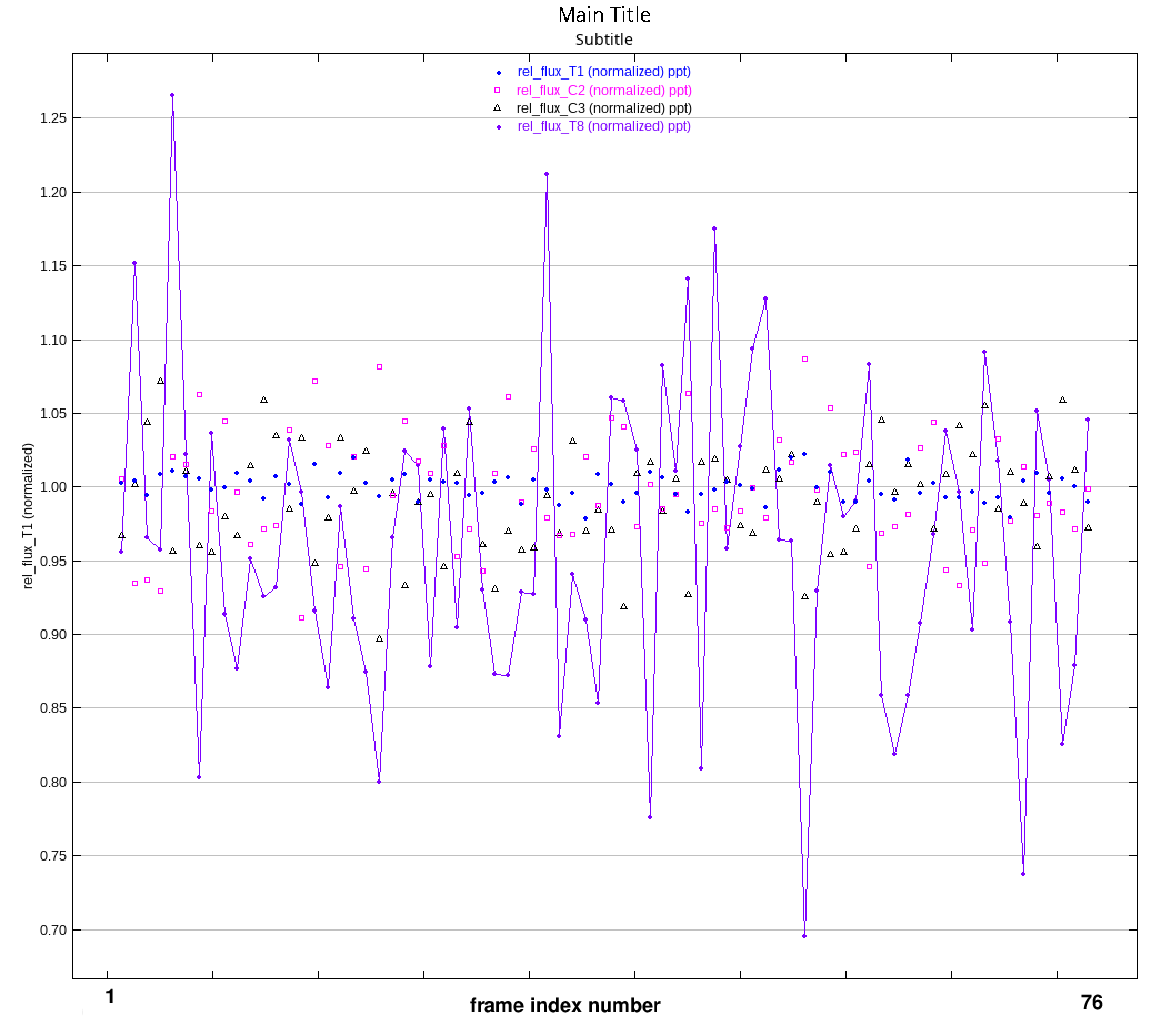
These values are a bit noisier than those of star A (standard deviation about 11 percent). The occultation should have occurred between frames 17 and 21, with the combined light dropping by 1.2 mag; that corresponds to an intensity of roughly 33 percent of the normal value. There is no sign of any such decrease in these measurements.
I performed a second analysis using my own software. In this case, I binned the data 4x4 at the start, which made it much easier to see the fainter stars.
I began with a regular run of aperture photometry, but discovered that, with the thresholds I'd chosen, the target star was very occasionally not detected automatically (though the other neighboring stars were). Rather than fiddle with the thresholds, I decided to perform forced photometry: I measured the offset of the target from the bright star "D" in a stacked median image, then placed an aperture at this fixed offset from "D" in each of the individual images.
I used circular apertures of radius 5 binned pixels = 5.2 arcsec to measure the light from each star detected in the image (plus the forced position of the target); there were typically 50-70 stars per image. Following the procedures outlined by Kent Honeycutt's article on inhomogeneous ensemble photometry, I used all stars available in each image to define a reference frame, and measured each star against this frame. The ensemble photometry yielded estimates of the frame-to-frame scatter in each star's magnitude:
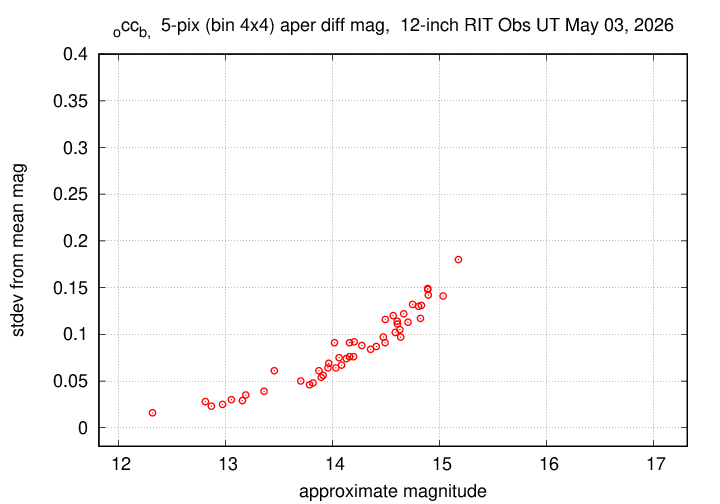
At the brightness of the target (V = 14.8), the uncertainty in each measurement is roughly 0.12 mag. Detecting a drop of 1.2 magnitudes should be very easy. The graph below shows the ensemble magnitudes of several bright stars, the three neighbors "A", "B", "C", and the target, labelled "occ" and given large green symbols.
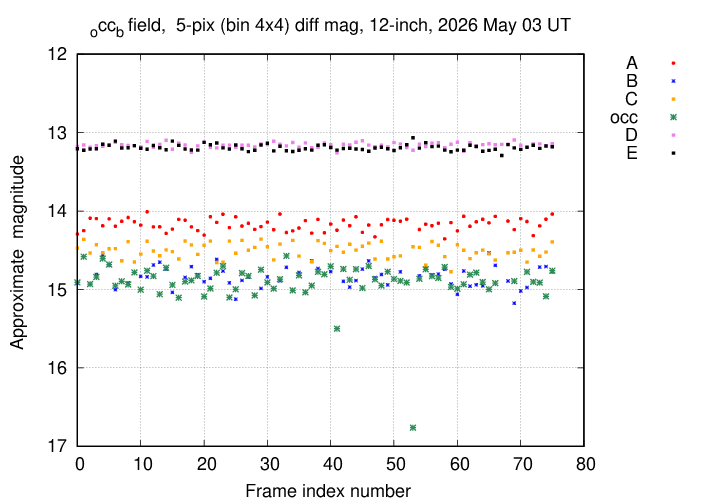
The target does have a couple of very faint measurements -- but they are isolated from each other and very distant from the expected time of the occultation. I suspect there are some bad pixels in those two images. At the time of the event -- frames 17 to 21 -- there is no hint of a systematic decrease in the brightness of the target.
In summary, I did observe the target star during the predicted time of occultation, and measured its brightness well enough to detect the predicted dip easily; but I saw no dip at all. In short, this event was a MISS from my location.
I've reported this miss to the International Occultation Timing Association using the
This recurrent nova brightens by about 8 magnitudes (!), from V = 10 to about V = 2, around every 80 years. Will we (finally) see another outburst THIS summer?
These observations involved:
Notes from the night:
The picture below shows a cropped image of the field of T CrB from Jun 14/15, 2024. The field of view is about 20 arcminutes across.
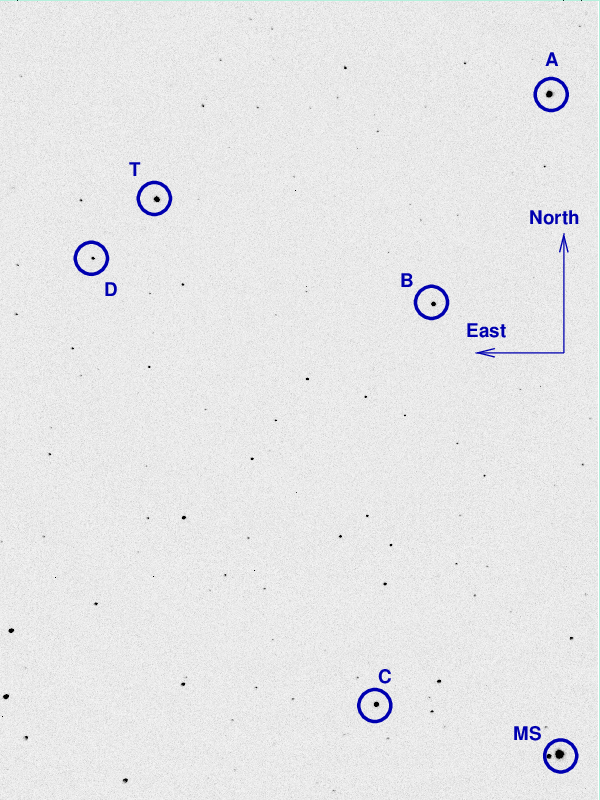
I've marked the location of several comparison stars, with magnitudes and names taken from the AAVSO's table X40237AAS. Note that the magnitudes listed for stars "A" and "B" have changed from the ones I listed in last year's notes.
  star       name                  B          V
------------------------------------------------------
      A     000-BJS-901         11.096     10.554
      B     000-BBW-805         11.779     11.166
      C     000-BPC-198         13.049     12.336
--------------------------------------------------------------------------
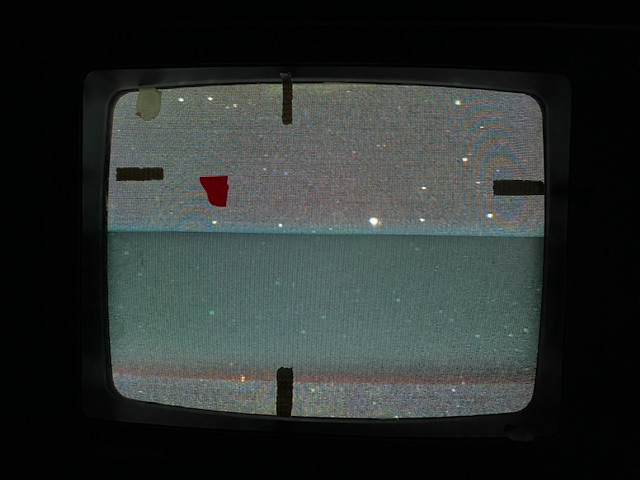
When the target is centered, the finder TV shows this field:
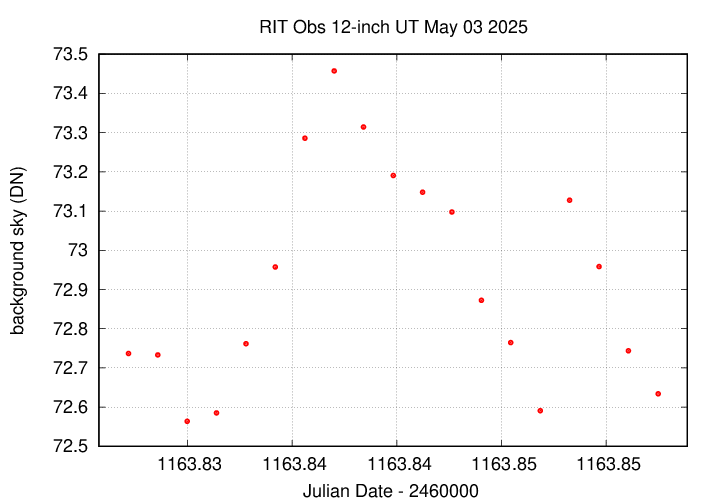
Here's the sky background over the course of the run. No big changes.
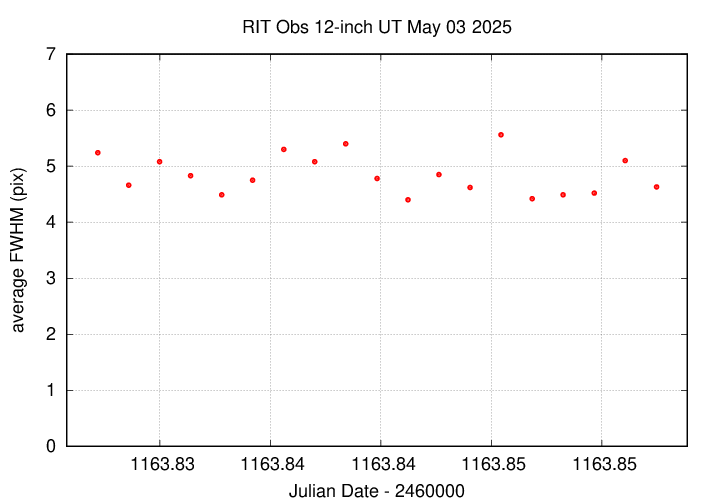
The FWHM was pretty steady.
The graph below shows changes in the photometric zeropoint of an ensemble solution of the instrumental magnitudes over the course of the run.
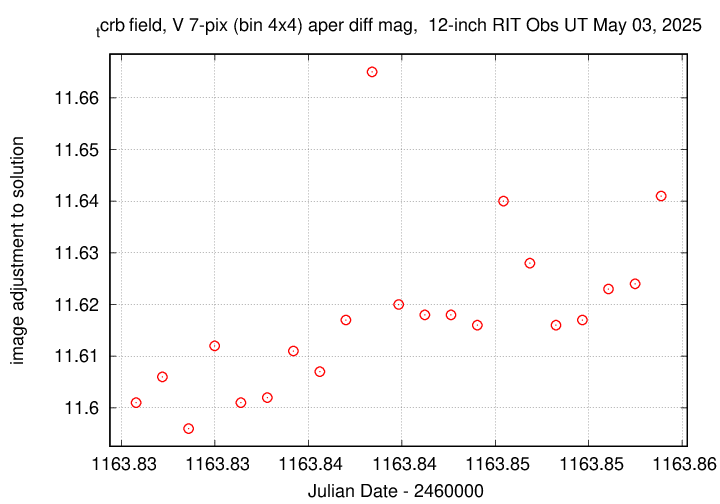
Using aperture photometry with a radius of 7 pixels in V filter (binned 4x4, each pixel is 1.036 arcsec, so a radius of 7.3 arcsec), and 7 pixels in B filter (binned 4x4, each pixel is 1.036 arcsec, so a radius of 7.3 arcsec), I measured the instrumental magnitudes of a number of reference stars and the target. Following the procedures outlined by Kent Honeycutt's article on inhomogeneous ensemble photometry, I used all stars available in each image to define a reference frame, and measured each star against this frame.
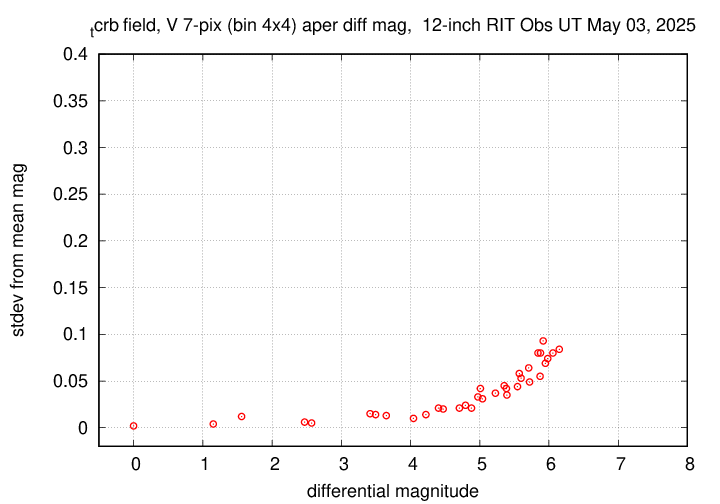
Sigma-vs-mag plots show that the floor in V-band was about 0.004 mag in V; it was 0.006 in B.
The measurements show that the target is still in quiescent phase.
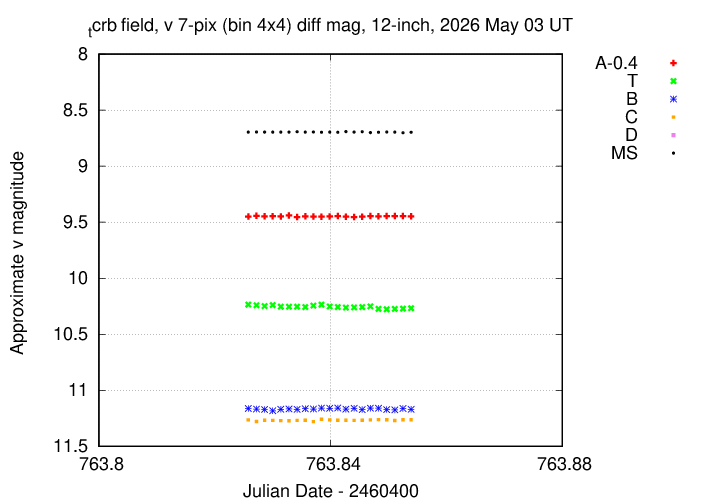
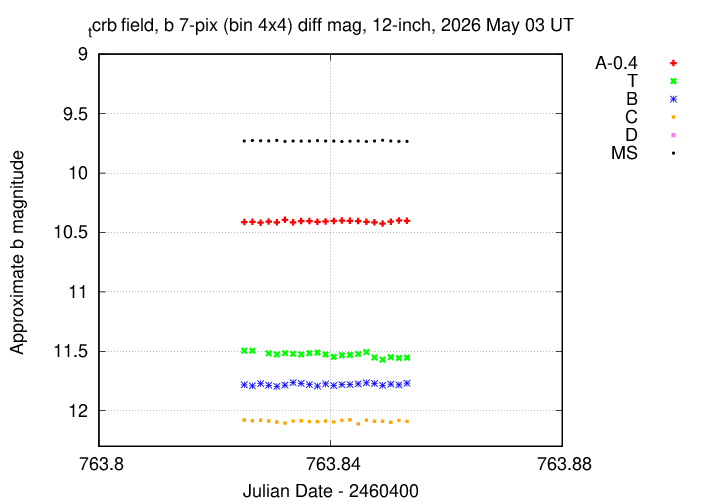
I've submitted these measurements to the AAVSO.