On the night of Jun 01/02, 2026, under very good conditions, I acquired images of the recurrent nova T CrB. This star undergoes outbursts at long intervals of 80 years or so. Its next outburst is predicted to occur soon (but then again, it was also predicted to occur during 2024), and so I've joined the crowd who are monitoring it.
The star is still quiescent.
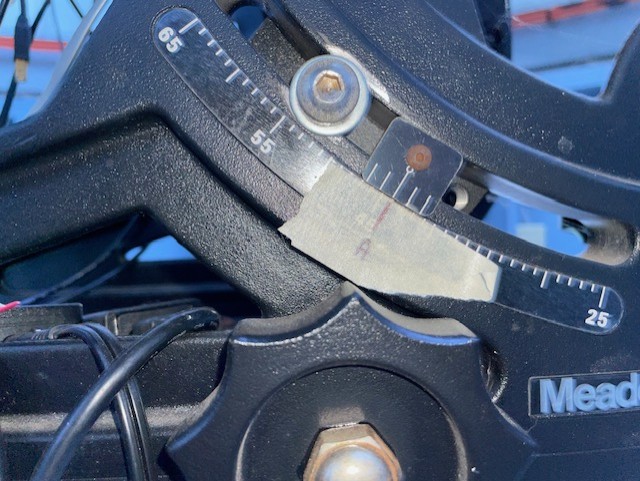
I found a good setting for the polar axis of the 12-inch. Hooray!
This recurrent nova brightens by about 8 magnitudes (!), from V = 10 to about V = 2, around every 80 years. Will we see another outburst THIS summer?
These observations involved:
Notes from the night:
After some adjustments to the polar axis setting, I found a location which allowed the guide star to sit basically motionless in its guidebox for over an hour. That's good enough for me.
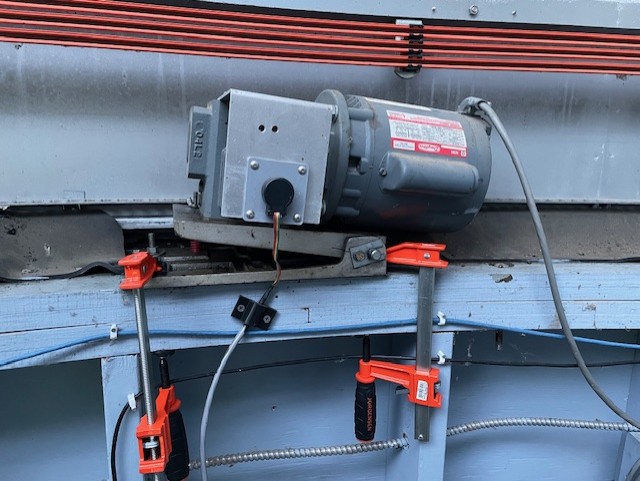
I noticed a "feature" of the dome rotation motor, which is mounted high on the top of the circular walls of the dome. When the motor is turned on in the "reverse" direction (so that the dome rotates CCW, opposite to sidereal motion in the southern sky), the base of the motor makes a sudden, short jump sideways; it sort of slides a bit away from the outer wall. I put a couple of clamps on the base of the motor, which has decreased the size of this jump -- but there is still some motion when the motor starts reversing. I think it's a good idea to run the motor only in the forward direction whenever possible, even if this means turning in a complete circle.
The picture below shows a cropped image of the field of T CrB from Jun 14/15, 2024. The field of view is about 20 arcminutes across.
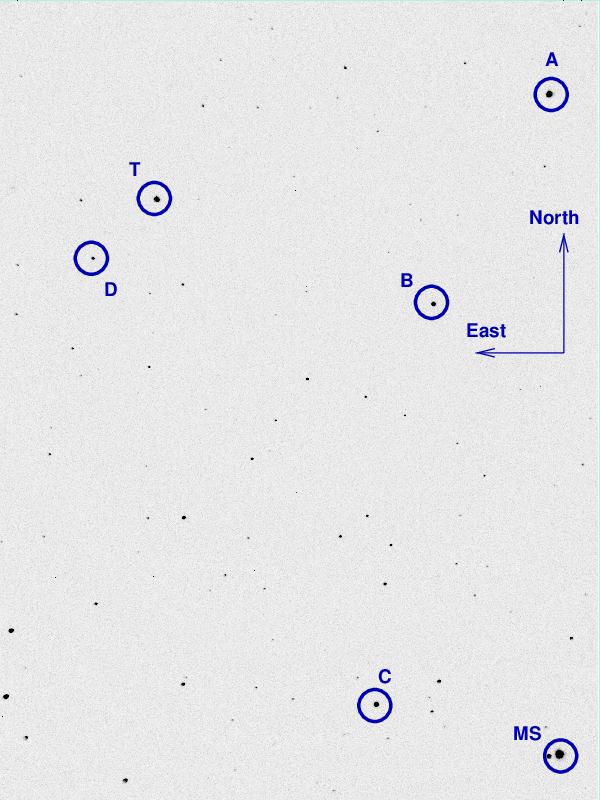
I've marked the location of several comparison stars, with magnitudes and names taken from the AAVSO's table X40237AAS. Note that the magnitudes listed for stars "A" and "B" have changed from the ones I listed in last year's notes.
  star       name                  B          V
------------------------------------------------------
      A     000-BJS-901         11.096     10.554
      B     000-BBW-805         11.779     11.166
      C     000-BPC-198         13.049     12.336
--------------------------------------------------------------------------
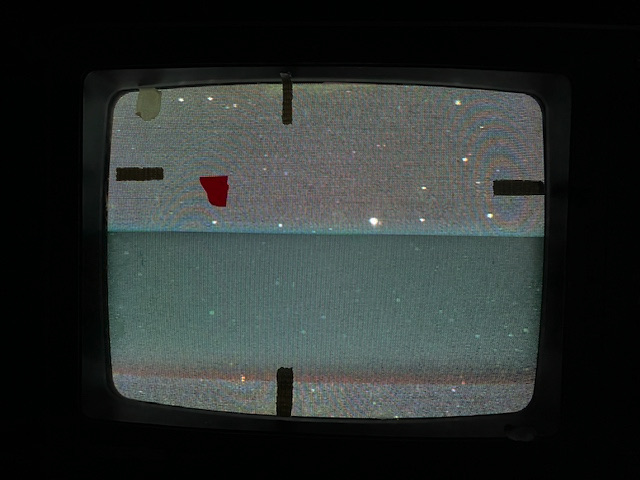
When the target is centered, the finder TV shows this field:
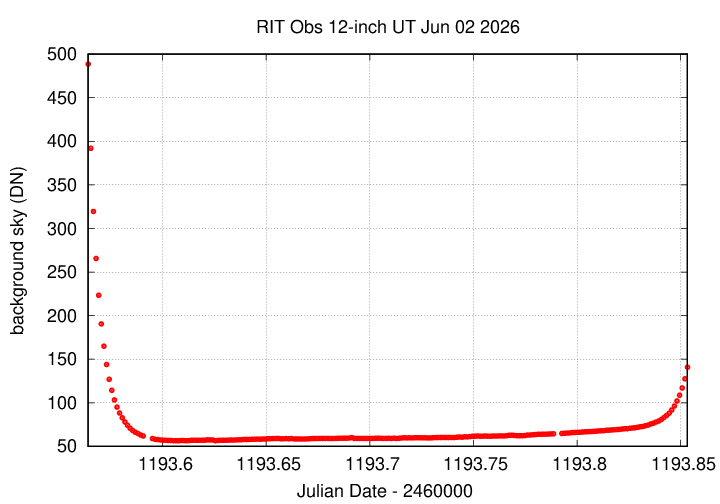
Here's the sky background over the course of the run. No sign of clouds at all.
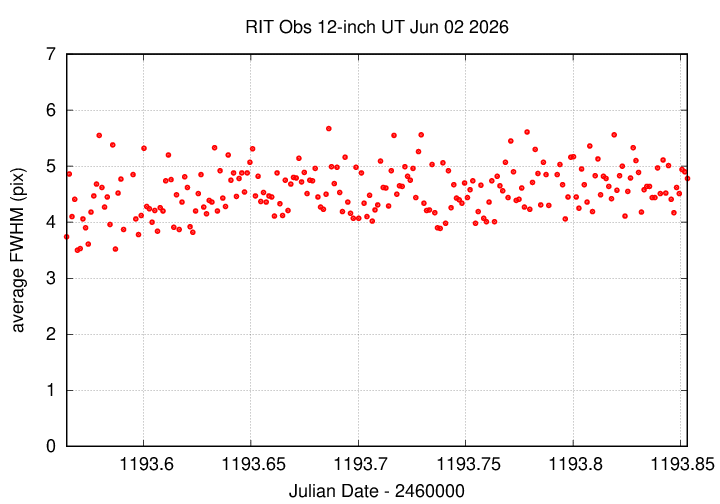
The FWHM shows a gradual increase the temperature dropped.
The graph below shows changes in the photometric zeropoint of an ensemble solution of the instrumental magnitudes over the course of the run. Very smooth, so no clouds.
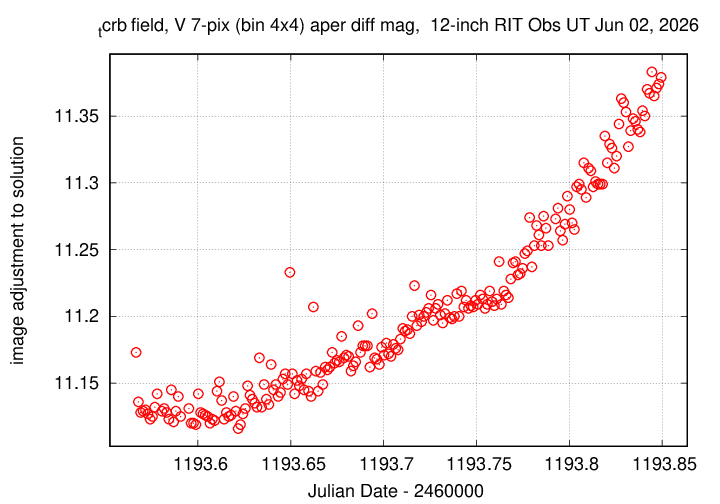
Using aperture photometry with a radius of 7 pixels in V filter (binned 4x4, each pixel is 1.036 arcsec, so a radius of 7.3 arcsec), and 7 pixels in B filter (binned 4x4, each pixel is 1.036 arcsec, so a radius of 7.3 arcsec), I measured the instrumental magnitudes of a number of reference stars and the target. Following the procedures outlined by Kent Honeycutt's article on inhomogeneous ensemble photometry, I used all stars available in each image to define a reference frame, and measured each star against this frame.
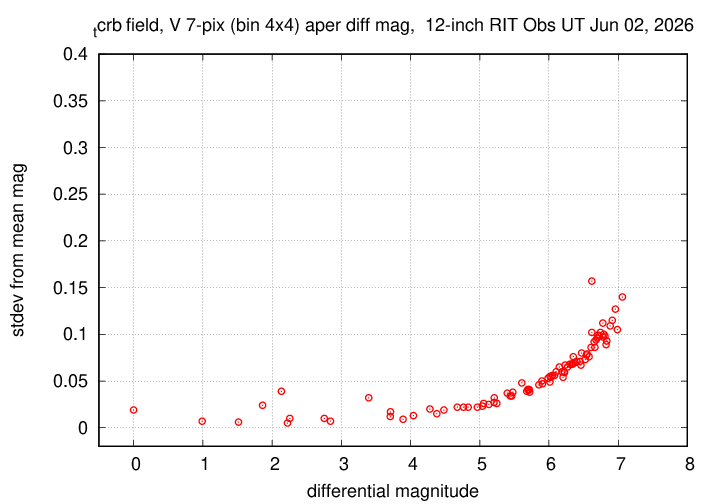
Sigma-vs-mag plots show that the floor in V-band was about 0.006 mag in V, which is good. It was 0.005 in B, which is also good.
The measurements show that the target is still in quiescent phase.
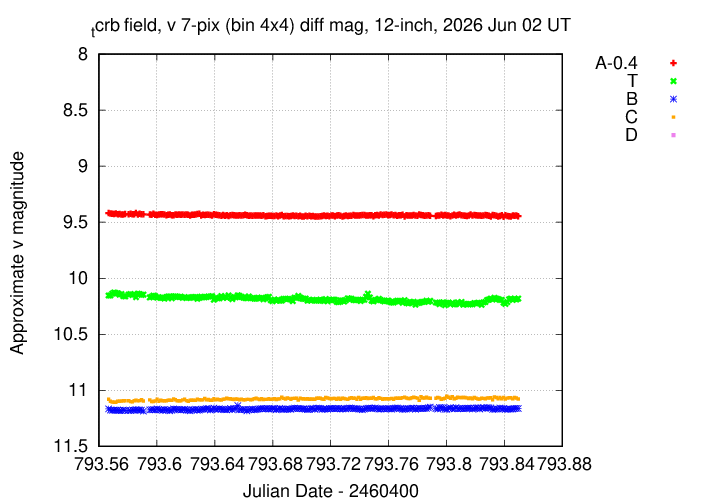
I noticed a small offset between my B-band measurements and those of AAVSO observer SSOA which grew near the end of my run -- which was the middle of his. That's undoubtedly due to color-dependent extinction as the field set as seen from Rochester; I don't try to correct for the effect. But we see the same short, sharp rises which occur several times in our common period of observations.
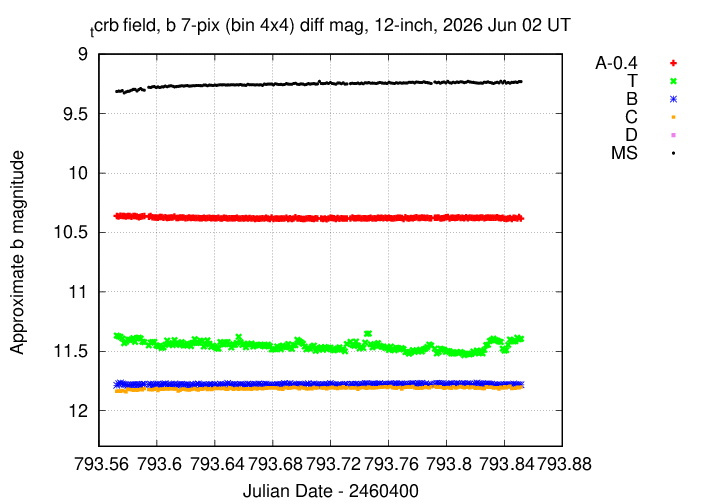
I've submitted these measurements to the AAVSO.