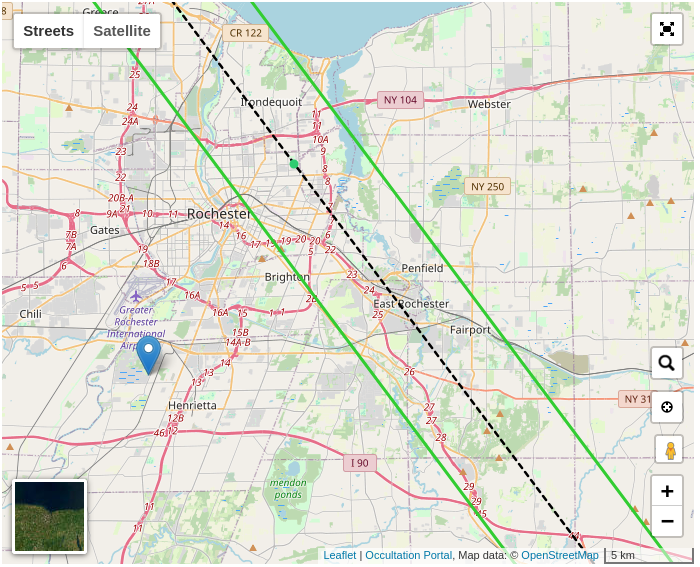
On the night of Feb 26/27, 2026, under decent conditions, I attempted to record an occultation of the star BD+04 1866 by the asteroid (19126) Ottohahn. You can find detailed information on this event in
The RIT Observatory was slightly outside the predicted shadow path, by about two path diameters ...
... but since the uncertainty in the location of the shadow was hundreds of kilometers, I figured it was worth a shot. Besides, it would allow me to test some of the equipment for the first time since last autumn.
These observations involved:
The MaximDL program can record sub-frames, rather than the full image, but it wasn't able to measure more than about 1 image per second, even if that image had a very short (0.1 sec) exposure time. Since this event was predicted to have a maximum duration of about 0.5 second, I needed to find a way to speed up the data collection. So, I switched to using ZWO's "ASICap" software package, which can record at rapid rates. This was my first time using it, so I'm pretty sure I made a number of less-than-optimal choices; for example, I wasn't able to figure out how to cool the camera, so it ran at about 8 Celsius during the measurements. As you'll see, there's quite a bit of noise in the images.
Notes from the night:
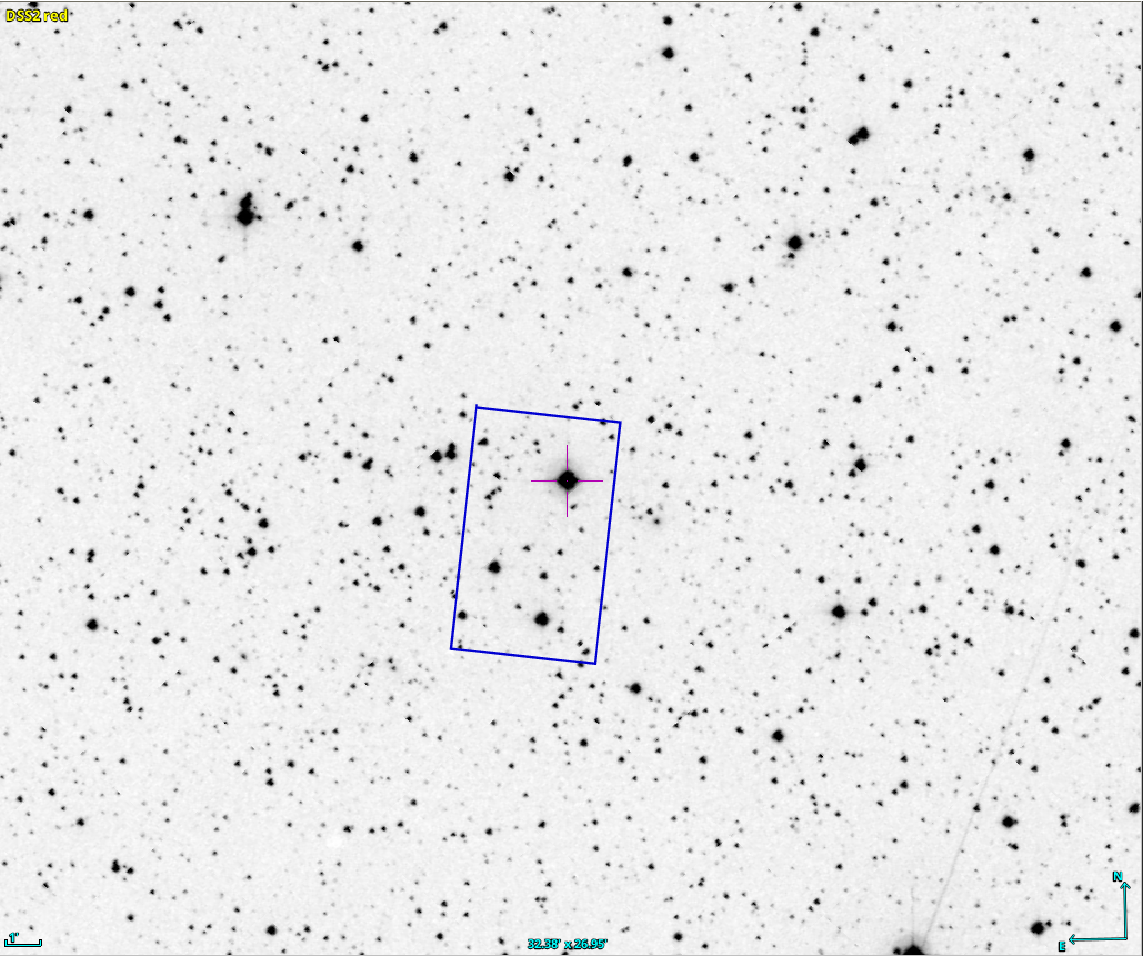
The target star, BD +04 1866, is at
RA = 07:58:36.5 Dec = +04:05:12 (J2000)
A chart of the field is shown below. The size of the chart is about 32 x 27 arcminutes. The target star is indicated by crosshairs. The blue rectangle shows roughly the area I chose for the recording.
For reasons I don't understand fully, the area captured by the camera is rotated roughly 90 degrees from the usual orientation. Here's an example of one of the frames. The target is the bright star at right, and the two fainter stars at left appear near the bottom of the blue box above. The orientation of this frame is roughly North right, East up.
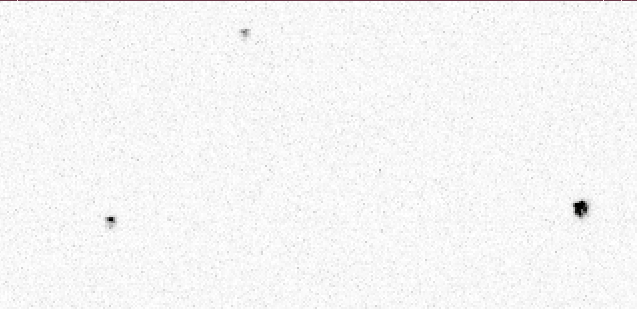
The FWHM of these images was about 4 pixels, but (as the image above shows), the focus wasn't great. I used an aperture of radius 10 pixels, with a sky annulus of radii 15 and 25 pixels, to measure instrumental magnitudes of the three stars.
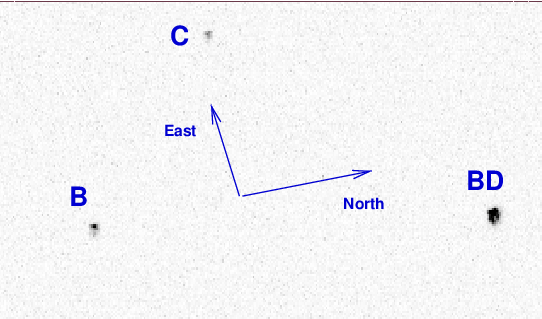
I measured these three stars over a period of about 5 minutes centered around the predicted time of occultation. According to ASICap, the local EST times of start and end were
StartCapture = 2026-02-26  23:35:26.341
EndCapture   = 2026-02-26  23:40:30.767
Using aperture photometry with a radius of 10 pixels, (binned 4x4, each pixel is 1.036 arcsec, so a radius of about 10 arcsec), I measured the instrumental magnitudes of the target and both reference stars. Following the procedures outlined by Kent Honeycutt's article on inhomogeneous ensemble photometry, I used all stars available in each image to define a reference frame, and measured each star against this frame. Yes, this does mean that I assumed the target had a constant brightness, but -- as you'll see -- it actually did.
The ensemble photometry yielded estimates of the frame-to-frame scatter in each star's magnitude:
  Star           mean_mag      stdev_mag
-------------------------------------------
 BD+04 1866       0.000           0.008
    B             1.399           0.076
    C             1.991           0.096
-------------------------------------------
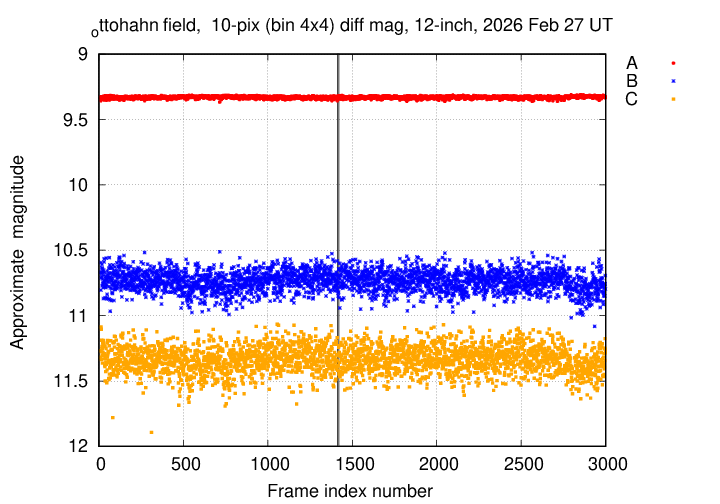
Here's the light curve for the three stars over the entire 5-minute recording. The small, similar variations in stars B and C are (very likely) due to some fluctuations in the measurements of the target star due to light clouds. For our purposes, they aren't important. The thin grey vertical bar indicates the predicted time of the event.
In order to determine the time of each frame precisely, I used an application called Astro Flash Timer for iPhone (which is now no longer supported, alas). I held the iPhone up in front of the telescope's aperture and triggered a brief (0.1 sec) flash of its LED. The time of that flash was determined using GPS signals received by the iPhone, so it should be accurate. I recorded two flashes, one before and one after the time of the event.
             time of flash             frame index
---------------------------------------------------
  Before:    23:37:11.149              0715.5

  After:     23:40:51.149              2883
---------------------------------------------------
The first flash showed up split between frames 0715 and 0716, while the second was contained entirely on frame 2883. Using these flashes, I could compute the average frame rate (9.85227 frames per second) and interpolate the time of any particular frame between the flashes.
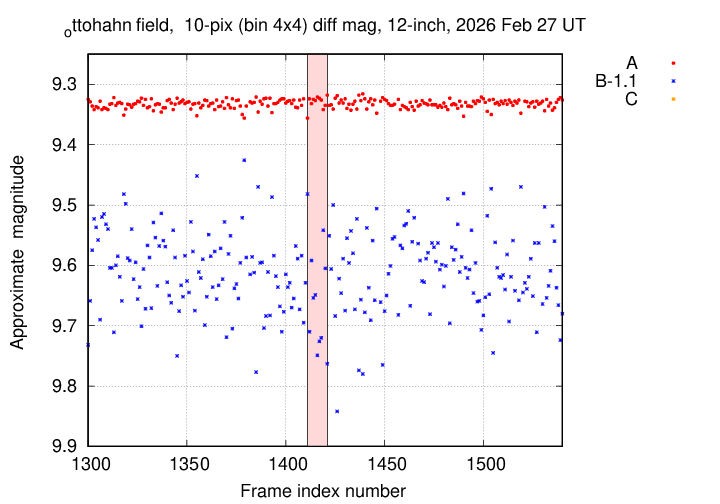
Based on this technique, the predicted time of the event falls at frame 1416.5. Below is a closeup of the measurements near the time of the event -- the shaded region is +/- 5 frames (about +/- 0.5 seconds) on either side of the center. I've shifted the measurements of star "B" up by 1.1 magnitudes so that they appear in the same figure and can be compared to those of the target star.
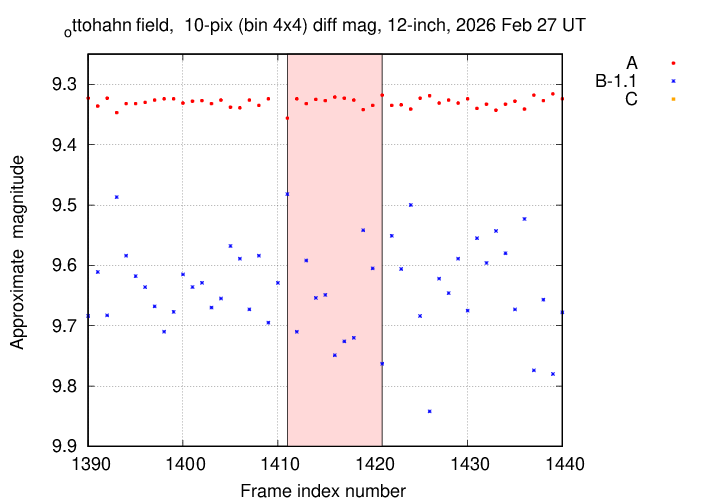
Here's a view even further zoomed in to the predicted time of the event. Since the magnitude drop was predicted to be over 10 magnitudes, it's obvious that I didn't see any occultation: it was a "miss" from my location.
I've reported this miss to