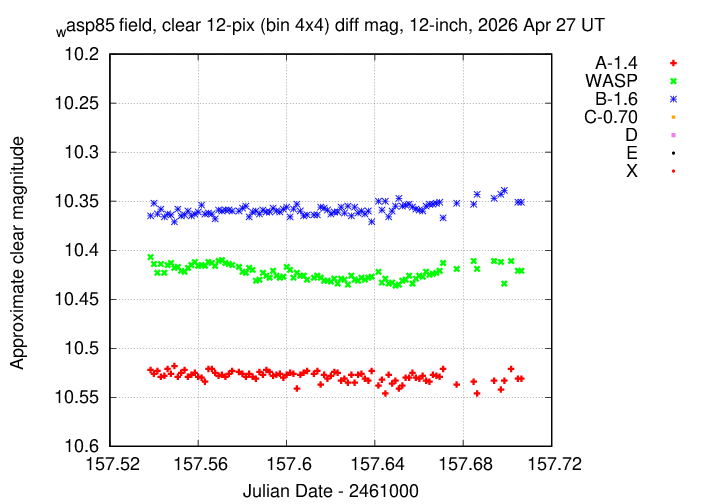
On the night of Apr 26/27, 2026, under challenging conditions, PHYS 373 student Aditya Vikram and I acquired images of the Wasp-85 system, hoping to measure a transit by its planet. The more-than-half-full Moon was only 11 degrees away from our target, however, and scattered light from the Moon added a lot of noise to our measurements (especially near the end of the event).
WASP-85 has a transiting exoplanet. We hoped to catch this planet in the act.
These observations involved:
Notes from the night:
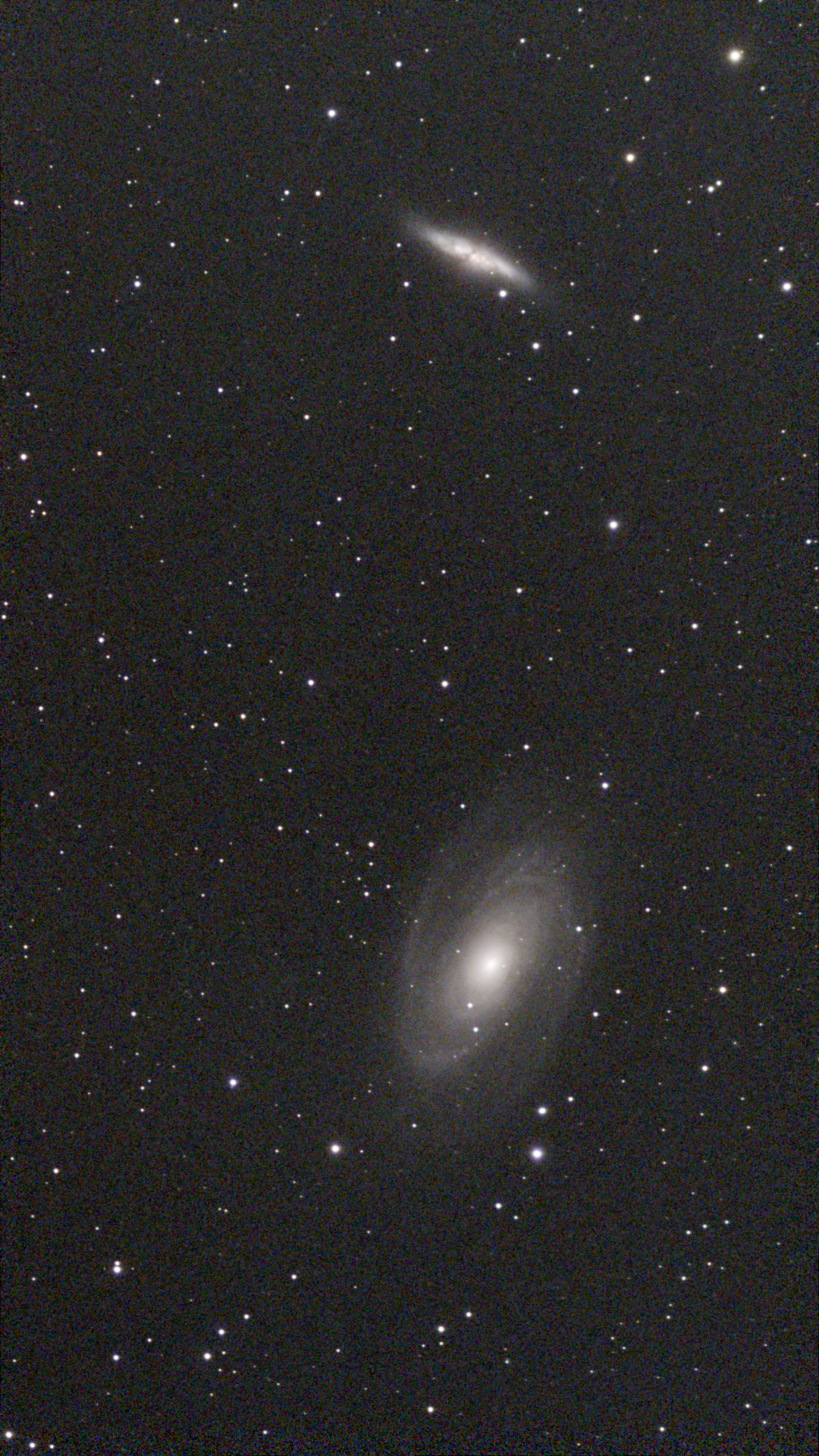
An RIT student, Sam F., contacted me earlier in the day to ask about visiting the observatory that night. Sam wanted to bring a Seestar to the site, set it up on the concrete pad, and use it to take pictures of some galaxies. I thought this was a nice idea, and Sam arrived around 9:30 PM. The picture below is one example of the data from Sam's Seestar. (Click on the image to see the full-size version)
Getting back to our regularly scheduled target, the picture below shows an image of the field of WASP-85 taken with our 12-inch telescope during this night. The field of view is about 20 arcminutes wide.
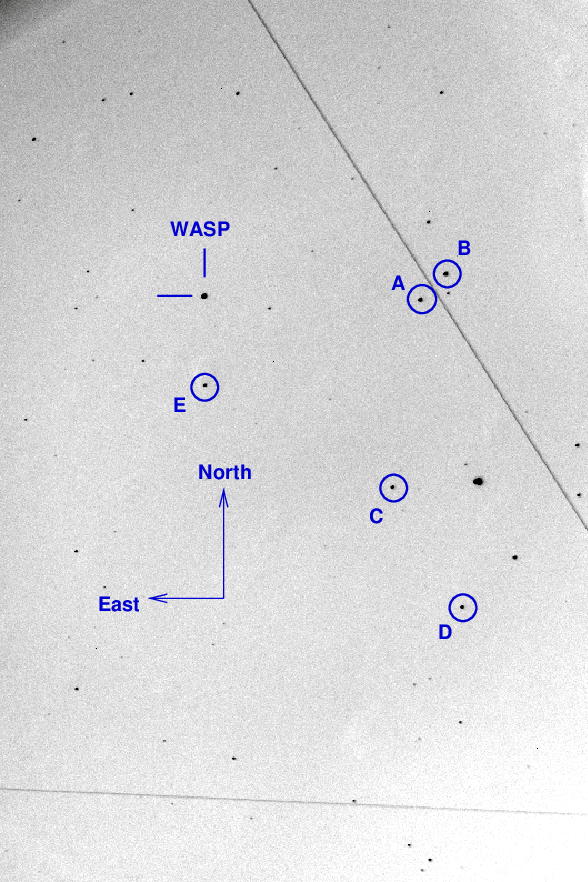
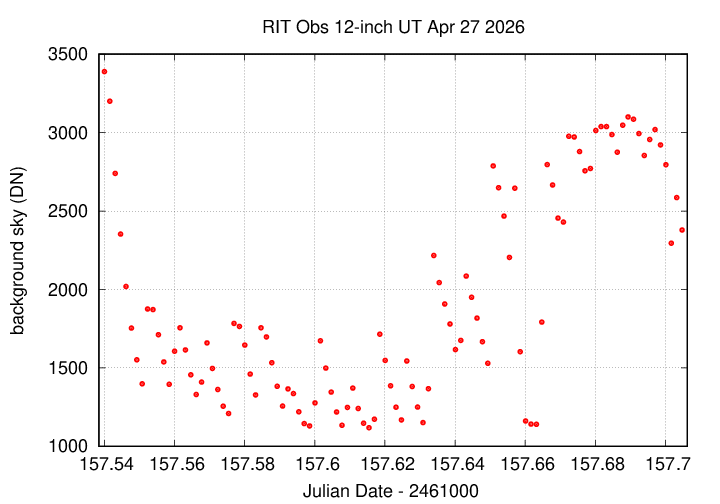
As you can see from this fully reduced image, there's quite a bit of variation in the background due to scattered light. This is one of the first images from the run, when the orientation of the dome slit caused only small amounts of moonlight to strike the telescope. Later on, however, particularly after JD 2461157.64, rotation of the dome caused much more moonlight to enter the dome slit and reach the telescope. Arg.
Here's the sky background over the course of the run. Note the rise due to more moonlight entering the dome.
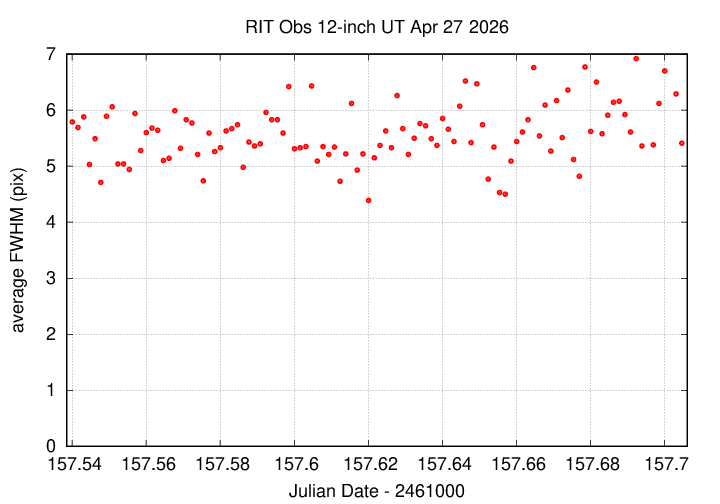
The FWHM got worse slowly during the night.
The graph below shows changes in the photometric zeropoint of an ensemble solution of the instrumental magnitudes over the course of the run. The value increases as the field sets due to increased atmospheric extinction.
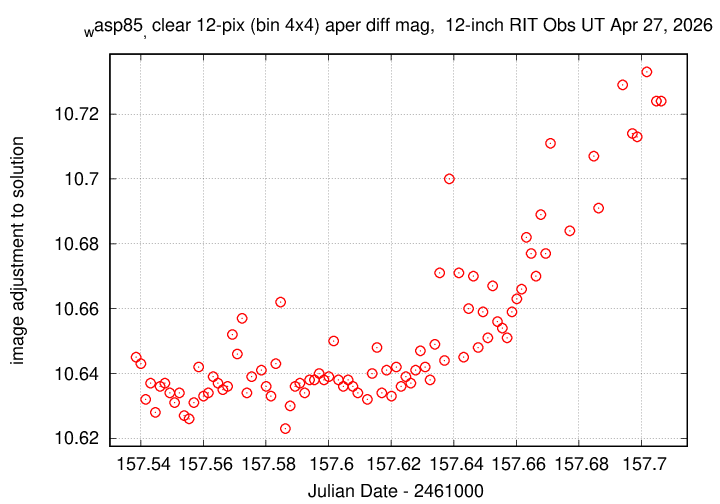
Using aperture photometry with a radius of 12 pixels in clear filter (binned 4x4, each pixel is 1.040 arcsec, so a radius of 12.5 arcsec), I measured the instrumental magnitudes of a number of reference stars and the target. Following the procedures outlined by Kent Honeycutt's article on inhomogeneous ensemble photometry, I used all stars available in each image to define a reference frame, and measured each star against this frame.
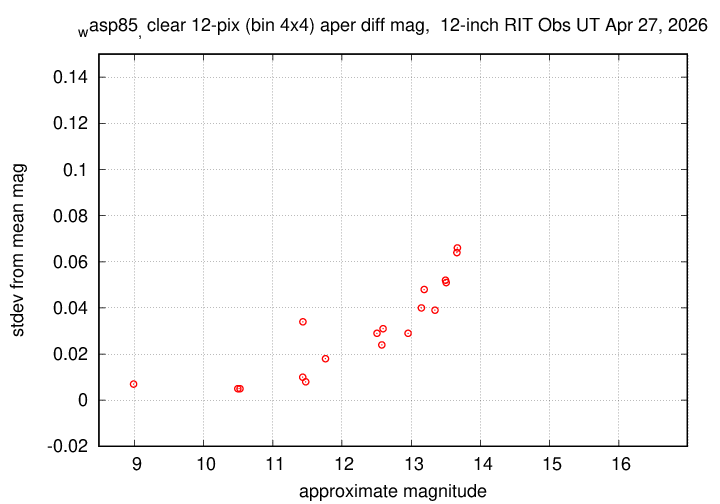
Sigma-vs-mag plots show that the floor was about 0.005 mag. The brightest star in this graph is WASP-85.
The measurements show the dip due to the transit clearly, but egress is nearly lost due to the increased noise. Sigh.