On the night of Apr 20/21, 2026, under mostly good conditions, I acquired images of
For the most part, the night was dark and clear. There was a 20-30 minute interruption by a cloud bank just as the ingress of WASP-43b's transit was starting, which led me to discontinue those observations. When the clouds left, I was able to acquire images of M51 through the B, V, and R filters for about 2.5 hours.
These observations involved:
Notes from the night:
The images I acquired do show M51, but the level of the galaxy's light appears low, not far above the sky level. This sort of faint-ish appearance of nebulosity has puzzled me for a few weeks; I recall more impressive images in years past. I think that the issue may be the camera's gain. At the moment, the FITS header reads:
  (Apr 20, 2026)

EGAIN   =  0.77999997138977051 /Electronic gain in e-/ADU
My suspicion is that this is set to be optimal for photometry of bright stars, when the goal is to maximize the number of electrons which can be recorded without saturating the camera. But it's not so good for faint sources: their relatively small number of photons is scaled to a small number of ADU, losing some of the dynamic range at the faint end. My guess is that modifying the gain may provide better signal-to-noise for objects with low surface brightness.
Back in 2025, when taking images of T CrB, I see that the EGAIN value had a different value:
  (Sep 11, 2025)

EGAIN   =  0.24951381981372833 /Electronic gain in e-/ADU
Changing the gain may also cause the flatfield exposures to yield the same, relatively high, numbers of counts that I recall from last year, for my usual exposure times. This evening, for example, a 10-second domeflat in V caused the median pixel value to be about 8000 counts; in years past, that would be closer to 20,000.
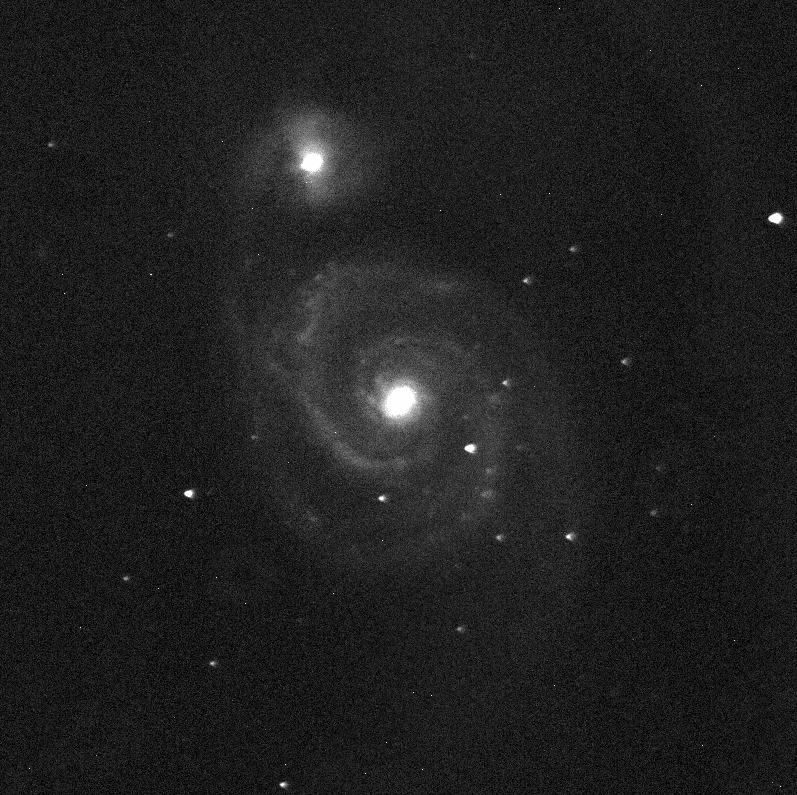
Below is one of the 120-second images in R-band.
I had to place the galaxy off-center a bit -- to the West of the optical axis -- in order to get the bright guide star in the guide camera, so one can see coma in the shapes of the stars, especially to the West (right) of the galaxy.
Note also the many single-pixel bright spots. Those should have been removed by the dark frame, but they apparently change value over time during the night.