On the night of Apr 11/12, 2026, under good conditions, PHYS 373 students Jamie Ludwig and Shivani Hancock, Dr. Melso, and I collected data on two objects:
Tonight was clear until the end of the run at around 3:30 AM, when light clouds passed through; it was clear again for a while. No equipment problems -- hooray!
V* MU UMa (not to be confused with the much brighter, non-variable star μ UMa) is a pulsing RR Lyrae star with a relatively short period of about 6.2 hours.
These observations involved:
Notes from the night:
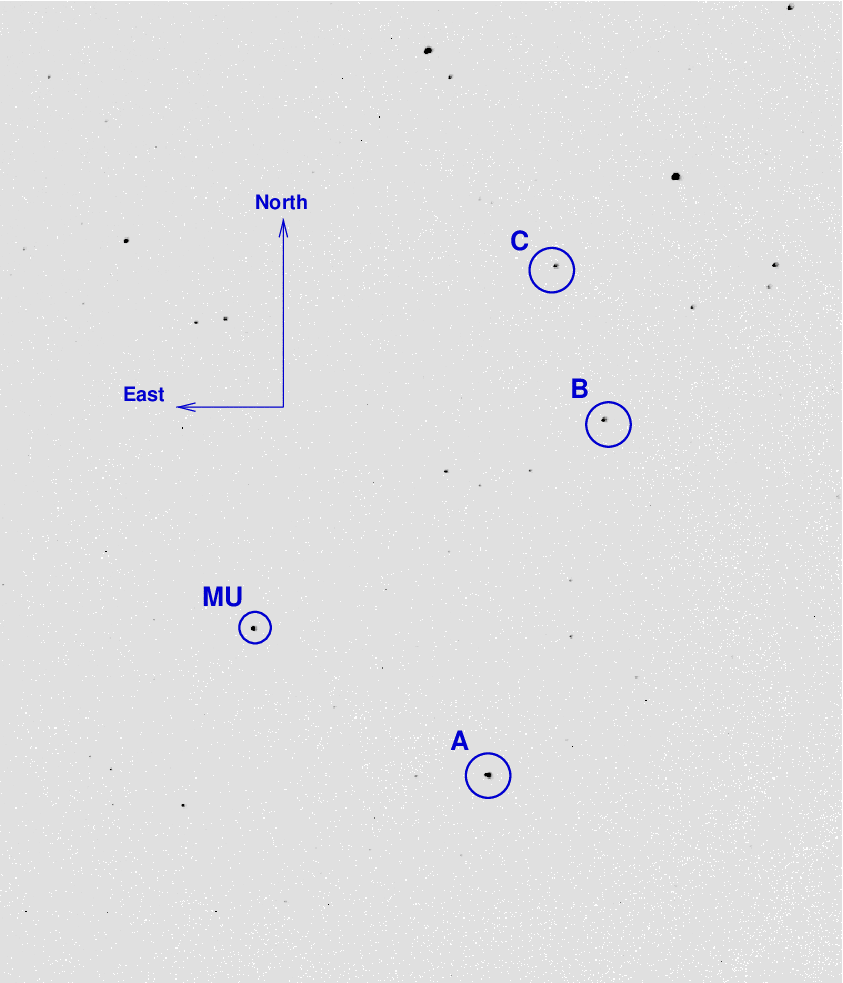
The picture below shows an image of the field of MU UMa taken last night. The field of view is about 20 arcminutes wide.
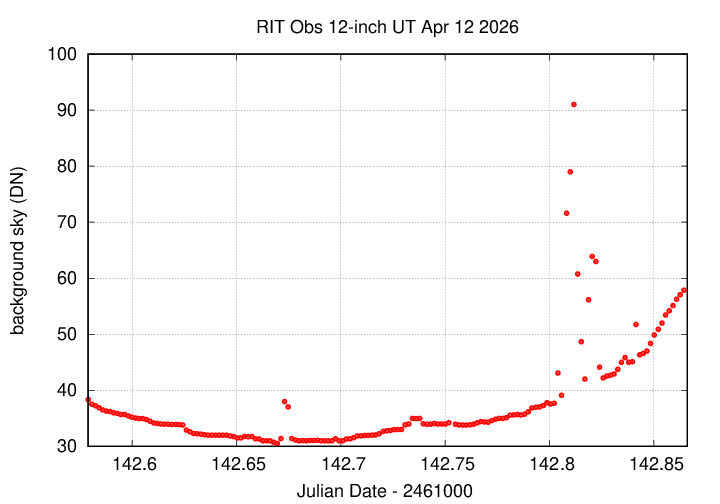
Here's the sky background over the course of the run. Note the brief spike due to clouds.
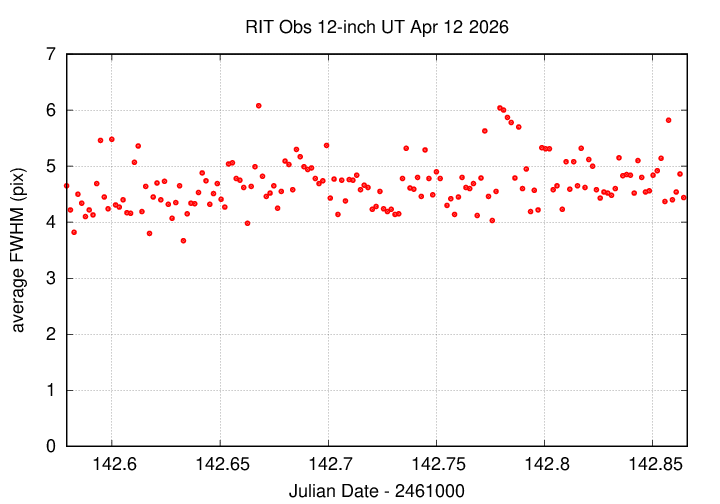
The FWHM was pretty steady.
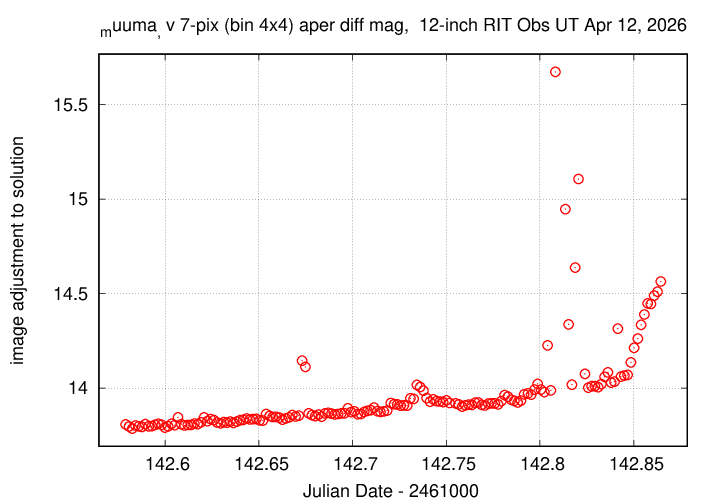
The graph below shows changes in the photometric zeropoint of an ensemble solution of the instrumental magnitudes over the course of the run. Note the spike due to clouds, plus the gradual rise as the field sets.
Using aperture photometry with a radius of 7 pixels in V filter (binned 4x4, each pixel is 1.036 arcsec, so a radius of 7.3 arcsec), and 7 pixels in B filter (binned 4x4, each pixel is 1.036 arcsec, so a radius of 7.3 arcsec), I measured the instrumental magnitudes of a number of reference stars and the target. Following the procedures outlined by Kent Honeycutt's article on inhomogeneous ensemble photometry, I used all stars available in each image to define a reference frame, and measured each star against this frame.
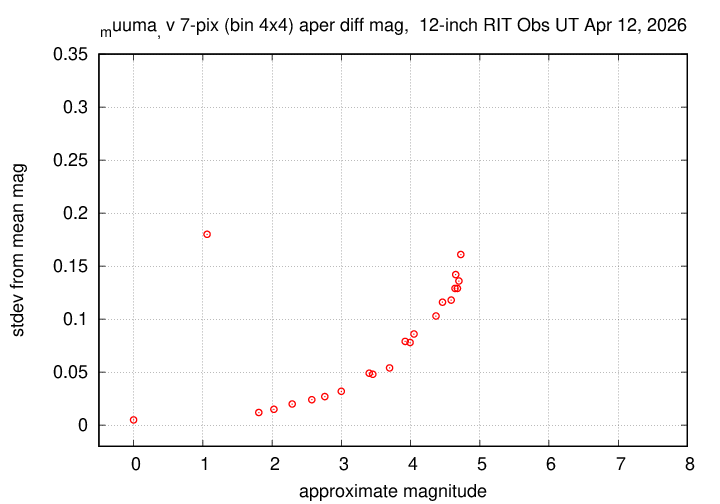
Sigma-vs-mag plots show that the floor in V-band was about 0.005 mag in V.