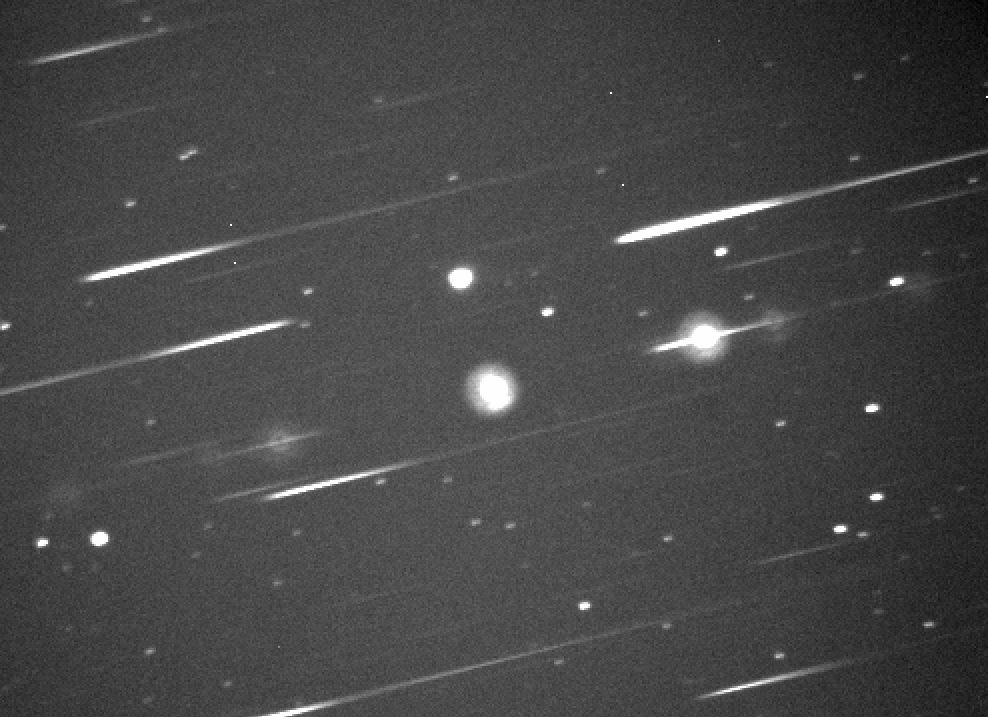
On the night of Apr 07/08, 2026, under excellent (but cold) conditions, PHYS 373 students, Anika Kumar, Dr. Melso, and I collected a large set of data on several objects:
Tonight was clear and dark: very good conditions. There were no major instrument problems, although the finder's video camera slipped out of its drawtube and fell toward the floor. The BNC and power cables stopped it before it struck the concrete, but this is the second time that it has slipped out in the past few weeks. I'll have to examine the nosepiece and setscrew.
Dr. Melso acquired a Star Analyser 100 and is working with one group of students in PHYS 373 to test it on our telescope. One of the images they acquired last night shows that we can achieve a rough focus and detect both the zeroth-order image and the first-order spectra of targets: this picture of the Eskimo Nebula (NGC 2392) shows the features clearly.
(North is up, East to left, field of view about 15 arcmin on a side)
Figuring out how to optimize data collection, and extract spectral information, will be an on-going project for this group.
WASP-43 has a transiting exoplanet, and was our first "regular" target for the evening.
These observations involved:
Notes from the night:
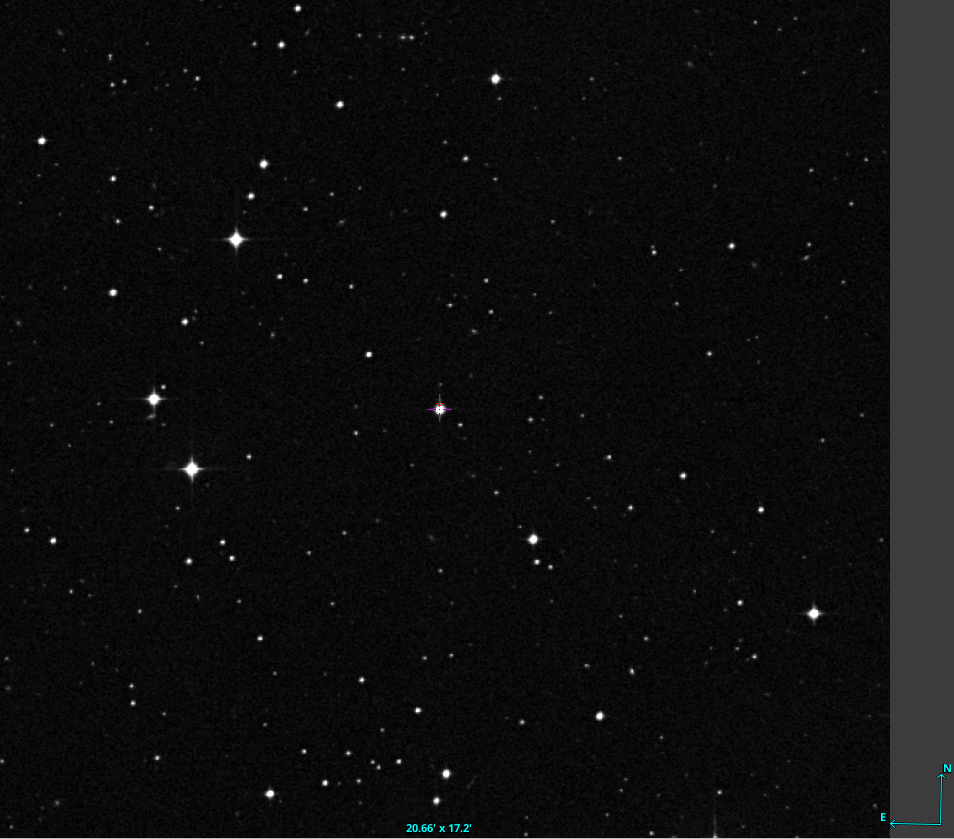
The picture below shows an image of the field of WASP-43 from the DSS2 red plates. The field of view is about 20 arcminutes wide.
WASP-104b has a transiting exoplanet. One group of our PHYS 373 class is hoping to measure the properties of the planet, using photometry of one full transit.
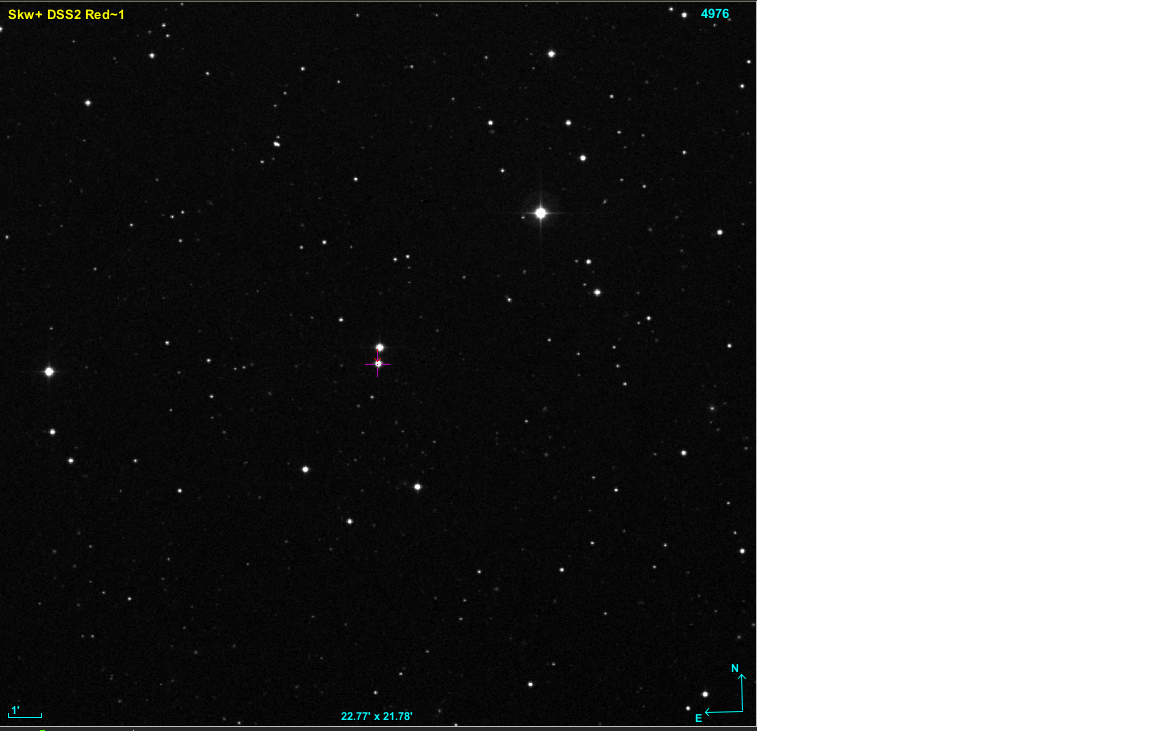
The chart below shows a region about 22 arcminutes on a side, centered on WASP-104.
NN Boo is a pulsing RR Lyrae star with a relatively short period of about 8.5 hours. If we can measure its average magnitude over the course of a cycle, we should be able to estimate its distance via the inverse-square law. How well will that estimate agree with the distance determined via parallax by Gaia?
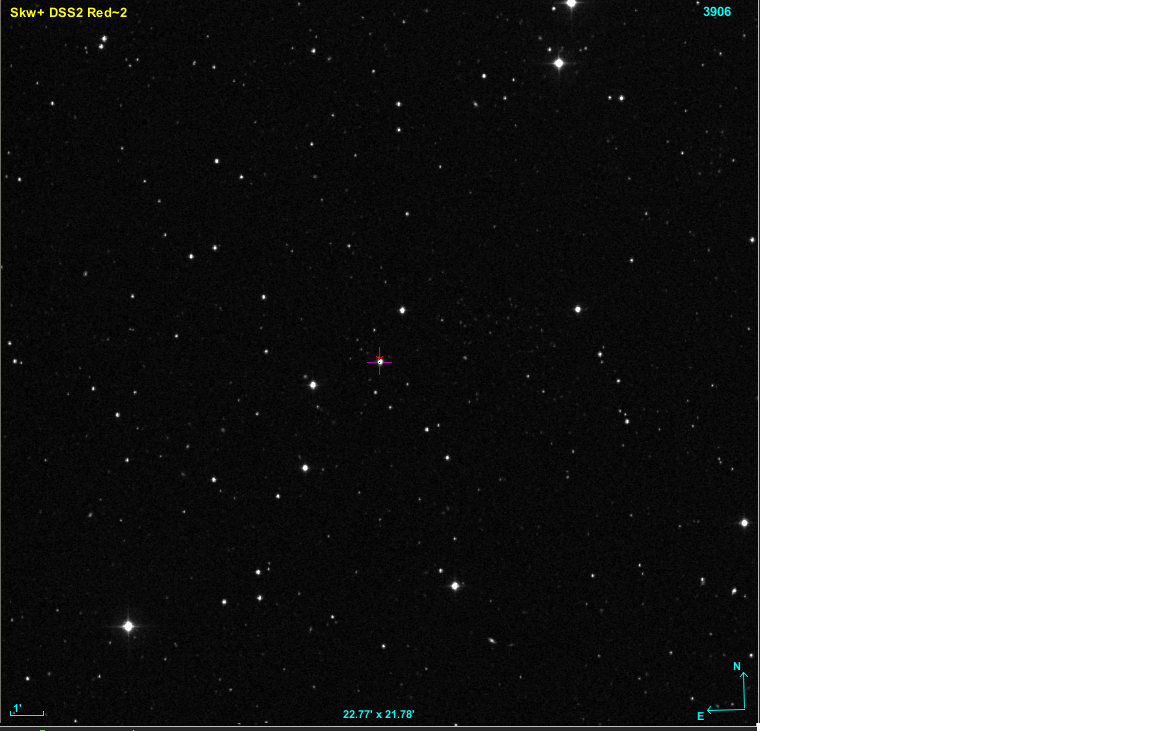
The chart below shows a region about 22 arcminutes on a side, centered on NN Boo.
During this evening, I was able to acquire a series of images in B-band and V-band, using 60-second exposures in each. Over the course of about 3 hours, we collected 69 images through each filter, covering phases approx 0.60 to 0.93. That leaves a bit more than half the cycle to acquire on some subsequent evening.