The star Sirius, in the constellation Canis Major, is the brightest star in the sky (apart from the Sun). It is actually a binary star system, in which an ordinary main sequence star, Sirius A, orbits a white dwarf, Sirius B. Some of their properties are listed below:
           star             temperature(K)        radius(m)
          ------------------------------------------------------
           Sirius A           9,900             1.19 x 10⁹
           Sirius B          25,000             5.71 x 10⁶
          ------------------------------------------------------
- Suppose that we compared one square meter of each star, side-by-side. The section of Sirius B would appear brighter, because it is hotter. Assuming both stars radiate like blackbodies, how many times brighter would the section of Sirius B appear, compared to the section of Sirius A?
- However, the two stars have very different sizes. What is the ratio of the surface areas?
- Putting together these two factors, estimate the ratio of luminosity of Sirius B to that of Sirius A.
- Convert the ratio of luminosities to a difference in magnitudes. How many magnitudes fainter should Sirius B appear?
- Look up the apparent V-band magnitude of Sirius A. What is it? Using this value, the result of the previous question, predict the apparent V-band magnitude of Sirius B.
- Bonus! What is the actual apparent V-band magnitude of Sirius B?
Let's try the same analysis to describe the density of matters at the centers of star. Use the following very approximate values as the sizes of an ordinary atom, and of an atomic nucleus.
             radius of ordinary atom:     10-10 meters
             radius of atomic nucleus:    10-15 meters
- Consider the center of the current Sun, where the density
is 77 x 103 kg/m3.
Assume that the material is pure hydrogen.
- How many H atoms in one cubic meter?
- What is the typical spacing between atoms, expressed in units of atomic radii, and nuclear radii?
- Consider the center of a white dwarf, in which the density
is 2.3 x 10⁹ kg/m3.
Assume that the material is pure helium.
- How many He atoms in one cubic meter?
- What is the typical spacing between atoms, expressed in units of nuclear radii?
- Consider the center of a neutron stars, in which the density
is 4.12 x 10¹⁷ kg/m3.
Assume that the material is pure neutrons.
- How many neutrons in one cubic meter?
- What is the typical spacing between neutrons, expressed in units of nuclear radii?
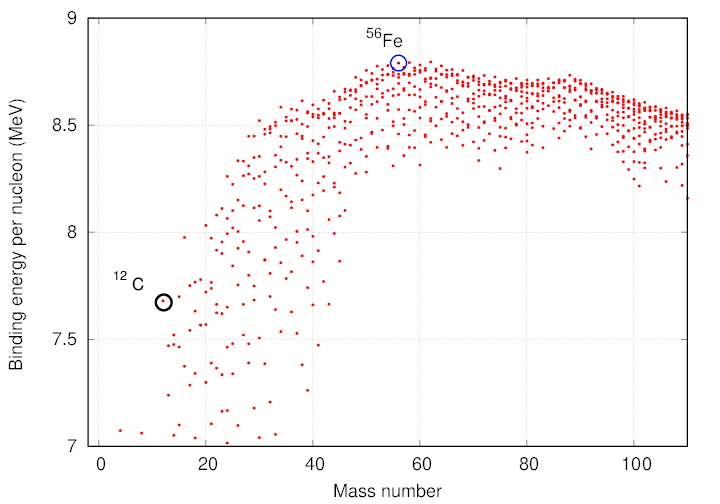
- Using the figure above, which shows the curve of binding energy, to estimate the total energy released per nucleon when fusion turns 12-Carbon into 56-Iron.
- Next, compute the total number of nucleons in a white dwarf star by dividing the mass of dwarf at the Chandrasekhar limit by the mass of one proton (protons and neutrons are the main members of the nucleon family, and their masses are the same as far as this problem is concerned).
- Multiply those numbers to compute the total energy released due to the fusion of an entire white dwarf from carbon to iron. Express that total energy in Joules.
- The energy required to move all parts of a spherical body away from each other to infinity is given by the absolute value of the gravitational potential energy (GPE) of the body. Compute the GPE for a white dwarf of mass M = 1.44 solar masses (convert to kg) and R = 0.06 solar radii (convert to meters). Express this GPE in Joules.
- Does the runaway fusion reaction produce enough energy to blow the star apart?
Anxious Fred listened to his astronomy professor describe this analysis, and immediately worried that the atmosphere of the Earth might someday collapse and leave people gasping for breath. "It would be terrible if all the oxygen and nitrogen gathered into a little ball in Saskatchewan," Fred thinks to himself. "What would happen to us in Rochester?"
Can you show Fred that there is no need to worry? Make the following assumptions about the Earth's atmosphere:
          temperature   T  =  20 C  =  293 K
          density       ρ  =  1 kg/m^3
          composition      =  pure nitrogen
- With these assumptions, what would be the mean molecular weight μ of the atmosphere?
- With these assumptions, what is the Jeans' length for the atmosphere?
- Based on this Jeans' length, should Fred worry that our atmosphere might collapse?
- First, consider a perfect blackbody which orbits our Sun at the same distance as the Earth: at 1 AU. What would the equilibrium temperature of this object be? Express the answer in Kelvin.
- What is the actual average surface temperature of the Earth, expressed in Kelvin? Please use a NASA source to look up this value; provide a link to the source along with your value.
- How big is the difference? Can you explain it?