- The star's temperature is T = 8500 Kelvin. How much energy does each square meter of the star emit in one second?
- What is the peak wavelength of this emission?
- Astronomer Joe decides to observe the star with a V-band filter. This filter transmits 100 percent of the light between 5070 and 5960 Angstroms, and no light at all outside that range. How much energy does each square meter of the star emit in this wavelength range per second?
- The radius of the star is R = 2.0 x 10⁹ m. How much energy does it emit each second in the V-band?
- This star is located a distance of 10 pc from the Earth. What is the flux of energy from the star in the V-band which reaches the top of the Earth's atmosphere? (in other words, ignore any absorption by the Earth's atmosphere)
- Joe's telescope is 50 cm in diameter. Again ignoring extinction by the Earth's atmosphere, how many photons per second will his telescope collect through the V-band filter?
Bonus! Would this star be visible to the unaided human eye? If so, roughly how bright would it appear to be?
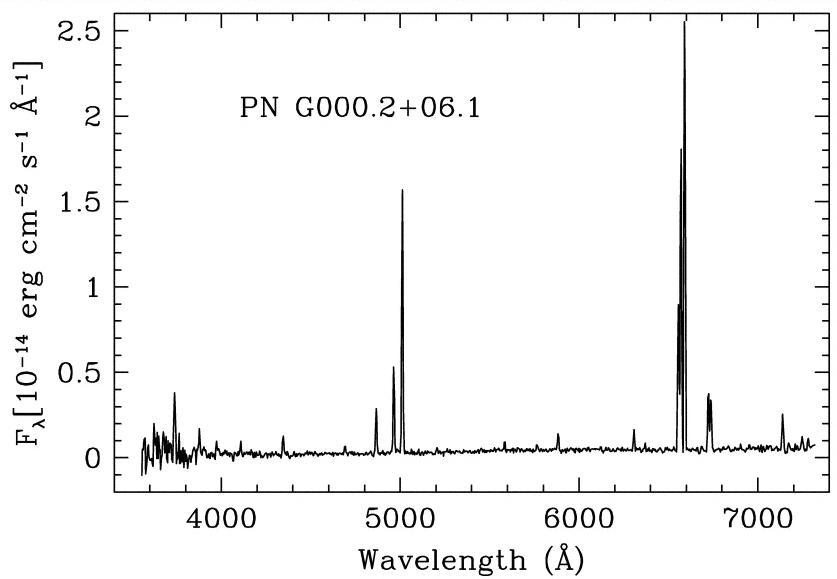
- Identify the emission lines which are due to Balmer transitions of hydrogen atoms. You should be able to find at least 3.
- For each such line, write down the initial and final energy levels involved in the transition.
- Estimate the radial velocity of the nebula with respect to the Earth, or at least provide an upper limit. Show your work.
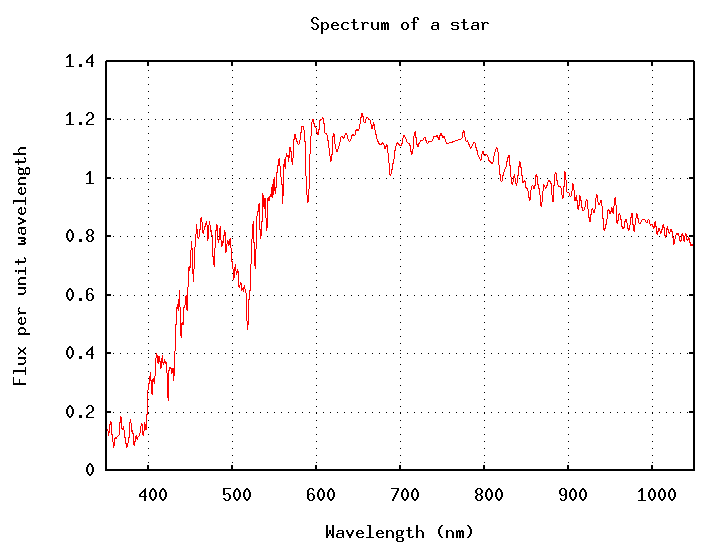
- Estimate the temperature of this star.
- Sodium atoms have the following energy levels:
(sort of -- I've assigned some new numbers)
            n          energy (eV)
          -------------------------
            1           -5.14
            2           -3.04
            3           -1.96
            4           -1.52
          -------------------------
One of the strongest lines in the spectrum above is due to a transition in sodium atoms. Which one is it? What is the wavelength, and what are the levels involved?