Circular Motion (not just uniform!)

Consider the special path of a circle. The natural coordinates to use with a circle are plane polar coordinates, r and θ. These are shown on the circle. Unit vectors are also defined, r-hat and θ-hat, each having magnitude of 1. The r-hat points radially outwards from the center, and the θ-hat points tangentially, in the direction of increasing angle.

If the object stays in a circle, the value of r is constant.

Experiment: You will stand on a rotating platform (or sit in your rotating chair or stand and rotate yourself in a circle) and measure the acceleration with a water accelerometer.

Predicting radial acceleration. Suppose you rotate with a constant speed while holding the accelerometer in a radial direction. Consider what happens at two positions, one close to your body, and one at arm's length. The center of the rotation is to the left of the page.

Near body (prediction)
Arm’s Length (prediction)


Predicting tangential acceleration. This time, hold the accelerometer parallel to your body, and consider the case where you rotate at constant speed (moving to the right) and at increasing speed (moving to the right).

Constant speed (prediction)
Increasing speed (prediction)

Now make measurements.

Radial near body (measured)
Radial arm’s length (measured)

Tangent constant speed (measured)
Tangent: increasing speed (measured)

Summarize the results of your measurements in a couple of sentences.


Draw a line on your accelerometer which is at an angle of 10! (not 30) degrees above the horizontal. Vary the speed and/or radius of the rotating accelerometer until the water's surface matches this line. Compute the acceleration of the water.


Section 4-7 shows that the radial (centripetal) acceleration component points to the center of the circle and has a magnitude of ar = v2/r when an object moves at speed v in a circle of radius r. This is true whether or not the object is changing speed.

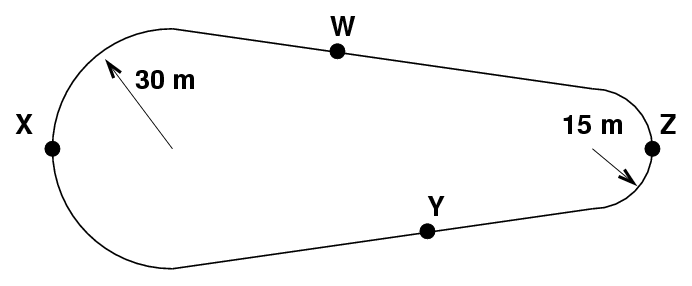
Example. You drive a go-cart around a go cart track, consisting of two arcs (radii shown on diagram) connected by two straight segments as shown.


(a) You drive at a constant 5.0 m/s. What is your acceleration (size and direction) at points W, X, Y, and Z?

(b) Your friend is more adventuresome. She drives the small arc at 5.0 m/s, then accelerates on the lower straight segment from 5 m/s to 15 m/s, which takes 5.0 s, drives the large arc at 15 m/s, and then gradually slows back to 10.0 m/s along the top straight segment. Find the acceleration (size and direction) for the points W, X, Y, and Z for your friend.