Let's review the observational evidence:
Is there any way to tie all these pieces of data together? Yes! One model which can explain them all is called the Big Bang model. The name was coined by a scientist who didn't like the theory and tried to make it sound silly.
The Big Bang is built upon three main tenets:
Note that the basic Big Bang Model does NOT say anything about the following questions:
Some of these questions all depend upon the values of certain parameters in the model, which we may derive from observations. Others have nothing to do with the Big Bang itself.
Our understanding of the laws of nature permit us to track the physical state of the universe back to a certain point, when the density and temperature were REALLY high. Beyond that point, we don't know exactly how matter and radiation behave. Let's call that moment the starting point. It doesn't mean that the universe "began" at that time, it just means that we don't know what happened before that point.
One of the primary successes of the Big Bang theory is its explanation for the chemical composition of the universe. Recall that the universe is mostly hydrogen and helium, with very small amounts of heavier elements. How does this relate to the Big Bang?
Well, a long time ago, the universe was hot and dense. When the temperature is high enough (a few thousand degrees), atoms lose all their electrons; we call this state of matter, a mix of nuclei and electrons, a fully-ionized plasma. If the temperature is even higher (millions of degrees), then the nuclei break up into fundamental particles, and one is left with a "soup" of fundamental particles:
Now, if the "soup" is very dense, then these particles will collide with each other frequently. Occasionally, groups of protons and neutrons will stick together to form nuclei of light elements ... but under extremely high pressure and temperature, the nuclei are broken up by subsequent collisions. The Big Bang theory postulates that the entire universe was so hot at one time that it was filled with this proton-neutron-electron "soup."
But the Big Bang theory then states that, as the universe expanded, both the density and temperature dropped. As the temperature and density fell, collisions between particles became less violent, and less frequent. There was a brief "window of opportunity" when protons and neutrons could collide hard enough to stick together and form light nuclei, yet not suffer so many subsequent collisions that the nuclei would be destroyed. This "window" appeared about one minute after the starting point, and lasted for about another minute.
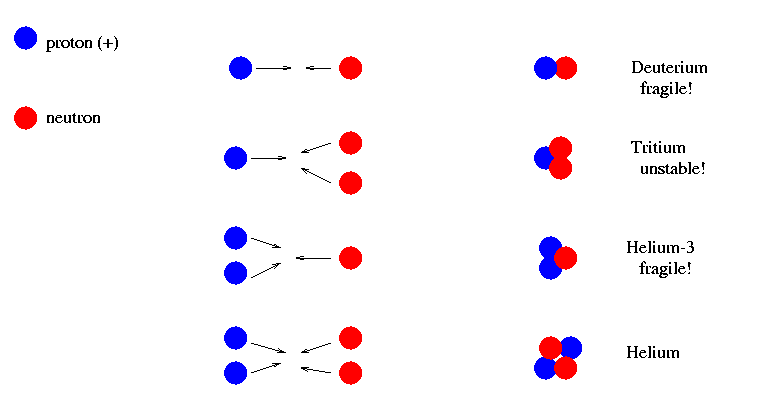
Which nuclei would form under these conditions? Experiments with particle colliders have shown us that most of the possible nuclei are unstable, meaning they break up all by themselves, or fragile, meaning they are easily broken by collisions.
Helium (the ordinary sort, with 2 protons and 2 neutrons) is by far the most stable and robust compound nucleus. Deuterium (one proton and one neutron) is easily destroyed, and so is helium-3 (2 protons, one neutron).
So, it seems that this period of hot, dense plasma would create a lot of helium. Could it create other, heavier elements, too?
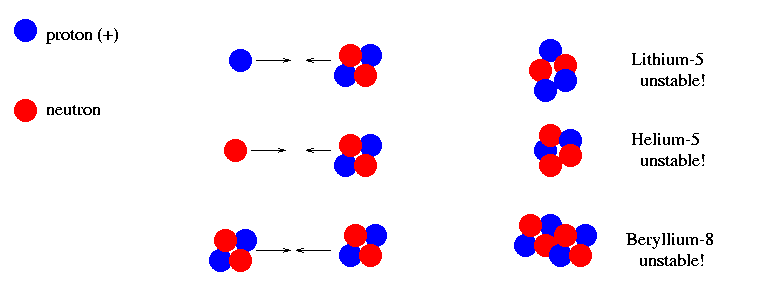
It turns out that none of the heavier nuclei which are easily made by collisions of single particles with helium nuclei, or helium nuclei with each other, are stable or robust. Almost all nuclei heavier than helium are likely to be destroyed by subsequent collisions. The only heavier nucleus which might possibly survive is lithium-7 (3 protons and 4 neutrons), but it requires the collision of a helium nucleus plus 3 other particles simultaneously, which isn't very likely.
Detailed models of Big Bang nucleosynthesis predict that the brief "window of opportunity" lasted only a minute or two. After that, about three minutes after the starting point, the temperature and density dropped so much that collisions between particles were rare, and of such low energy that the electric forces of repulsion between positively-charged nuclei prevented fusion. The result is
For more information,