Spin the wheel and measure its angular acceleration
If you spin a wheel rapidly, then release it, it will
gradually slow down and finally come to a halt.
The question of the day is
is the angular acceleration constant?
Here's how to answer the question.
- Place a piece of masking tape on the rim of a wheel to serve
as a marker
- Rest one end of the axle on top of some pieces of paper on
the tabletop. Have one person hold the axle vertical (so the wheel
is horizontal) and spin the wheel as fast as he can.
- Assign a second person with a stopwatch to measure the time it takes
the wheel to rotate 3 times.
- Make measurements every 10 seconds until the wheel stops spinning.
You should have at least 6 measurements.
Give each measurement an uncertainty of +/- 0.1 seconds.
- Make a neat table showing your measurements. Compute the
angular speed for each measurement and add it to the table.
Include the uncertainty in this angular speed, too.
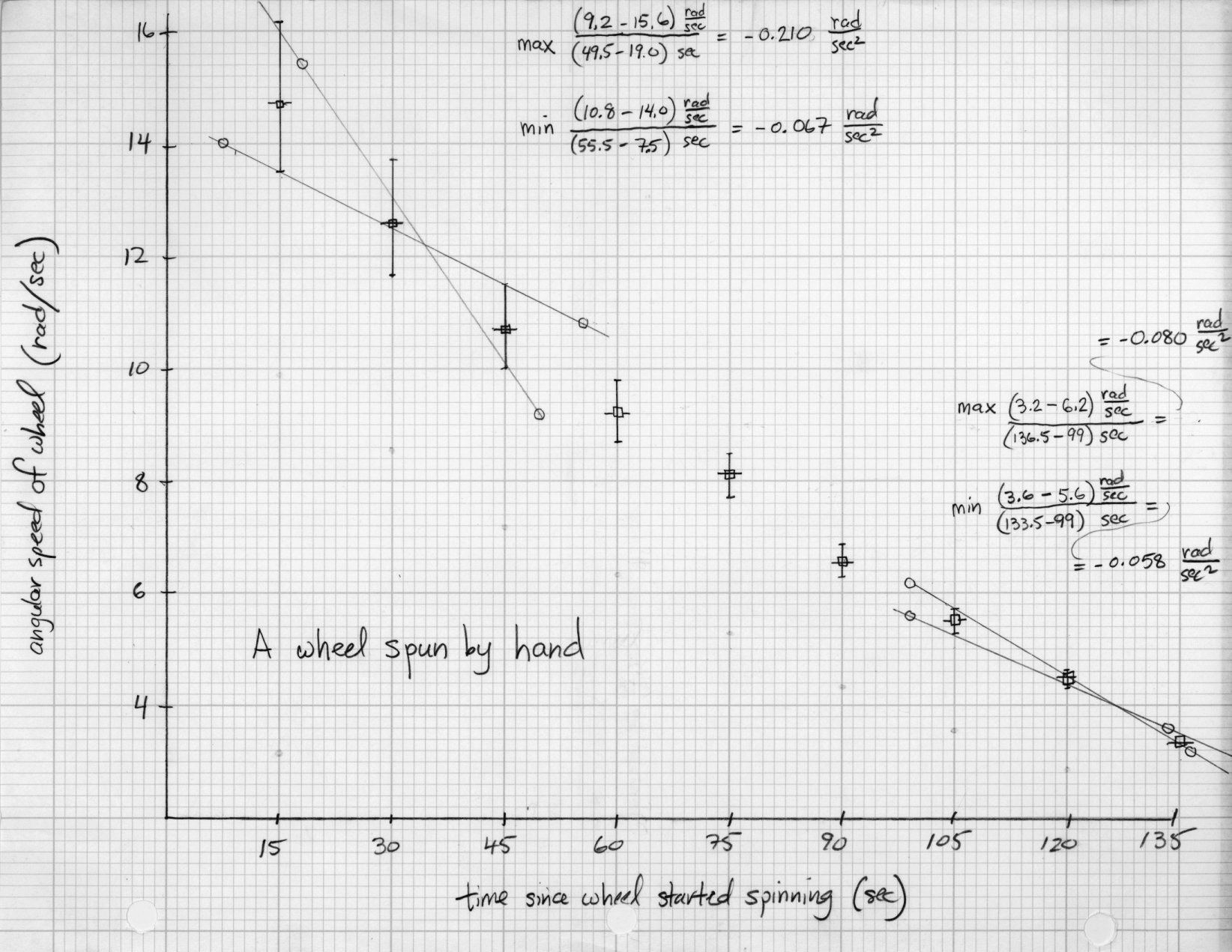
- Make a graph which shows angular speed as a function of
time since the wheel started spinning.
(Your graph should somewhat resemble
this graph from a different experiment)
Using your data, you must answer the following questions.
If you're not sure how to compute the uncertainty in
angular velocity or angular acceleration,
read this guide (PDF).
If you don't finish in the assigned time in class,
take this home and finish it before our next class meeting.
- Estimate the average angular acceleration using
the first 2 measurements of the experiment.
Be sure to include an uncertainty.
- Estimate the average angular acceleration using
the last 2 measurements of the experiment.
Be sure to include an uncertainty.
- Did the wheel decelerate at a constant rate?
Explain.
- What was the angular displacement of the wheel during the first
10 seconds of the experiment?
- What was the angular displacement of the wheel during the last
10 seconds of the experiment?
- Estimate the total angular displacement of the wheel
from start to finish.
- Pretend that during this experiment,
the wheel had not been spinning horizontally,
but was rolling down the hallway outside the classroom.
Would it have reached the far end of the hallway before
stopping?
Due at the start of our next class meeting.