Build a "bicycle" and roll it down a ramp
You will investigate the motion of a wheel as it rolls
down a ramp in a
vertical orientation.
First, join another group in the class to construct
a "bicycle" using your two wheels together.
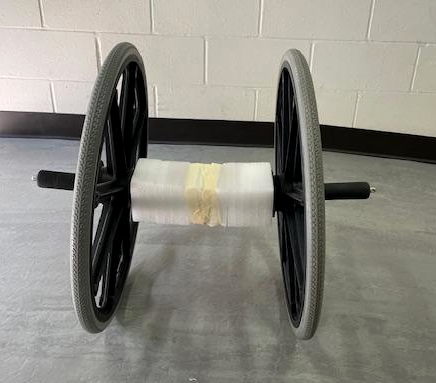
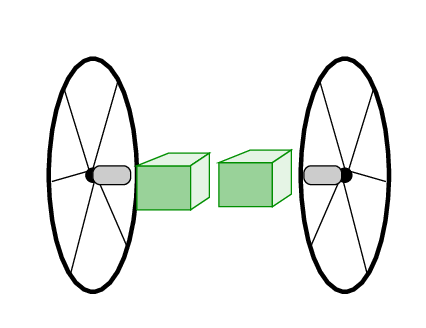
Use masking tape to connect two of the white foam blocks together,
then insert each wheel's axle into one end of the double-block.
The result will be a fragile vehicle, so
please treat it gently.
Your job is to take the "bicycle" outside the room to the pass-through
corridor between the two halves of the Gosnell Building on the third floor.
The floor there slopes down gently from the carpeted side (with our
classroom and the atrium) to the older, linoleum side.
All the students from both groups will form a large team
to do the following:
- measure the length of the ramp using metersticks or other tools
- measure the height of the ramp using metersticks or other tools
- wait for a time when no people are walking through the ramp area
- place one "guard" at each end of the ramp to prevent anyone
from coming through and being hurt
- place one or two "timers" at the bottom of the ramp with stopwatches
- place the "starter" at the top of the ramp,
holding the bicycle in place
- place the "catcher" at the bottom of the ramp
- allow the "starter" one or two little practice runs,
so that he can identify the top of the ramp properly
and place the bicycle at a spot where it will
start to roll smoothly
- at a signal,
the "starter" will release the bicycle so that it begins
to roll down the ramp;
at the same moment, the "timers" begin their stopwatches
- when the bicycle reaches the bottom of the ramp,
the "catcher will gently bring it to a halt;
the "timers" will stop their watches
The result should be a measurement of the time it takes
the "bicycle" to roll all the way down the ramp.
You should also know the distance it has rolled,
and the height of the ramp.
- Write a neat table with all of your measurements.
Be sure to include units.
As you perform the following analysis,
you may assume that the accleration of the "bicycle"
was constant during its motion.
- Write an equation which can be used to calculate
the average linear acceleration of the bicycle.
- Use that equation to calculate
the average linear acceleration of the bicycle.
Include units and a direction ("North", "South", "East"
or "West")
- Determine the average angular acceleration of the bicycle.
Include units and a direction.
- Compute the final angular velocity of the wheels,
showing all your equations and calculations.
Include units and a direction.
- Compute the final linear velocity of the wheels,
showing all your equations and calculations.
Include units and a direction.
- Compute the angular displacement of the wheels
over the course of their journey,
showing all your equations and calculations.
Include units and a direction.
Bonus!
Suppose that we covered the ramp with frictionless ice,
placed a frictionless ice cube at the top of the ramp,
and released it from rest.
- How long would it take the ice cube to slide down the ramp?
Show your work.
- Is this time the same as the time it took the bicycle
to roll down the ramp?
If not, explain why the times are different.
Staple together all your work.
Write the names of all group members on the first sheet.
Place your work in the folder on your table.