 Copyright © Michael Richmond.
This work is licensed under a Creative Commons License.
Copyright © Michael Richmond.
This work is licensed under a Creative Commons License.
Joe ties a ball of mass m to a piece of string of length R, then attaches the string to a horizontal rod. He gives the ball a push, and it starts to swing in a vertical circle around the rod.
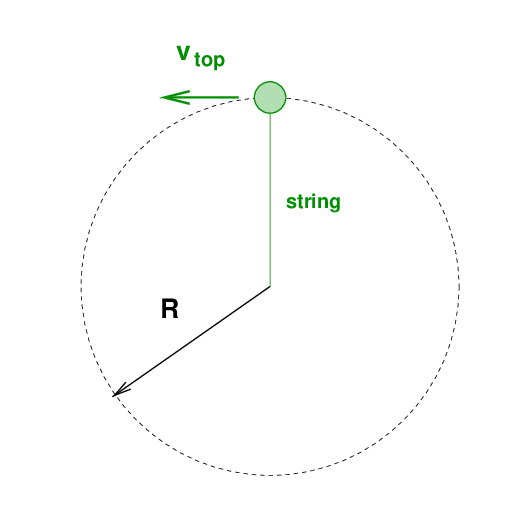
If the initial push is too small, the ball can't make it all the way to the top of the circle before falling down. Joe realizes that there's a critical speed, vtop, that the ball must have at the top of the circle in order to keep the string taut, so that the ball swings in a nice circular path.
  Q:  What is the critical speed vtop that the ball must
         have at the top of the circle in order to keep the string taut,
         so the ball moves in a perfect circle?
If the ball has exactly the critical speed vtop at the top of the circle, and then swings down to the bottom, how fast will it be moving at the bottom of the circle?
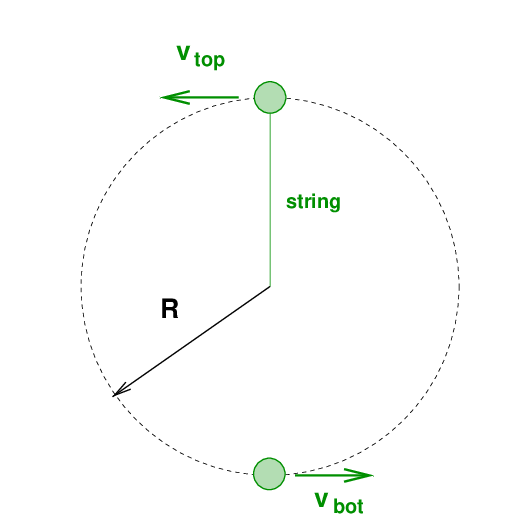
  Q:  What is the speed vbot that the ball will have
         when it reaches the bottom of the circle?
Joe THINKS he knows that critical speed that the ball must have in order to go over the top of the circle without allowing the string to go limp. But how can he be sure?
Joe can tie the ball to a long piece of string, suspend it above the horizontal bar, and then hold the ball at some height H above the bottom of the circle. When he releases the ball, it will swing downward in an arc and gain speed, reaching a maximum vbot at the bottom of the circle.
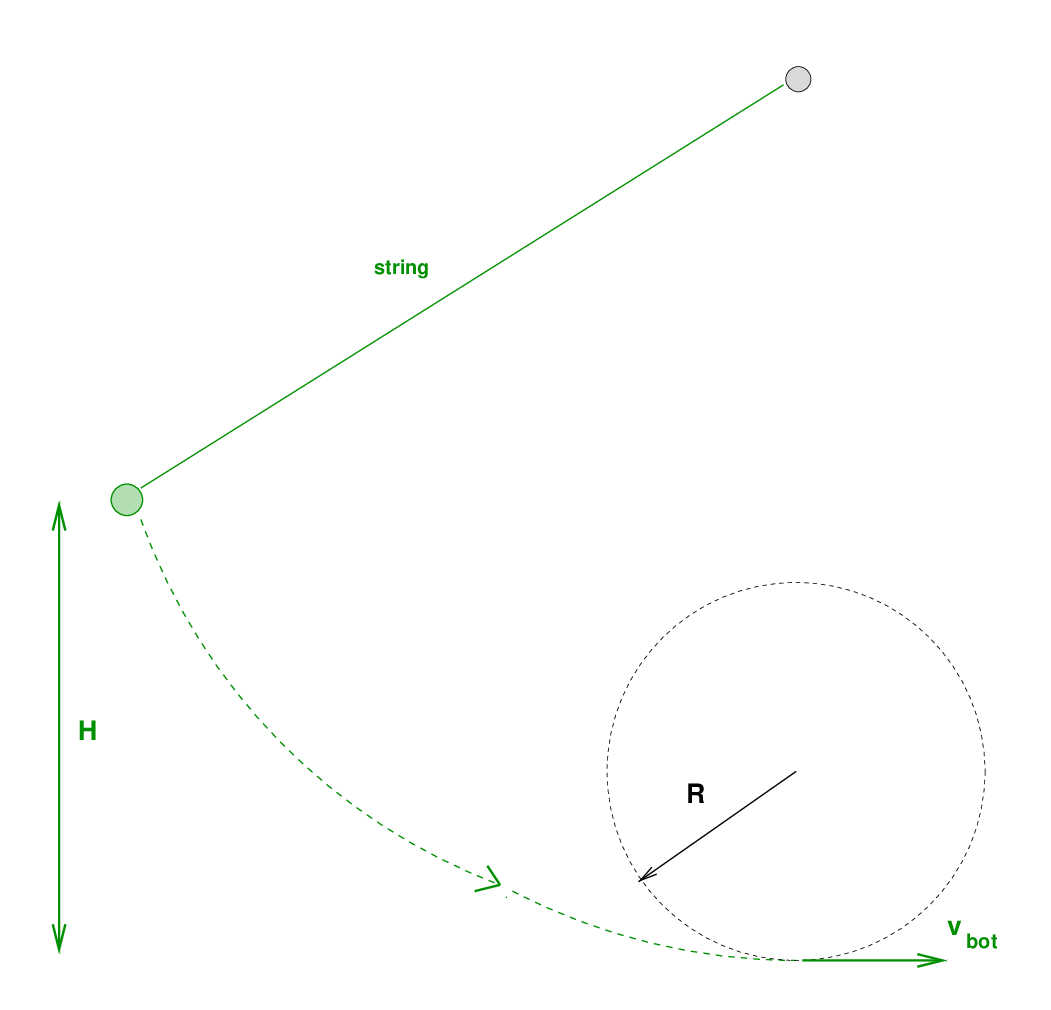
  Q:  What is the minimum height H from which the ball can
         be released and subsequently swing up and around the top
         of the loop?
Copyright © Michael Richmond.
This work is licensed under a Creative Commons License.