 Copyright © Michael Richmond.
This work is licensed under a Creative Commons License.
Copyright © Michael Richmond.
This work is licensed under a Creative Commons License.
When an object engages in Simple Harmonic Motion, there are a particular set of connections between its kinematic properties:
Let's take a look.
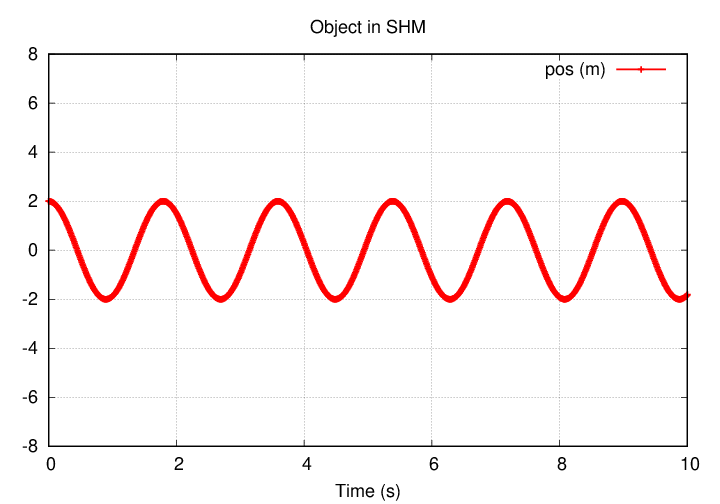
The position of the object oscillates as a function of time. Simple enough.
The velocity also oscillates -- but not in exactly the same way.
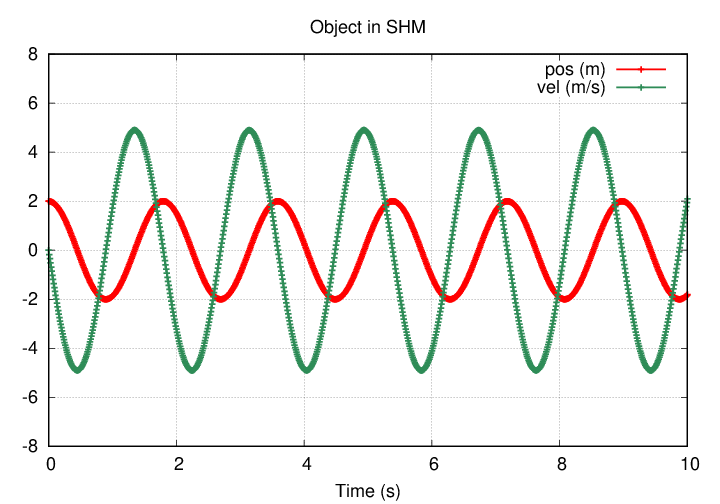
  Q:  When the object is moving fastest, where is it?
         Why?


  Q:  When the object is moving slowest, where is it?
         Why?
The difference is one consequence of the velocity being the derivative of position with respect to time. The derivative of cosine(t) (for example) is sine(t) -- and those two functions don't have zeroes, or maxima, at the same times. One way to describe this relationship between position and velocity is to use the term phase.
"The position is out of phase with velocity by 90 degrees."
Let's add acceleration to the party.
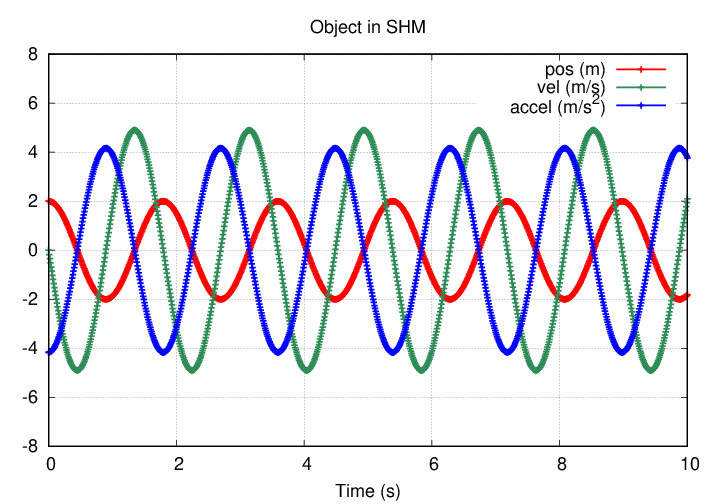
  Q:  When the object has the largest acceleration, where is it?
         Why?


  Q:  When the object has zero accleration, where is it?
         Why?
Now, the force on the object is just some constant times its acceleration, right? After all,
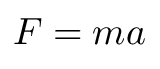
That means that we can compare the POSITION of an object in simple harmonic motion to the FORCE on it.
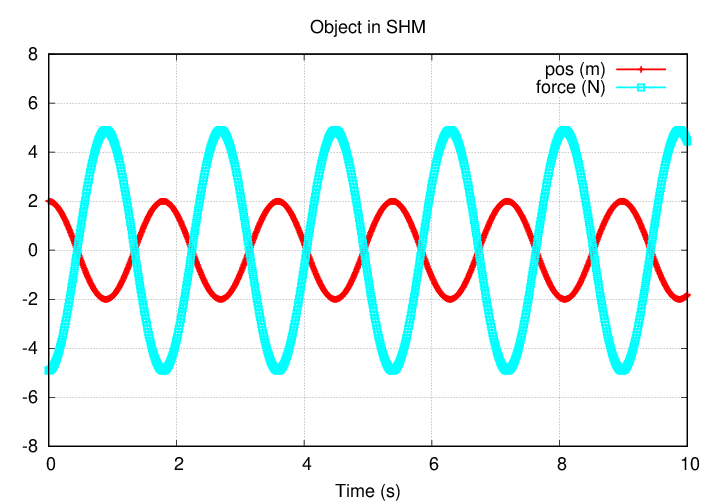
  Q:  When the force on an object is largest, where is it?
         Why?


  Q:  When the force on an object is smallest, where is it?
         Why?
Copyright © Michael Richmond.
This work is licensed under a Creative Commons License.